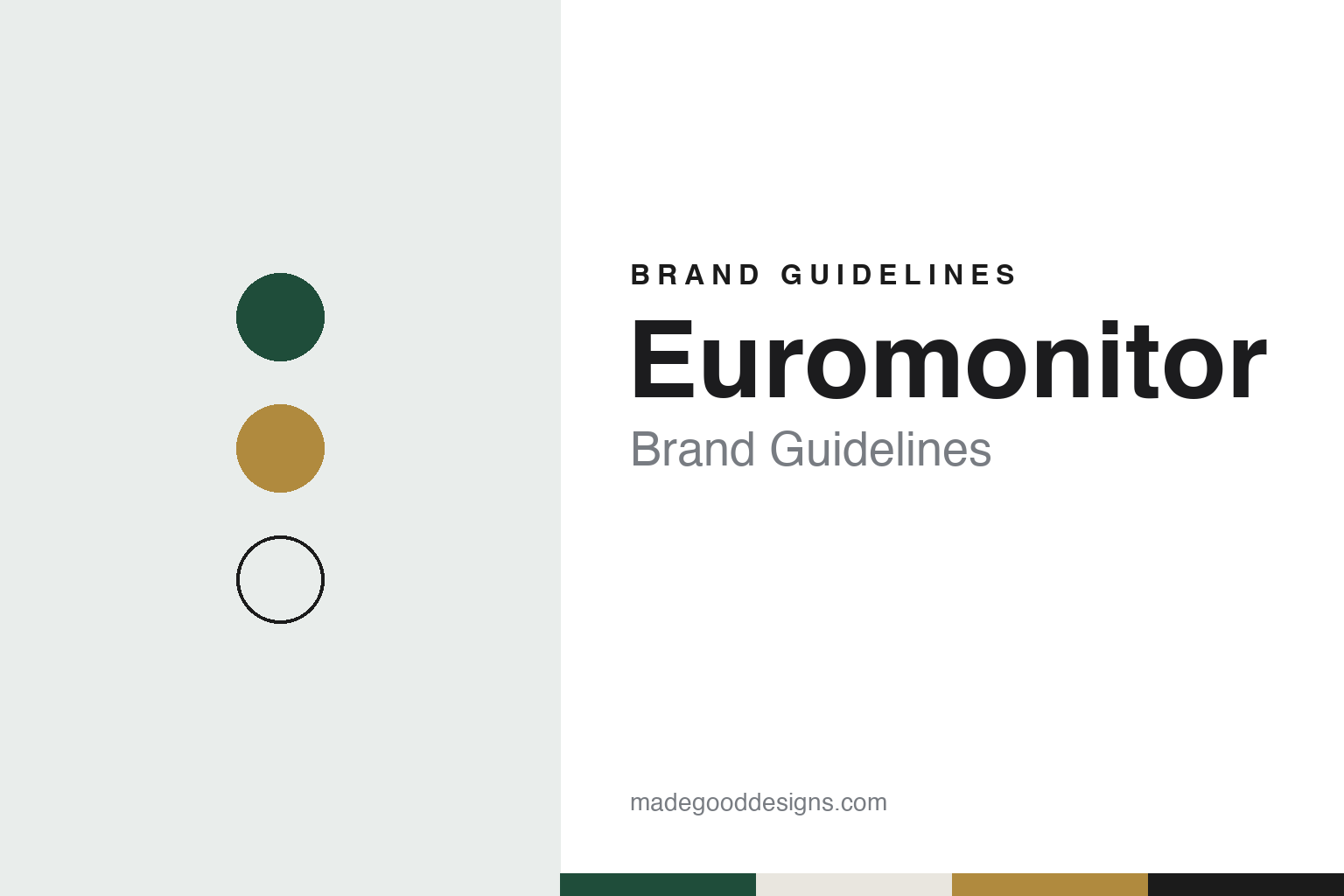
Euromonitor Brand Guidelines
A London report publisher that became a market data platform.
Aa
Two constants: a deep green, stone and brass palette and a report serif register. Abstract homage — not a Euromonitor asset; no logo, report cover or screen is reproduced.
Euromonitor Publications
Market reports and directories for the UK.
Euromonitor International began in London in 1972. English Wikipedia says it was founded by Robert Senior, and that Trevor Fenwick joined in 1978. The UK company register at Companies House shows the business incorporated on 31 January 1972 as Euromonitor Publications Limited, a name it kept until 1990.
The first name fits the company’s own account. Its history page says Euromonitor started by publishing market reports and directories for the UK market, and describes its early work as human-led analysis of industries, companies, economies and consumers. The company register records the later steps in the name: Euromonitor plc from September 1990, Euromonitor International plc from May 2005, and the present Euromonitor International Limited, a private limited company, from March 2010. Its register entry lists both publishing and market research as its business.
The company’s history page puts its international growth in the 1990s, when it says it opened new offices and built a network of analysts in more than 100 countries. It says it began using machine learning in its research in 2006, and that its Passport platform became a single destination for its market, industry and consumer data during the 2010s. Those dates are the company’s own account.
In April 2014, Euromonitor received the Queen’s Award for Enterprise in the international trade category; Travel Weekly listed the London research company among that year’s winners on 22 April 2014, and English Wikipedia records the same award.
Colour
Passport, country reports and an annual trends list.
Euromonitor’s main product is Passport, a subscription database of market research; English Wikipedia says much of its content is written by the company’s own analysts, alongside information drawn from other sources. The company’s site describes Passport as covering industries, channels, products, consumers and economies, and sells it alongside custom research, single reports and content licensing.
The scale it gives is its own, though MrWeb repeated the first two figures in 2026: 16 offices, analysts on the ground in more than 100 countries, clients in 110 countries, and country research covering more than 210 national markets. The office list on its site names London as headquarters, with offices including Chicago, São Paulo, Dubai, Bengaluru, Shanghai, Tokyo and Sydney.
In June 2026, MrWeb reported that Euromonitor had released a new version of Passport “rebuilt from the ground up,” with a conversational, AI-based interface, access for Microsoft users through a copilot agent and an extended API. Its chief executive called it the company’s biggest investment since it was founded in 1972, the report said, with an early access programme for selected clients first.
Outside its paid platform, Euromonitor publishes an annual Top Global Consumer Trends report. The 2027 edition, released from London on 4 November 2026, named five trends — Shelf Assured, Reluctant Reliance, Peer Powered, Mode-Switching and Future Tense — and the company issued versions of the release in Japanese, Korean, Chinese, Arabic and Portuguese as well as English. Its newsroom presents these releases next to a running list of press coverage that quotes its analysts.
The release explains each trend briefly. Shelf Assured describes reliability becoming a value in its own right as costs rise; Reluctant Reliance describes consumers who want help from generative AI but not its authority; Peer Powered describes friends, family and like-minded groups acting as the new influencers; Mode-Switching describes a move away from constant self-improvement towards selective effort; and Future Tense describes a preference for immediate, tangible value over long-term promises. The report draws on Passport data, the release says, and the survey figures it quotes are the company’s own.
Typography
How research and data firms present themselves.
Market research and data firms sell something that is hard to picture: answers drawn from surveys, panels and statistics. Their public identity is therefore carried less by products than by publications and screens. Euromonitor International, for example, presents an annual Top Global Consumer Trends report as a headline release, issued from London in November 2026 in English, Japanese, Korean, Chinese, Arabic and Portuguese, while its newsroom lists press coverage that quotes its analysts.
The platform has become the main showcase. Euromonitor describes Passport as a single hub for market, industry and consumer data, and in June 2026 the trade news service MrWeb reported a rebuilt version with a conversational, AI-based interface. In the same month Dynata launched Dynata+, which it describes as a self-service platform where users check feasibility, see pricing and launch survey projects themselves. Firms that run panels also publish panel books and quality pages, and some name a standard such as ISO 20252 on their sites.
Numbers carry much of the visual weight. Euromonitor’s 2027 trends release gives each trend a short coined name followed by a few headline survey percentages, and Dynata says its new platform shows feasibility, pricing and project progress in real time. In a category like this, a brand is read through headings, figures and the screens that hold them.
Ownership is often part of the story told on corporate pages. Dynata’s press room keeps its 2017 merger release, its 2019 rename and its 2024 restructuring announcements; Euromonitor’s site describes it as independent and privately owned, and the UK company register shows its holding structure. This guide sets out what can be checked about each firm — who founded it, who owns it, and what it says about its own reach — and marks clearly what rests on the company’s word.
Aa
A report serif for a firm that began as a publisher. (Specimen set in Source Serif 4, a serif STAND-IN; NOT the Euromonitor logo.)
Euromonitor
Independent and privately owned, by its own description.
Euromonitor describes itself as an independent provider of global market intelligence, and the footer of its website says the company is privately owned. The company register gives the current structure: since May 2024, a holding company, Euromonitor Holdings Limited, has been listed as the person with significant control of Euromonitor International Limited, holding more than three-quarters of its shares.
Its name has changed only in its legal form across five decades — from Publications to plc to International — while the Euromonitor word itself has stayed in place since 1972.
The company’s current material leans on two ideas. One is local presence: it stresses analysts working in-country, in native languages, and argues that this context explains the “why” behind the numbers. The other is a consistent taxonomy, which it says lets clients compare countries, categories and sales channels on the same terms. Its history page sets these out decade by decade, from the 1970s publishing years to the AI tools of the 2020s.
For a design guide, the useful point is that Euromonitor’s public face is mostly made of publications: report pages, trend lists, newsroom releases in several languages, and the Passport platform. A brand of this kind lives in charts and covers more than in products on a shelf. The 2026 rebuild of Passport points the same way: MrWeb reported that the aim was to bring Euromonitor’s data directly into the tools and workflows clients already use, rather than keeping it on a single screen.
For a design guide, Euromonitor shows how a firm that began as a London publisher can keep one name while its product moves from printed directories to an online platform. Compare Mintel, another London research and data firm, and Kantar. For this guide we use deep green, stone and a brass with a serif, an unofficial interpretation; no product or logo is reproduced.
Explore & save
Keep Euromonitor’s identity on hand — save it to a board in the Made Good inspiration library.
Euromonitor identity set
Pin the Euromonitor deep green, stone and brass palette and the report serif register to your own board.