Finsbury Brand Guidelines
A 1994 London firm whose name ran through three mergers.
Aa
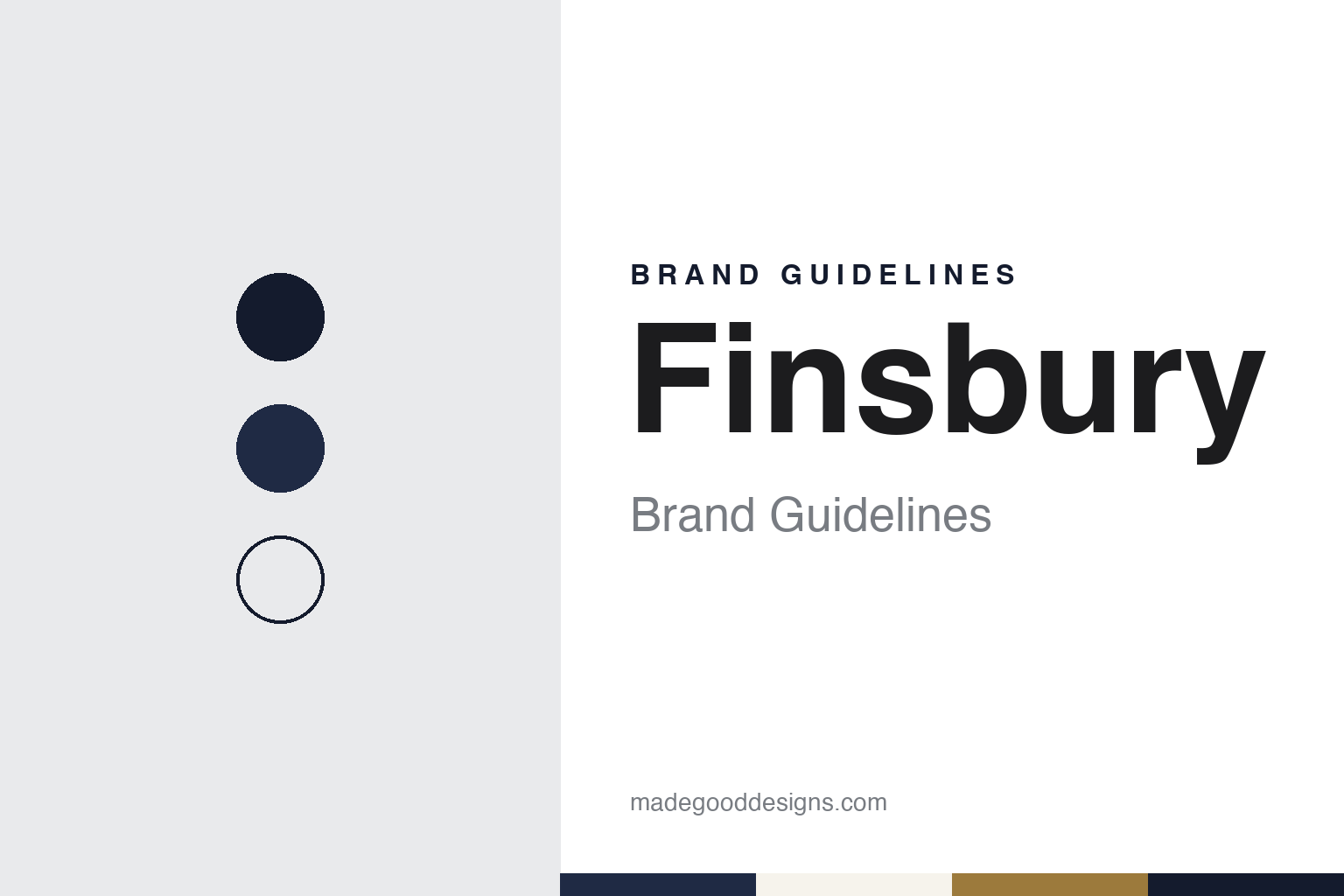
Two constants: an ink blue, stone and brass palette and a classic serif register. Abstract homage — not a Finsbury or FGS Global asset; no logo or wordmark is reproduced.
A London firm
Founded in 1994, sold to WPP in 2001.
Finsbury was a London financial and corporate communications firm founded in 1994 by Roland Rudd, according to The Guardian in April 2023 and English Wikipedia. The Guardian described the business it grew into as one that advises large corporate clients on how to talk to journalists about everything from regular financial results to crisis management: the work of results days, takeovers, listings and boardroom changes, where a company’s words are read by investors as closely as by the press.
The firm did not stay independent for long. English Wikipedia says it was sold to WPP, the London-based marketing and communications group, in 2001, with Rudd staying on as chairman. A decade later, in 2011, it merged with Robinson Lerer & Montgomery, a New York consultancy, to form RLM Finsbury, with Rudd as chairman and Walter Montgomery as chief executive of the enlarged firm. In 2014 the combined business went back to the single name Finsbury, a change English Wikipedia ties to the firm’s global ambitions.
That pattern of merging and renaming is the core of the Finsbury story. Within seven years of the 2014 rename, the name had been folded into two further combinations, and today it lives on inside FGS Global, whose website lists Finsbury as one of the four firms the group was built from, rather than as a trading brand of its own. This guide follows the name from a single London firm to that larger group and notes, step by step, which parts are reported by the press and which rest on the company’s own account.
Colour
Finsbury Glover Hering, then FGS Global.
The next combination closed in January 2021. O’Dwyer’s reported on 12 January 2021 that Finsbury, The Glover Park Group and Hering Schuppener had completed their merger and a management buy-in of 49.99 percent of the combined business, forming Finsbury Glover Hering. WPP remained a 50.01 percent investor, and its chief executive joined the board. The new firm, O’Dwyer’s said, operated from 18 offices with almost 700 consultants; Rudd and Carter Eskew became co-chairmen, with Alexander Geiser as global chief executive. The Guardian later dated the formation of the group to 2020, the year the deal was put together; the completion came in the new year.
The two partners brought different backgrounds to the new name. English Wikipedia says the Glover Park Group was founded in Washington, D.C., in 2001 and acquired by WPP in 2011, and that Hering Schuppener was founded in Düsseldorf in 1995 by Ralf Hering and Bernd Schuppener, working on capital-market communication around acquisitions, mergers and restructurings. The three-name title put a London, a Washington and a German firm side by side on one letterhead.
The joint name lasted less than a year. On 13 October 2021, WPP announced that Finsbury Glover Hering and Sard Verbinnen & Co, a New York firm founded in 1992 by George Sard and Paul Verbinnen according to English Wikipedia, had agreed to merge. English Wikipedia describes Sard Verbinnen’s work as managing deals, investor relations and crises; by 2021, the same encyclopedia says, it had more than 200 employees, and its co-founder George Sard joined Rudd and Eskew as a co-chairman of the merged firm, according to the WPP announcement. WPP said the combined business would have about 1,000 professionals in 25 offices across Asia, Europe, the Middle East and the United States, with its global headquarters in New York, and that it would operate under a new name from 2022. English Wikipedia says the firms merged and adopted the name FGS Global in December 2021, with Geiser as chief executive.
Typography
How communications agencies present themselves.
Public relations and communications agencies sell advice, so their visual identity is mostly carried by what they publish about themselves. Case-study pages, award announcements and research reports do much of the work that a product range does for a manufacturer. FleishmanHillard, for example, announced in October 2026 that a campaign it made with Icelandair had been named the top entry in PRovoke Media’s Global SABRE Awards, and the guides in this set treat such pages as the agency’s own dated claims.
Names change more often than logos in this field, usually after a merger. Founders’ surnames are joined, shortened or dropped, and a hyphen can disappear: FleishmanHillard closed up its two founders’ names in 2013, English Wikipedia says. When holding groups rearrange their agencies, one firm may also keep another as a dedicated brand inside it, as FleishmanHillard did with Porter Novelli in February 2026.
Many firms present their offices and their people rather than objects. Partner profiles, office lists and pages on how the firm is owned and run take the place of a catalogue; Brunswick’s site, for instance, gives a page to each of its offices and describes the firm as a partnership. Some firms also publish magazines or research series under their own names, which become a second visible identity beside the logo.
Ownership and leadership are recorded on corporate pages, in company registers and in trade and business press, and they change with each acquisition, investment or appointment. The guides in this set give office, staff and partner counts only as a dated source states them, name the owner as of that source, and treat colours and typefaces as an unofficial interpretation unless the agency has published its own.
Aa
A classic serif for a financial-communications register. (Specimen set in Source Serif 4, a serif STAND-IN; NOT the Finsbury or FGS Global logo.)
FGS Global
From WPP to KKR-managed funds.
Ownership then moved away from WPP. In a statement reported by Marketing-Interactive on 7 August 2024, WPP described a strategy that began with the 2021 merger of Finsbury, the Glover Park Group and Hering Schuppener, continued with the Sard Verbinnen deal later that year and the arrival of KKR as a minority shareholder in 2023, and ended with an agreement to sell WPP’s majority stake in FGS Global to Kite Bidco, an entity controlled by investment funds managed by KKR. English Wikipedia says KKR’s acquisition of the majority stake from WPP was announced in December 2024, and FGS Global’s own website no longer presents the firm as part of WPP.
Today FGS Global describes itself as a strategic communications and advisory firm with 1,800 colleagues across 31 offices, organised around practices that include Crisis & Issues Management, Strategy & Reputation, and Transaction & Financial Communications, with a newer AI + Innovation group. It says it was built from four firms, Finsbury, Hering Schuppener, The Glover Park Group and Sard Verbinnen & Co, and that it has grown since then through a select group of acquisitions. Those figures and descriptions are the company’s own. Finsbury itself no longer trades under its own name: the London firm of 1994 is now one strand of a group headquartered in New York.
For a design guide, Finsbury shows how a firm’s name can travel through a run of mergers, from a single word to a three-name partnership to a shortened group title. Compare Brunswick, another London-founded communications firm, and WPP, Finsbury’s owner from 2001. For this guide we use ink blue, stone and a muted brass with a serif, an unofficial interpretation; no product or logo is reproduced.
Explore & save
Keep Finsbury’s identity on hand — save it to a board in the Made Good inspiration library.
Finsbury identity set
Save the Finsbury ink blue, stone and brass palette and the classic serif register for your own reference.