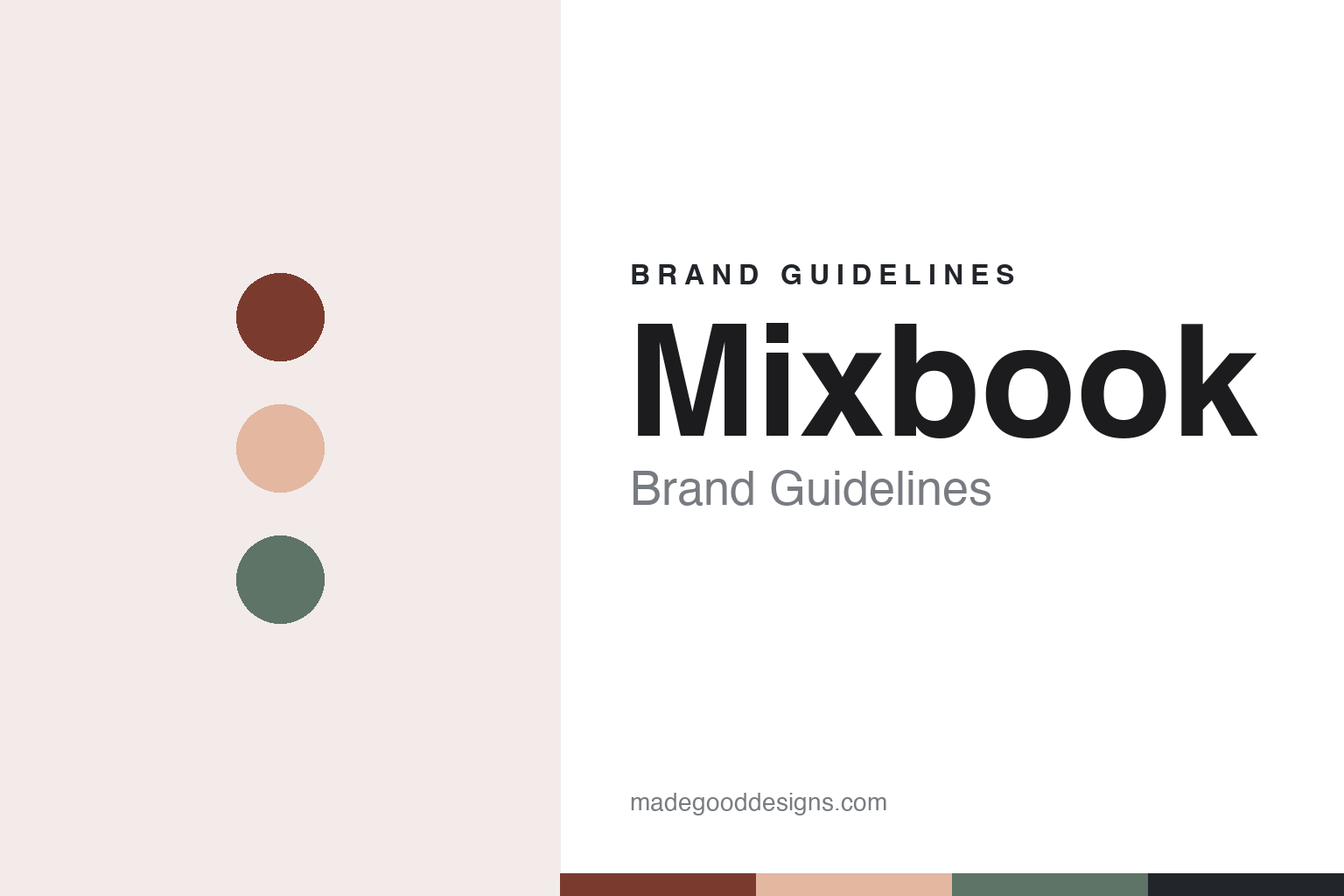
Mixbook Brand Guidelines
The template-first photo-book company from Redwood City.
Aa
Two constants: a redwood, pearl blush and album sage palette and a storybook serif register. Abstract homage — not a Mixbook product or mark; no book, template or logo is reproduced.
Two Berkeley alumni
A photo-book editor first, a printer second.
Mixbook is an online photo-book company based in Redwood City, California, the town its terms of service and privacy notice give as its postal address. The company says it was started in 2006 by two Berkeley alumni, Andrew Laffoon and Aryk Grosz; Laffoon signs the company’s own story as co-founder and chief executive, and the copyright line at the foot of its website runs from 2006.
Mixbook’s own timeline, published on its About page, puts its first website and photo-book editor online in 2007. It says it expanded internationally in 2015, and its website now points to local versions for Australia, Canada, the European Union and the United Kingdom, alongside its main site, which carries the company’s full range of books, cards and decor.
In 2017, the company says, it refocused its mission on helping people connect through their stories. Its stated purpose is “to empower people to be creative and connect deeply with the ones they love”, and its About page describes the work as being about more than photo books. The same timeline records a partnership with Martha Stewart beginning in 2019.
The company’s recent work has centred on software. Mixbook says that in 2024 it introduced AI-powered tools in Mixbook Studio, which it says changed how its photo books are made, and launched Mixbook Movies, a move into digital memories rather than printed ones. Its website now also promotes Story Mode, offered as a way to skip the blank page when starting a book.
Colour
Templates, papers and covers.
Mixbook sells more than books. Its website groups photo books by occasion — travel, family, wedding, baby, pet and coffee-table books among them — and also sells cards and invitations, calendars, and wall decor that includes acrylic and metal prints. Separate programmes cover schools, with yearbooks from preschool to college, and businesses, with books for portfolios, real estate and non-profit groups. The card range runs from wedding stationery — save-the-date cards, invitations and thank-you cards — to holiday photo cards, including real-foil designs, magnets and year-in-review cards.
The editor is the centre of the brand. In a review published in February 2020 and updated that August, Digital Camera World said the software ran entirely in the web browser with nothing to download, and offered nearly 400 fully customisable templates, backgrounds and stickers. It listed three paper types — semi-gloss, pearl finish and an ultra-thick premium matte used for the lay-flat book — and covers running from softcover and hardcover to hardcover with a dust jacket and leather with a dust jacket, in landscape, square and portrait shapes. The reviewer built an 8.5-inch square hardcover and found the process simple to navigate; the review listed delivery to North America, Europe, Australia and the United Kingdom.
Five years later the format list had shifted. Tom’s Guide, in a review published in November 2025, listed softcover, hardcover and lay-flat books in square sizes from 6 to 12 inches, with between 20 and 399 pages, noted a mobile app, and gave standard delivery as six to ten days. Its reviewer described themed presets for occasions from birthdays to weddings and chose a travel typography preset; uploaded photographs went into a bank to draw from, with an option to remove each image once used, and the site offered cropping and effects for editing pictures in place.
Lay-flat binding, as both reviews describe it, lets a spread open fully so that nothing is lost in the gutter; on standard bindings, Tom’s Guide noted, a join stays visible across a double-page spread.
Typography
Photo books and prints, online.
Photo-book and photo-printing services sell something the customer has already made: the pictures. Their own sites therefore tend to lead with the customer’s photographs rather than with the company. Home pages show open books, framed prints and wall pieces in ordinary rooms, often styled around an occasion such as a wedding, a new baby, a holiday or the end of a year, and the product sits in the frame as a finished keepsake.
The making itself is shown through the tools. Most of these companies offer an online editor and a phone app, and they describe both in plain, step-by-step language: upload, choose a size and cover, arrange the pages, order. Automatic layouts, themes and templates are presented as time-savers, while desktop editors with grids, rulers and finer controls are offered to people who want to place every picture themselves.
Product naming follows the physical object. Ranges are sorted by format, page count, binding and cover — soft cover, hard cover, fabric, leather, lay-flat — and by paper finish, with words such as matte, lustre or gloss doing most of the work. Wall pieces are named by their material, from stretched cotton and acrylic to metal, wood and framed prints, so the label tells the buyer what will hang on the wall.
Behind the consumer brands sit the labs and the owners. Corporate pages explain which group a label belongs to, where its printing sites are and how its brands divide up the countries they serve, while lab-led services describe their printing methods and papers in more detail. For a designer, the useful lessons are in that split: a warm, occasion-led consumer voice on top, and a precise, material-led vocabulary underneath.
Aa
A warm display serif for a brand that talks about stories rather than prints. (Specimen set in Fraunces, a serif STAND-IN; NOT the Mixbook logo.)
Mixbook
One story at a time.
Mixbook’s identity is carried mostly by its voice. Its website calls its customers “Mixbookers”, and Laffoon’s note on the About page ends with the promise to bring people closer “one story at a time”. The company’s own milestones are told the same way: not as factories or machines, but as an editor going live, a mission refocused on stories, a partnership with a lifestyle name, and software that turns photographs into a book or a film.
That voice sits on top of a large template library. The company describes Story Mode as a way to skip the blank page, and its card ranges are sold as named designs to personalise. The reviews show the same approach from the customer’s side: Digital Camera World counted hundreds of templates, backgrounds and stickers, and the Tom’s Guide reviewer picked a ready-made typographic preset for a travel book before placing a single photograph. The About page sums up the editor in three words, “Drag. Drop. Done.”, and names designs for every occasion and style, AI help and print quality as the reasons it gives for choosing Mixbook.
The physical product is described in the language of materials. Papers are named by finish — semi-gloss, pearl, premium matte — and covers by construction, from softcover to lay-flat to leather with a dust jacket.
For a design guide, Mixbook shows a photo-book company that leads with its editor and its templates and frames printing as the end of a story-telling process. Compare Shutterfly, an American photo-book service, and Chatbooks, another American photo-book service. For this guide we use a redwood brown, a pearl blush and an album sage with a serif, an unofficial interpretation; no product or logo is reproduced.
Explore & save
Keep Mixbook’s identity on hand — save it to a board in the Made Good inspiration library.
Mixbook identity set
Pin the Mixbook redwood, pearl blush and album sage palette and the storybook serif register to your own board.