Xiabuxiabu Brand Guidelines
Taiwan-style hot pot from a Beijing chain born in 1998.
Aa
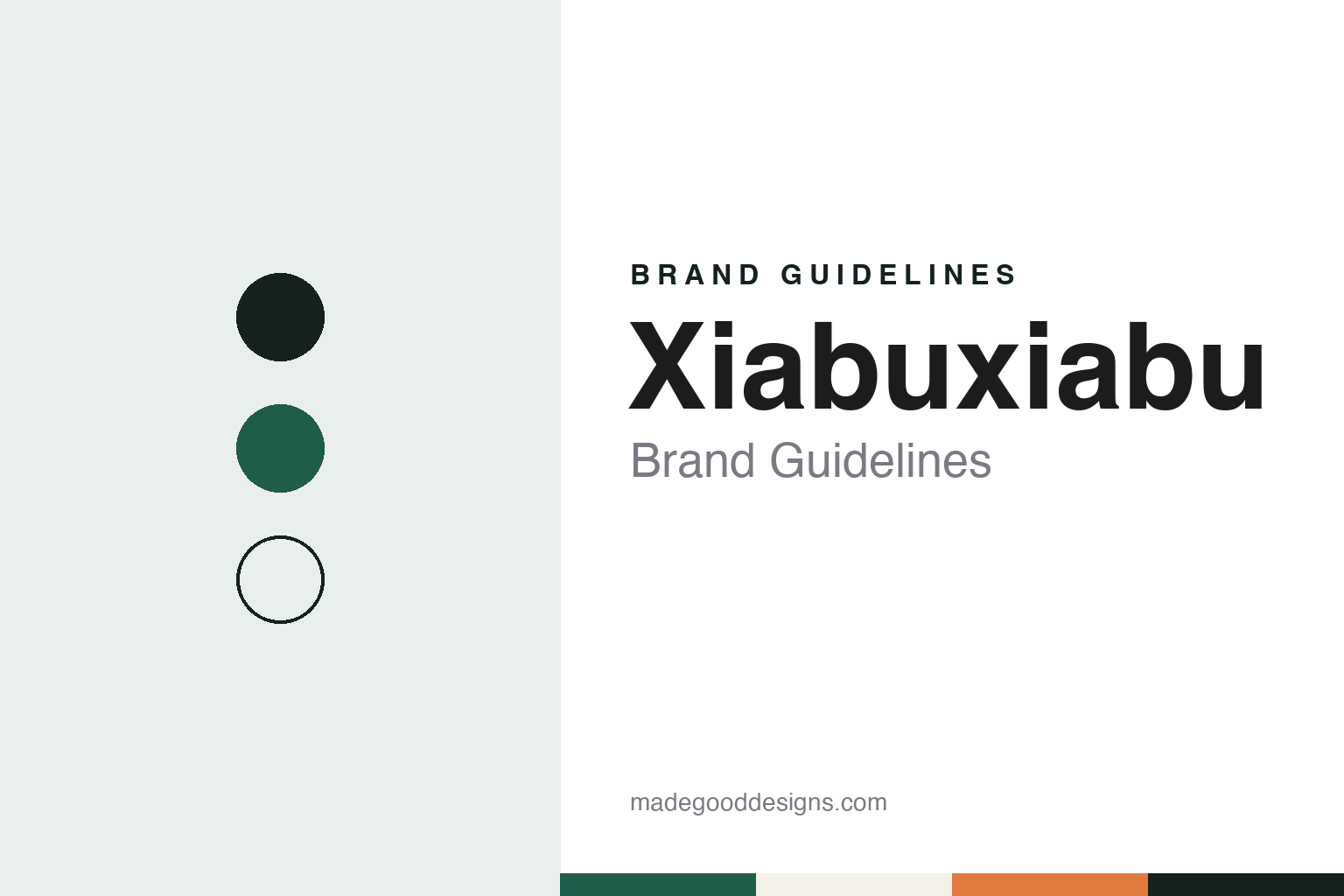
Two constants: a scallion green, cream and tangerine palette and a rounded humanist sans register. Abstract homage — not a Xiabuxiabu product or mark; no logo, sign or menu is reproduced.
Beijing, 1998
A Japanese word, a Taiwanese founder, a Beijing chain.
Xiabuxiabu was founded in Beijing in 1998. Yicai Global, the English service of the Shanghai financial daily Yicai, gave that founding year in May 2021 and named Ho Kuang-chi as the company’s founder and chairman; China Daily again described him as founder and chairman in January 2026. English and Chinese Wikipedia both give the founding year as 1998 and place the headquarters in Daxing district, in Beijing’s southern suburbs.
The name is borrowed. Chinese Wikipedia says the characters 呷哺呷哺, read xiābǔ xiābǔ, are a transliteration of the Japanese shabu-shabu, the dish of thin slices swished through a simmering pot, a simpler way of eating than most Chinese hot pot.
The style it serves is Taiwanese. Yicai Global described the group as operating Taiwan-style hot pot brands, and China Daily’s 2026 report on a new steak brand again framed the group around Taiwan-style cooking. The format grew in Beijing first, before the chain moved into other cities in northern and eastern China. English Wikipedia says that by 2008 the company used centralised kitchens and ran 53 restaurants in the capital, and that by 2012 there were more than 300, spread across Beijing, Shanghai and Tianjin and the provinces of Hebei, Jiangsu and Liaoning.
Colour
Investors, a listing and a sister brand.
Outside money arrived early. English Wikipedia says the private-equity firm Actis took a majority stake in 2008, with the stated aim of tripling the number of restaurants within three years, and that in 2012 Actis sold to the growth-equity investor General Atlantic.
The company then went public. Chinese Wikipedia says the holding company, Xiabuxiabu Catering Management (China) Holdings, listed on the main board of the Hong Kong Stock Exchange on 17 December 2014, under the stock code 0520; the company’s own website carries the code on its home page. Haidilao, the Sichuan hot pot chain founded in 1994, followed it onto the Hong Kong exchange in September 2018, Vulcan Post reported.
New formats followed. Chinese Wikipedia says the group launched a hot pot and stewed-dish delivery brand in 2017 and a tea brand, Chamicha, in 2018; the company’s website now lists Chamicha as an alliance brand. Another addition is Coucou, a sister brand that pairs hot pot with tea. In May 2021 Yicai Global listed three Taiwan-style hot pot brands under the group: Xiabuxiabu, Coucou and In Xiabuxiabu. English Wikipedia says there were 1,077 restaurants across the Xiabuxiabu and Coucou brands by 2021. Chinese Wikipedia lists the group’s other names as Coucou Hot Pot, the tea brands Chaqi and Chamicha, and a Coucou retail line. Coucou is the group’s higher-priced format: KrASIA, in an October 2024 article adapted from the Chinese business site 36Kr, grouped it with the upmarket hot pot chains and reported that it closed 23 restaurants in the first half of 2024.
The group also works behind the restaurants. Its website names a design and engineering company serving chain restaurants, a food company making sauces, and a halal food company sourcing beef and lamb from the Xilingol grasslands of Inner Mongolia. On its home page the company gives a figure of about 1,200 directly operated restaurants, without a date.
Typography
Hot pot as a chain business.
Korean fried-chicken and hot-pot chains tend to present themselves through what happens to the food, not through a mascot. A chicken chain’s company pages will often explain a sauce before they explain a logo: a soy-and-garlic glaze, a chilli version, a honey version, each with its own year of launch and its own name on the menu. Kyochon, for example, describes sauce brushed on piece by piece and has carried the brush into its wordmark; bb.q points to a training centre it calls Chicken University. Hot-pot chains put the pot itself at the centre of the table, so the broth, the burner and the plates of raw ingredients around it become part of how the brand is seen.
Shop interiors and menus are where these identities become consistent. As franchise networks grew into the hundreds and then the thousands, the companies describe bringing in uniform interiors, standard menu boards and set colour schemes; Kyochon, for one, dates uniform shop interiors and orange-based menu boards to 1999, the year it passed 100 shops. Delivery boxes, sauce packs and takeout bags carry the same marks, and some chains have built whole shop formats around delivery and takeout.
Names are usually plain. Menus are organised by sauce or cooking method, and side brands are given short, descriptive names of their own; several groups now run cafés, bars or noodle formats under separate names alongside the main chain. Some write their names in Korean characters, some in Latin letters, and some with punctuation or a founding year built into the mark.
Corporate pages fill in the rest: who founded the company and when, which group owns it, where it is listed, and how many shops and countries it reports. Those figures come from the companies, and dated press reports are the way to check them. This guide reads each brand through those pages and through independent reporting, and treats colour and type as an interpretation, not a copy.
Aa
A rounded humanist sans for a friendly, everyday chain. (Specimen set in Nunito Sans, a sans STAND-IN; NOT the Xiabuxiabu logo.)
Xiabuxiabu
Founder-led, and still adding brands.
The founder has stayed at the centre of the business. In May 2021, Yicai Global reported, Ho Kuang-chi took over as chief executive as well as chairman, after the company said the previous chief executive had left over the performance of its newer brands. In August 2021, Chinese Wikipedia says, the group announced that it would close 200 restaurants it judged to be in the wrong locations, and a further 84 closed in 2022.
The latest brand moves beyond hot pot. In January 2026 the group announced Xianiupai, or Xia Steak, a sub-brand serving Taiwan-style thick-cut steak with set meals that include Chinese and Western side dishes and drinks, China Daily reported. Ho told the paper the idea was to make steak easier to order by bundling it into fixed meals, and that the brand was aimed at families and groups. According to the report, the beef comes from Australia, New Zealand, the United States, Argentina, Uruguay and Brazil, is marinated for 24 hours, is prepared by trained kitchen staff and is seasoned mainly with black pepper from India’s Malabar Coast; the first outlet was announced for Changping district, in Beijing. The paper also said the brand had set up a system for tracing its beef from purchase through processing, and quoted analysts who saw room for brands placed between mass-market dining and higher-end steak restaurants as beef eating rises in China.
That pattern, one core chain and a run of sister brands aimed at different meals and prices, is the part of Xiabuxiabu most visible to diners. The doubled name, taken from a Japanese dish and applied to a Taiwanese style of cooking in Beijing, is the thread that ties the group’s brands back to its first restaurants.
For a design guide, Xiabuxiabu shows how a short, repeated name can carry a mass-market chain and leave room for sister brands with their own identities. Compare Haidilao, the Sichuan hot pot chain founded in 1994, and Little Sheep, the Mongolian hot pot chain. For this guide we use a scallion green, a pine ink, a tofu cream and a tangerine with a sans, an unofficial interpretation; no product or logo is reproduced.
Explore & save
Keep Xiabuxiabu’s identity on hand — save it to a board in the Made Good inspiration library.
Xiabuxiabu identity set
Pin the Xiabuxiabu scallion green, cream and tangerine palette and the rounded humanist sans register to your own board.