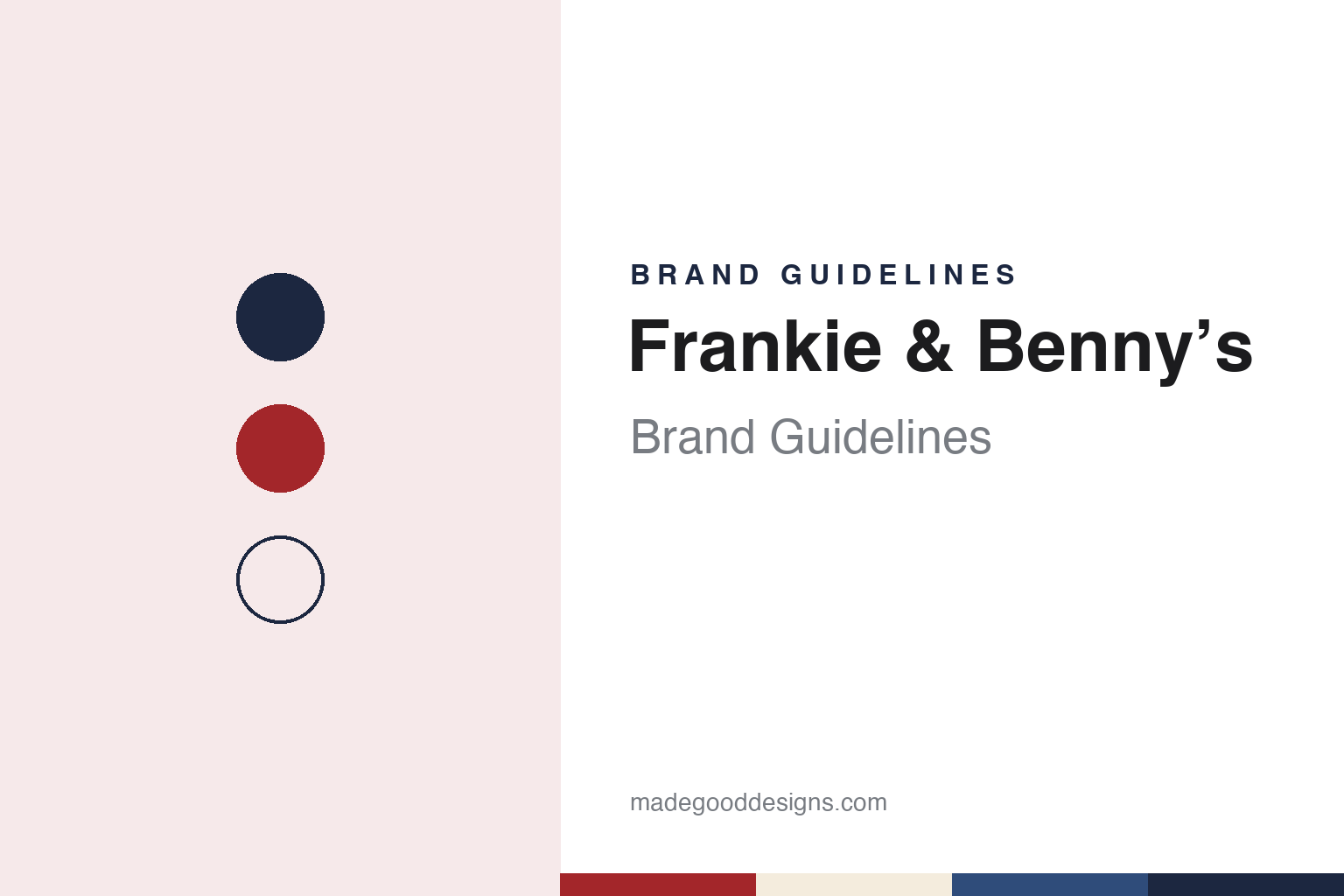
Frankie & Benny’s Brand Guidelines
A 1995 Leicester diner, a neon sign and Big Table.
Aa
Two constants: a Frankie & Benny’s red, blue and cream palette and a Condensed sans register. Abstract homage — not a Frankie & Benny’s product or mark; no sign, logo or menu is reproduced.
Leicester, 1995
A New York story told in the East Midlands.
Frankie & Benny’s is a chain of New York Italian-themed restaurants in Britain, and it began in the East Midlands rather than in Manhattan. English Wikipedia says the first restaurant was opened in 1995 by City Centre Restaurants, and its article on The Restaurant Group places that first site in Leicester. The chain’s own website tells the same story: its journey, it says, began in 1995 with “a single restaurant in Leicester.”
City Centre Restaurants was founded in 1987 by Matthew Brown to run the Garfunkel’s restaurant chain, English Wikipedia says, and in the late 1980s it bought the Mexican-themed chain Chi Chi’s and renamed it Chiquito. In January 2004 the company changed its name to The Restaurant Group, usually shortened to TRG. Frankie & Benny’s grew inside that group. English Wikipedia says TRG converted former Deep Pan Pizza restaurants into Frankie & Benny’s and other brands at some point between 1998 and 2005, and that the chain opened its 100th restaurant in 2005. By 2024, Restaurant Online reported, much of the remaining estate sat on leisure and retail parks.
The name comes with an invented history. English Wikipedia describes a fictional backstory in which Frankie Giuliani leaves Sicily for New York’s Little Italy with his parents in 1924, the family opens a restaurant there, and Frankie and his school friend Benny, a third-generation American, take it over in 1953. Restaurant Online noted in October 2021 that the name has been explained through that story of two schoolfriends, but that the brand was actually founded in England in 1995. The mix it describes, American food served alongside Italian dishes, has shaped the menu ever since.
Colour
From The Restaurant Group to Big Table.
The chain grew large and then shrank sharply. English Wikipedia says 33 underperforming restaurants were closed or sold in 2016 and 18 more in 2019. In June 2020, it says, TRG told staff that a large number of Frankie & Benny’s outlets would not reopen after the spring closures of that year, and the group entered a company voluntary arrangement that month under which it planned to cut 125 sites. In August 2024 Restaurant Online, in an article first published by its sister title MCA, described a cull of the estate “from 250 to 50” over recent years.
Ownership changed in 2023. TRG agreed in September 2023 to pass its leisure division, made up of Frankie & Benny’s and Chiquito, to The Big Table Group, the owner of Bella Italia and Café Rouge; English Wikipedia says the sale completed on 30 October 2023, and The Grocer dated the acquisition to September 2023. TRG itself was then bought by the American private equity firm Apollo, a deal English Wikipedia says completed in December 2023. Big Table says on its website that it runs around 200 restaurant sites, with brands including Bella Italia, Las Iguanas, Café Rouge and Chiquito, and that it is owned by the private equity firm Epiris.
Big Table’s original plan was conversion rather than revival. Restaurant Online reported in August 2024 that the business case had been to turn most of the restaurants into other Big Table brands, such as Banana Tree and Las Iguanas, and that two further Frankie & Benny’s sites were being converted to Bella Italia. Instead the group began trialling a refreshed menu at three restaurants, leaning into the chain’s New York-inspired origins, with bagels and longer breakfast, brunch and lunch service. Chief executive Alan Morgan told MCA that many customers assumed the chain no longer existed.
In September 2024, English Wikipedia says, the owners decided to take the chain back to its 1995 origins after research with thousands of existing and potential customers.
Typography
Design and documentation.
Britain’s Italian restaurant chains tend to tell their stories through a room and an oven. Pizza Express traces itself to a single pizzeria on Wardour Street in Soho, opened in 1965 with an oven brought from Italy, according to accounts in MCA and Restaurant Online in 2018. Franco Manca, which began in Brixton Market in 2008, says its founders built their own oven there before opening anywhere else.
Menus and naming are usually plain. Dishes are listed by ingredient and region rather than by invented brand names, and some chains publish where those ingredients come from: Franco Manca’s pages run through its flour, tomatoes, cheeses and coffee one by one. Restaurant names lean on a founder, a place or a simple description; Franco Manca, the company says, means “Franco is missing,” after the man who ran the market pizzeria before it.
The corporate pages tell a second story, about owners. Many of these chains have passed between founders, stock-market listings and investment firms. In 2014 City A.M. noted that the private equity firm Cinven’s Gondola group ran Pizza Express alongside Zizzi and ASK Italian; Franco Manca was bought by the listed group Fulham Shore in 2015, and Fulham Shore by the Tokyo-listed Toridoll in 2023.
Restructurings are part of that record too. Company voluntary arrangements, which let a business close restaurants and reset its leases with creditors’ approval, were used by Pizza Express in 2020 and announced by Franco Manca’s owner in 2026, according to trade press reports. Each guide in this series sets out what can be checked about a chain, who founded it, who owns it and what has changed, and marks what rests on the company’s own word.
Aa
A condensed sans, in the spirit of a diner sign. (Specimen set in Oswald, a sans STAND-IN; NOT the Frankie & Benny’s logo.)
Frankie’s
A neon sign, revised twice.
The look has been revised more than once. In 2017, English Wikipedia says, TRG tried to reinvent the brand for younger customers with a new menu, a tweaked logo, new branding and new staff uniforms, introduced into 2018. In October 2021 Restaurant Online reported that the company had dropped “Benny’s” from the chain’s signature neon red logo at a refurbished restaurant in Basildon, pushing the name Frankie’s to the fore. The redesigned Basildon site had a larger kitchen, set up for the growth of delivery and takeaway, and was the first of three major refurbishments planned that year.
The 2024 relaunch went the other way, back to the 1990s. The Grocer reported on 1 October 2024 that the chain had brought back its original New York-Italian menu after customer research, with stuffed calzones, meatballs, chicken parm and bagels, and that its staff would wear a new uniform inspired by the chain’s classic apron. At that point it ran 57 sites, The Grocer said. English Wikipedia adds that the refresh changed the brand colours to blue and red and brought 1950s music back into the restaurants.
The name has stayed flexible. Smaller high-street and town-centre outlets have traded as “Little Frankie’s,” with a shorter menu, according to English Wikipedia, and the chain now calls itself Frankie’s throughout its own website. In November 2026 that website says it has more than 50 restaurants and describes hand-stretched sourdough pizzas, pasta bowls and burgers, served in booths. Its pages promote seasonal set menus, student offers and cinema deals.
For a design guide, Frankie & Benny’s shows how an invented founding story and a neon sign can carry a chain through decades of closures and a change of owner. Compare Bella Italia, its sister brand at The Big Table Group, and Olive Garden, an American Italian chain. For this guide we use a diner red, an ink blue and cream with a condensed sans, an unofficial interpretation; no product or logo is reproduced.
Explore & save
Keep Frankie & Benny’s’s identity on hand — save it to a board in the Made Good inspiration library.
Frankie & Benny’s identity set
Pin the Frankie & Benny’s red, blue and cream palette and the Condensed sans register to your own board.