Marugame Seimen Brand Guidelines
Toridoll’s Kakogawa udon chain, known abroad as Marugame Udon.
Aa
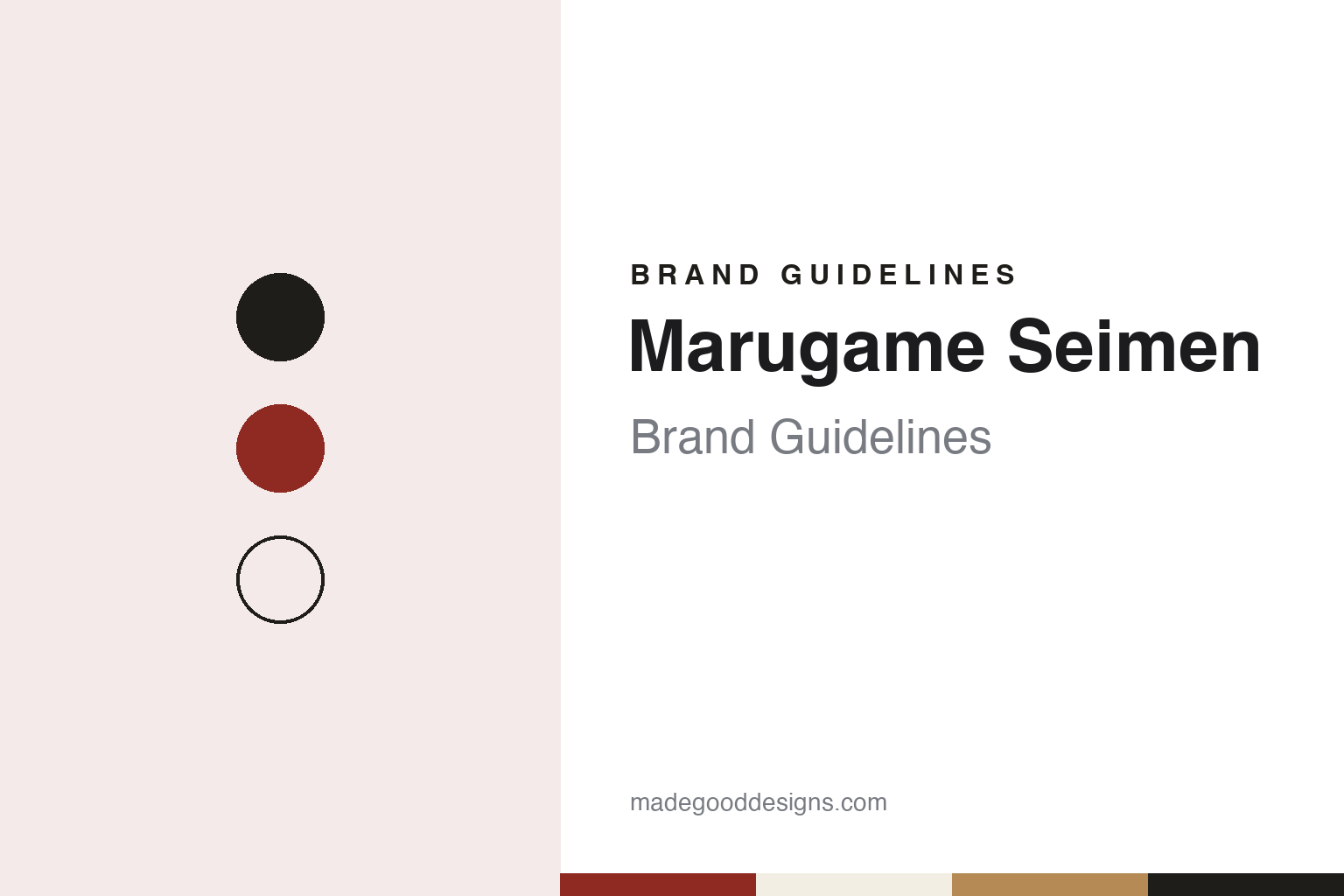
Two constants: a Marugame red, ink and flour white palette and a plain gothic sans register. Abstract homage — not a Marugame Seimen product or mark; no dish, logo or signboard is reproduced.
Kakogawa
A udon chain named after a town it did not start in.
Marugame Seimen is a chain of self-service udon shops run by Toridoll Holdings. Japanese Wikipedia says the first shop, Marugame Seimen Kakogawa, opened in November 2000 in Kakogawa, in Hyōgo Prefecture, the city where Toridoll itself began; English Wikipedia also gives Kakogawa and 2000. Nation’s Restaurant News named Takaya Awata as the founder and chief executive of Toridoll Holdings in September 2019.
The name is a borrowed place. “Seimen” means noodle-making, and Marugame is a city in Kagawa Prefecture, the home of Sanuki udon. Japanese Wikipedia says Awata visited Marugame in 2000, saw customers queuing at a noodle works for freshly made udon, and named his shop after the town; his father came from neighbouring Sakaide. The chain did not start in Marugame and, both Wikipedias say, has no shop there. English Wikipedia notes that people in Kagawa have criticised the name for that reason. Japanese Wikipedia adds that an unrelated noodle maker called Marugame Seimen traded in Marugame from 1969 to 2023, and that Toridoll learned of it only after its own shops had opened.
For most of its life the chain was a brand inside Toridoll rather than a company of its own. Japanese Wikipedia traces the present business through a 2016 company split: a preparatory company formed in March 2016 took the Toridoll name that October, became Toridoll Japan in July 2017, and was renamed Marugame Seimen on 1 April 2020. Its registered head office moved from Kobe to Shibuya, Tokyo, in June 2021, into the building that also houses Toridoll Holdings.
Growth came quickly. Japanese Wikipedia records that the chain opened its Okinawa Misato shop on 9 May 2011, giving it a shop in all 47 of Japan’s prefectures, and that it passed 1,000 shops at home and abroad in March 2018. English Wikipedia gave 786 shops in Japan and 271 outside it as of June 2024. In Kagawa itself, Japanese Wikipedia says, the chain has had a single shop, in Takamatsu, since February 2022.
Colour
Noodles made in the shop.
The format is a counter and a tray. Diners pick a bowl of udon at the counter, then move along to tempura and rice balls and pay at the end. Japanese Wikipedia says every shop has a noodle machine and makes its own noodles in-house, most of them on machines from Yamato Seisakusho and some from Sanuki Menki, both makers based in Kagawa. The signature dish is kamaage udon, noodles served straight from the pot, alongside kake, bukkake and kamatama bowls; the large round vegetable kakiage is a regular side. Shop signs, Japanese Wikipedia notes, pair the name with a descriptive line such as “Sanuki kamaage udon.”
The same model went abroad. Nation’s Restaurant News reported on 10 September 2019 that the private-equity firm Hargett Hunter Capital Management had taken a minority stake in Marugame Udon USA, then eight restaurants — two in Hawaii and six in California — and that the business would move its base from Irvine to Dallas. The paper described cafeteria-style service with an open kitchen, udon made in each unit, and 14 to 16 tempura items. Japanese Wikipedia dates the first American shop, in Waikiki, to 1 April 2011, run by a Toridoll subsidiary set up in Hawaii in 2009.
Europe followed in 2021. Restaurant Online reported on 5 August 2021 that Marugame Udon had opened its first European restaurant close to London’s Liverpool Street station, on a corner site with separate doors for eat-in diners and for delivery riders, through a joint venture between Toridoll and Capdesia Group. Diners met an open kitchen where the noodles are made and cooked, took a tray and moved through stations. The 100-cover room had stacks of Japanese roof tiles, a backlit image of Mount Fuji and a light fitting shaped like a tangle of noodles. On 23 August 2021 the same title reported that a second London site, at The O2 in Greenwich, would open the following month, and that the noodles are made daily in the restaurants on machines imported from Japan.
Other markets have opened and closed. Japanese Wikipedia lists Seoul in December 2012, Hong Kong in January 2013 and Vancouver on 24 February 2024; the chain left South Korea in August 2021 and returned to Seoul on 15 September 2025 under a franchise agreement with Lotte GRS. English Wikipedia records a Singapore shop at ION Orchard from 2018 to 2023, the closure of three shops in Thailand on 31 March 2022, and a first shop in Brunei on 27 May 2025.
Typography
Counters, trays and names.
Japan’s fast-food and conveyor-sushi chains present themselves first through the shop itself. A beef-bowl shop is often a single counter with stools, a curry or noodle shop a short line from order to tray, a sushi restaurant a lane of plates running past the tables. Many chains also run suburban roadside stores with car parks, table seating and drive-throughs, and units in station buildings and shopping-centre food courts, so the same name has to work on a tall roadside sign and on a narrow arcade front.
Ordering is part of the look. Many shops ask customers to buy a ticket from a machine before they sit down, and the machine’s screen, buttons and photographs become a menu in their own right; newer stores add self-checkout and mobile ordering. Conveyor-sushi chains add a piece of equipment of their own: the lane that carries plates past the seats.
Naming is usually plain. Signboards tend to state the dish as well as the name, and menus describe a bowl by what is on it, such as cheese, grated radish, kimchi or spring onion and egg, often in sizes from small to extra large. Some chains keep a word of their own for a familiar dish, and many publish their menus in English and Chinese for visitors.
Behind the shop front sits a listed company. Most of the large chains belong to parent groups listed on the Tokyo Stock Exchange that run several formats under separate names, and their corporate sites publish company histories, store counts and overseas subsidiaries year by year. Those pages, read alongside Japanese and English press, are the clearest record of when a chain opened its first store, when it went abroad and who owns it now.
Aa
A plain gothic sans for a counter-service noodle shop. (Specimen set in Zen Kaku Gothic New, a sans STAND-IN; NOT the Marugame Seimen logo.)
Marugame Udon
One name, two spellings, many signs.
Outside Japan the name changes. Japanese Wikipedia says the chain first used the reading “Marukame” abroad, because English speakers were likely to read the “game” in Marugame as the English word, and that the Waikiki shop dropped “Seimen” for “Udon,” a word overseas diners already knew. In October 2023 the Waikiki signboard was changed to “Marugame Udon” after the company found that local customers said “Marugame” anyway. English Wikipedia notes that in English-speaking markets the bukkake bowl is listed as “BK udon.” Restaurant Online and Nation’s Restaurant News both used the name Marugame Udon in their reports.
At home the chain has added a spoken and written voice to the name. Japanese Wikipedia says that from the 2018 business year it adopted the line “Kokoro no udon” — roughly, “udon from the heart” — and introduced a newly made sound logo in its television advertising. Its Japanese advertising has used a rotating cast of actors and entertainers.
The link with Marugame has also become more formal. Japanese Wikipedia records that Toridoll Holdings signed a regional partnership agreement with the city of Marugame in April 2022, and that in November 2024 Marugame Seimen opened a training facility, which it calls “Kokoro no honten,” on Hiroshima, an island that belongs to Marugame city. The company says it uses the site for staff training and tests and for udon-making classes for families.
Newer products stretch the noodle. Japanese Wikipedia lists the “Shake udon” cup, launched in 2023, and the “Udonut,” a doughnut made with udon in the dough, launched on 25 June 2024.
For a design guide, Marugame Seimen shows how a chain can carry one counter format into many countries while adjusting a single word on the sign for each market. Compare Sukiya, another Japanese chain built on a quick bowl, and Mos Burger. For this guide we use a deep red, charcoal ink, flour white and a tempura gold with a sans, an unofficial interpretation; no product or logo is reproduced.
Explore & save
Keep Marugame Seimen’s identity on hand — save it to a board in the Made Good inspiration library.
Marugame Seimen identity set
Pin the Marugame red, ink and flour white palette and the plain gothic sans register to your own board.
Source & notes
Frequently Asked Questions
What font can I use to match the Marugame Seimen look?
This guide describes Marugame Seimen’s type as “A plain gothic sans for a counter-service noodle shop”. Its type specimen is set in Zen Kaku Gothic New from Google Fonts as a stand-in; Zen Kaku Gothic New is not Marugame Seimen’s own lettering.
What colours are in the Marugame Seimen palette?
This guide’s Marugame Seimen palette is Noren red #8E2A22, Charcoal ink #1F1D1A, Flour white #F3EEE4, Tempura gold #B58A55 and Paper #FAF7F1. The tones are the guide’s own unofficial interpretation, not official Marugame Seimen hex codes.
Who founded Marugame Seimen?
Marugame Seimen was founded by Takaya Awata (Toridoll). This guide lists Toridoll Holdings as its owner.
Who owns Marugame Seimen?
Marugame Seimen is owned by Toridoll Holdings.