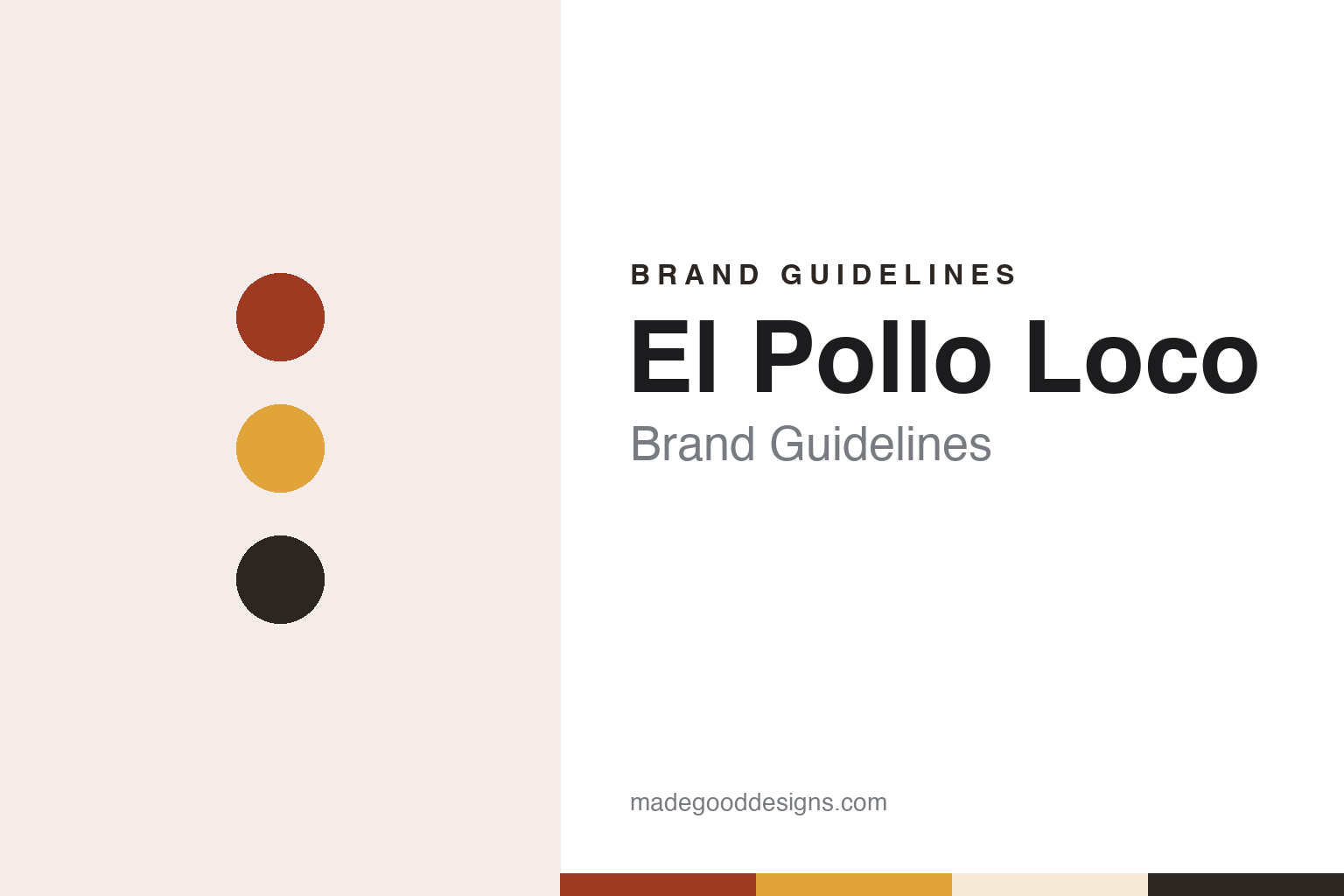
El Pollo Loco Brand Guidelines
A Guasave grill, a 1980 Los Angeles start and Nasdaq LOCO.
Aa
Two constants: an ember red, grill gold and charcoal palette and a rounded grotesque register. Abstract homage — not an El Pollo Loco product or mark; no logo, sign or menu board is reproduced.
The crazy chicken
A Sinaloa grill that crossed the border in 1980.
El Pollo Loco, Spanish for “the crazy chicken,” began in Guasave, in the Mexican state of Sinaloa, where Juan Francisco Ochoa opened a grilled-chicken restaurant in the mid-1970s. The two English Wikipedia articles on the chain differ on the year: the overview article gives 1974, the article on the US company 1975. Both agree on what came next. By 1979 the chain had spread across northern Mexico, and on 8 December 1980 Ochoa opened the first US restaurant in Los Angeles. English Wikipedia describes the opening menu as very short: half or whole chicken, a packet of warm tortillas and a cup of salsa. A second restaurant followed in Santa Ana in the autumn of 1981.
The business split in two in 1983. Denny’s bought the 19 US restaurants, and the Ochoa family kept the Mexican restaurants, which it still runs under the El Pollo Loco name. English Wikipedia counts three separate companies today: the family’s Mexican chain, the US company and a Philippine chain owned since July 2017 by the Manila restaurant operator The Bistro Group. Each works in its own territory and serves a different menu, so the US company’s brand is not the same as the one diners meet in Mexico or Manila.
In the United States the chain moved from owner to owner. TW Services bought Denny’s, and with it El Pollo Loco, in 1987. The chain opened its 200th restaurant, in Yorba Linda, California, in May 1990. In 1999 American Securities Capital Partners bought it from Advantica, the renamed TW Services, and in 2005 it passed to Trimaran Capital Partners. Under these owners the chain tried several times to grow beyond the Southwest: English Wikipedia records five Florida restaurants opened from 1987 and closed in 1991, Japanese restaurants opened with the trading house Mitsui from 1988 and closed by 1994, and a franchise push east from 2006 whose restaurants had closed by 2012.
Colour
Citrus, flame and a salsa bar.
The product at the centre of the brand is grilled chicken. The company describes it as “citrus-marinated and fire-grilled,” English Wikipedia notes, and the menu around it has grown to tacos, burritos, bowls, quesadillas and tostada salads. Some ideas stuck and others did not. In 1994 the chain tested a side-dish bar, a barbecue line, fries and ice cream at a few restaurants; only the salsa bar survived, and it was rolled out across the chain the following year.
The look of the restaurants has been reworked several times. English Wikipedia dates a major makeover to 2012, and when the company listed on Nasdaq in July 2014 its then chief executive pointed investors to what he called the new “Hacienda” remodels, Nation’s Restaurant News reported. The same report said a three-year rebranding had rebuilt the Mexican dishes around the signature citrus-marinated chicken and aimed the brand at a wider audience. In December 2020 the Orange County Business Journal described a “restaurant of the future” design in two versions: one with a takeout window, two drive-through lanes, curbside spaces and patio-only seating, and one that keeps a smaller dining room opening through garage-style doors onto outdoor seating, with digital menu boards in the drive-through.
A further prototype followed in October 2024, keeping the fire stack gradient, logo and font with a brighter interior, as Fast Casual described it. Marketing leans on the grill as well. For a National Grilled Chicken Day on 9 September 2026 the chain ran a Times Square billboard and a music challenge in which customers made tracks over a beat built from the sound of its grills, Nation’s Restaurant News reported in November 2026. The Loco Rewards loyalty programme carries much of the chain’s app marketing.
Typography
Design and documentation.
Mexican and burrito fast-casual chains tend to present themselves through the counter as much as the sign. The format is usually the same in outline: a menu of burritos, bowls, tacos and nachos, a kitchen line where each order is made up in front of the customer, and a choice of eating in, taking away or ordering ahead. The Caterer described one Australian chain’s signature dishes in 2025 simply as “customisable burritos and bowls,” and companies in the category describe their own kitchens in terms of speed and made-to-order assembly.
Names in the category often borrow Spanish words or invented surnames, and the shortened form can matter as much as the full one. Guzman y Gomez, named after two of a founder’s childhood friends according to English Wikipedia, is generally shortened to three initials. The same company calls its head offices Hola Central, and Zambrero’s UK chief executive called the chain’s franchise partners the “Zam Fam” in 2025, so the naming habit often reaches past the menu into the business itself.
Visual identities in the category often lean on bright colour and hand-made graphic details, as the companies describe them. Guzman y Gomez says its logo letters are drawn to look like sticky tape, a nod to street art in Mexico, and Inside Retail reported in 2023 that Zambrero had moved to a brighter, more upbeat look for posters, decals, signage and menus while keeping its green colourway. In both cases a small set of colours and one recognisable graphic idea are meant to carry from the shop front to the menu board.
Behind the counters sit very different businesses: founder-owned franchisors, private-equity-backed groups, chains that have been through administration or Chapter 11, and companies listed on a stock exchange. Their corporate pages set out founding stories, founders and timelines of openings, while dated press and official records fill in owners, listings and closures.
Aa
A rounded grotesque for menu-board warmth. (Specimen set in Rubik, a sans STAND-IN; NOT the El Pollo Loco logo or brand font.)
El Pollo Loco
From private equity to Nasdaq and new states.
The company returned to the stock market on 25 July 2014, when shares of El Pollo Loco Holdings began trading on Nasdaq under the ticker LOCO. Nation’s Restaurant News reported that day that the Costa Mesa chain had 401 restaurants in five states: California, Arizona, Nevada, Texas and Utah. It reached Louisiana in March 2018 and Colorado in November 2022, when English Wikipedia counts 478 restaurants, 196 of them company-owned. The 500th opened in Colorado Springs in October 2024, English Wikipedia says. Fast Casual had counted 495 restaurants in seven states a few weeks earlier.
Growth outside California is now the stated direction. Liz Williams, chief executive since March 2024, told analysts in November 2026 that the chain had entered its tenth state, Idaho, in June 2026, Nation’s Restaurant News reported, and the company announced its entry into New York in September 2026, a move not completed at the time of writing. The same report said digital orders made up 31% of system sales in the third quarter of 2026. The headquarters are in Costa Mesa, in Orange County, California.
For a design guide, El Pollo Loco shows how a chain can rebuild its restaurants several times while holding on to a single idea, the flame of the grill, in its mark and its marketing. Compare Pollo Tropical, another grilled-chicken chain with a regional base, and Del Taco, a Southern California Mexican chain. For this guide we use ember red, grill gold and charcoal with a sans, an unofficial interpretation; no product or logo is reproduced.
Explore & save
Keep El Pollo Loco’s identity on hand — save it to a board in the Made Good inspiration library.
El Pollo Loco identity set
Pin the El Pollo Loco ember red, grill gold and charcoal palette and the rounded grotesque register to your own board.