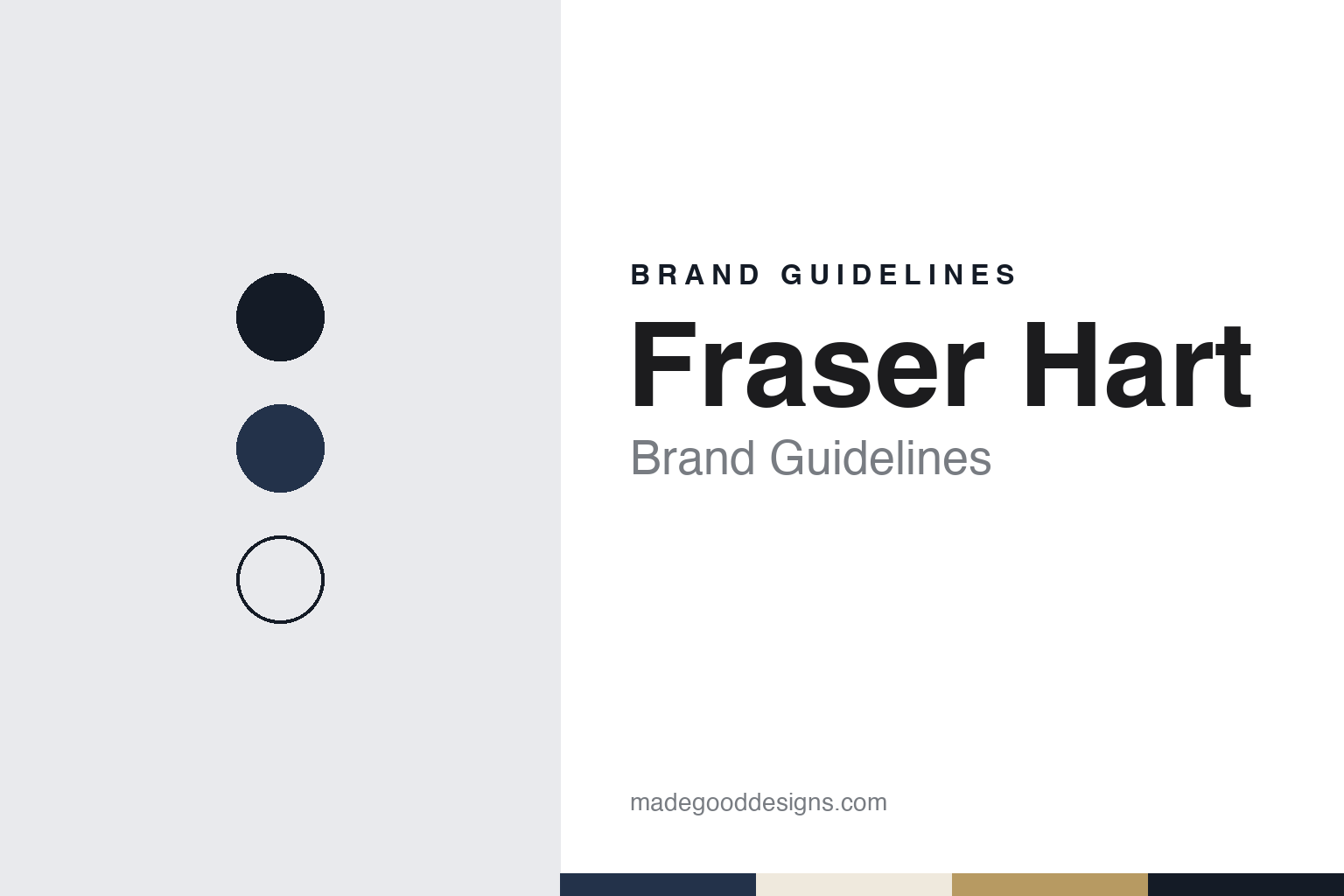
Fraser Hart Brand Guidelines
A 1935 Glasgow company and its Dublin owners.
Aa
Two constants: an ink blue, ivory and champagne palette and a bookish serif register. Abstract homage — not a Fraser Hart product or mark; no ring, watch, logo or shop sign is reproduced.
Fraser Hart
A Glasgow company with three names.
Fraser Hart is a chain of jewellery and watch shops in Britain, and its paperwork leads back to Glasgow. The company dates itself to 1936 and says it began as a family business. Companies House, the UK’s official register, shows that the company now trading as Fraser Hart was incorporated in Scotland on 2 May 1935 under a different name, Hill Brothers (Wholesale) Limited, with a Glasgow registered office that it keeps today.
The register also records two later renamings. In March 1986 the company became Associated Goldsmiths Limited, and in November 1998 it took the name Fraser Hart Limited. A shop profile carried on the business directory of Solihull’s town-centre improvement district says the business began trading in 1936 when its founder, Fred Hill, set up a jewellery shop in Glasgow. The register supports the Hill link: a company called Fred Hill (Glasgow) Limited, incorporated in October 1941 and now listed as non-trading, still sits in the chain of companies that owns Fraser Hart Limited.
The business later spread well beyond Scotland. In September 2010 the York newspaper The Press described the Fraser Hart branch on Coney Street, in the centre of York, as part of an independent, family-owned group of 34 branches. By then the chain had already changed hands, as the next section shows.
Glasgow has stayed part of the picture. The Argyll Arcade, the covered jewellery arcade in the city centre, lists two Fraser Hart shops in its retailer directory: one under the Fraser Hart name and one called Born by Fraser Hart, which shares its name with the company’s range of laboratory-grown diamonds. The arcade’s own website describes it as part of Glasgow’s story since the early nineteenth century and as a place known for engagement rings.
Colour
From Glasgow to a Dublin holding company.
By then Fraser Hart belonged to an Irish group. In April 2022 The Irish Times reported that Anthony Nicholas, a Dublin holding company, owned both Field’s, the jewellery chain in Ireland, and Fraser Hart in Britain. The paper said the group was controlled by the Obernik family, which has long been involved in the Irish jewellery business, that the group traces its history in the Irish market to the 1940s, and that it entered the British market by buying Fraser Hart in 2007.
Companies House shows the same structure from the British side. Fraser Hart Limited is owned through a short chain of holding companies, the last of them Anthony Nicholas (UK) Limited, a head-office company incorporated in July 2007, the year of the purchase.
The next chapter was a run of disposals. According to the Irish business site The Currency, in December 2019 Anthony Nicholas agreed to sell four Fraser Hart shops to Watches of Switzerland, as part of a programme to refocus on its two main brands, Fraser Hart and Field’s, and to build up online selling. The site reported in March 2022 that the sale closed in March 2020 and left the company with 32 Fraser Hart stores in the UK.
Two more shops followed. The Irish Times reported, from the group’s accounts, that it sold two British stores to Beaverbrooks, the family-owned jewellery chain, in the financial year that ended in June 2021, and that the group described the sale as the “final step” in its series of disposals. At that point, the paper said, the group ran 13 Field’s stores in Ireland and about 28 Fraser Hart stores in Britain.
The count has fallen again since. In November 2026 the Fraser Hart website said it had 22 shops nationwide. Over sixteen years the dated figures run from 34 branches in 2010 to 32 in 2020, about 28 in 2022 and 22 in 2026.
Typography
How the chains present themselves.
High-street jewellery chains sell from small, bright shops in town centres and shopping centres, and much of their identity work happens at close range. The fascia over the door, the window display, the ring tray on the counter, the gift box and the carrier bag carry the name more often than any advertisement does, and several chains are run side by side by one parent group, each with its own sign, colours and tone of voice.
The windows do much of the talking. Rings, watches and gifts are usually grouped in themed displays that change with the retail calendar, from engagement season to Christmas, while counter trays, pouches and boxes repeat the same colours and lettering at hand scale. Catalogues, once printed and now mostly online, follow a similar structure: collections set out in grids, with plain product descriptions of metal, stone and size.
Naming tends to be literal. Collections are often named for a material, a cut, an occasion or a designer, and stores for the town or shopping centre they stand in, so the house name does most of the brand work. Where a chain stocks other makers’ watches and jewellery, its own mark sits beside theirs, and the shop has to frame those names without competing with them.
Corporate pages tell a second story. Many chains publish heritage timelines naming founders and first shops, then explain which parent group owns them today, from family companies to listed groups. Reading a chain’s identity therefore means reading two layers: the shopfront a customer walks past, and the ownership history that decides how many names a group keeps, merges or retires.
Aa
A bookish serif for a Glasgow jeweller. (Specimen set in Cormorant Garamond, a serif STAND-IN; NOT the Fraser Hart logo.)
Fraser Hart
Watches, diamonds and an in-house range.
The shop floor is built around watches and diamond jewellery. In November 2026 the Fraser Hart website listed watch brands including TUDOR, OMEGA, TAG Heuer and Grand Seiko, alongside pre-owned and ex-display watches, and jewellery from names such as Messika, Chopard, Gucci and Marco Bicego.
The company’s own names sit in the bridal and diamond sections. The website groups engagement rings into collections it calls Classic, Floral, Prism and Signature, and offers both earth-grown and laboratory-grown stones. Its lab-grown line is sold as Born Lab Grown Diamonds, the name that also appears over the Born by Fraser Hart shop in Glasgow’s Argyll Arcade. Another range is called Northern Star.
The name itself is a later layer. The register shows the company was registered under other names for more than six decades before it became Fraser Hart Limited in November 1998, the name it still uses on its legal paperwork today, while its shops, website and Glasgow arcade fascias carry the Fraser Hart and Born names.
For a design guide, Fraser Hart shows how a jeweller can carry one name through renaming, a sale abroad and a shrinking estate, while selling watch brands that have identities of their own. Compare Beaverbrooks, which bought two of its shops, and Goldsmiths, another British watch and jewellery chain. For this guide we use ink blue, ivory and champagne with a serif, an unofficial interpretation; no product or logo is reproduced.
Explore & save
Keep Fraser Hart’s identity on hand — save it to a board in the Made Good inspiration library.
Fraser Hart identity set
Pin the Fraser Hart ink blue, ivory and champagne palette and the bookish serif register to your own board.