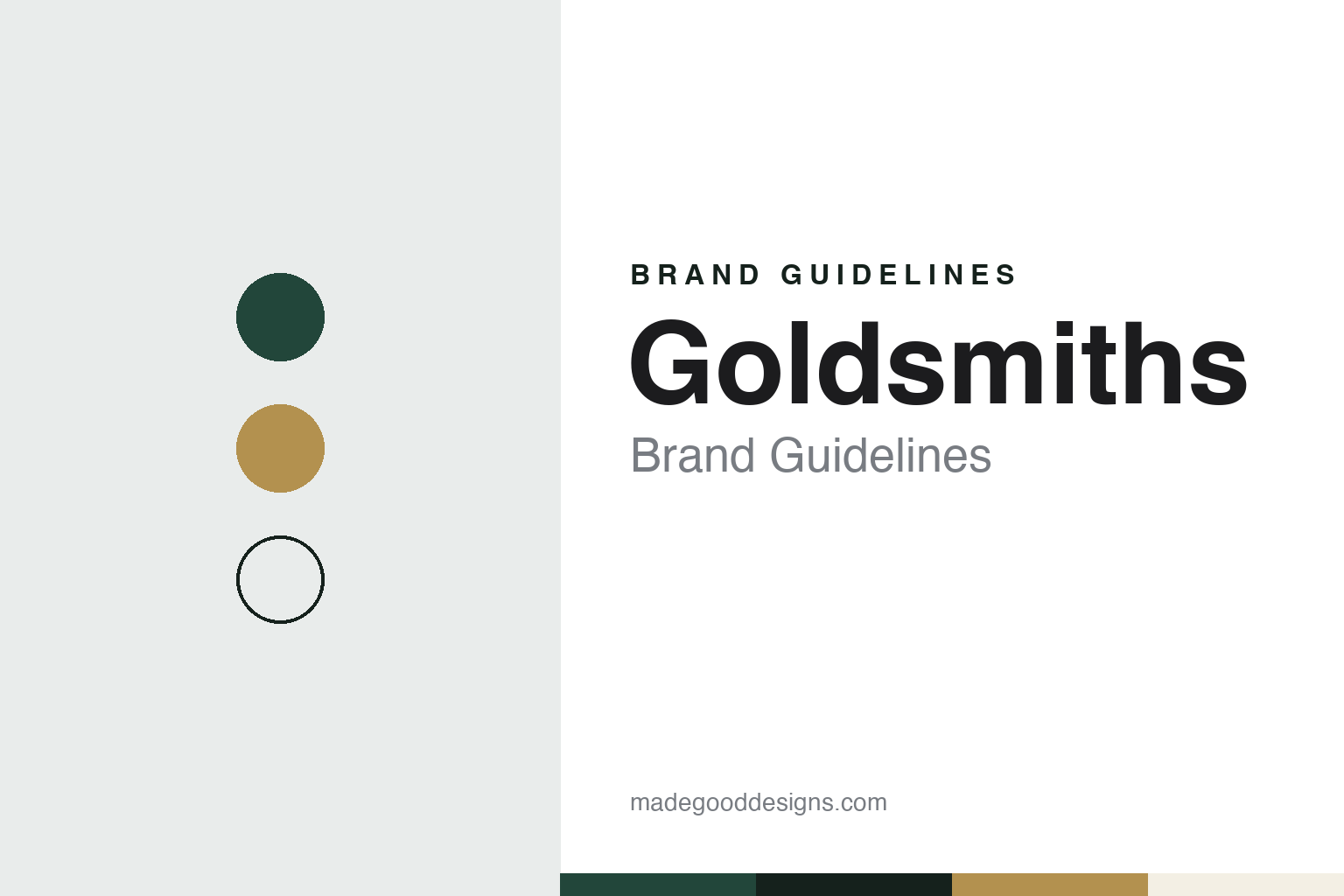
Goldsmiths Brand Guidelines
A Newcastle jeweller that grew into a national chain of showrooms.
Aa
Two constants: a green, gold and ivory palette and a classical serif register. Abstract homage — not a Goldsmiths product or mark; no logo, fascia or packaging is reproduced.
Northern Goldsmiths
Two founding dates, one city.
Goldsmiths starts in Newcastle upon Tyne, but its founding year depends on who is telling the story. The company’s own history page says its first showroom opened in Newcastle in 1778, and the American trade magazine JCK gave the same year in December 2012. English Wikipedia gives 1892: it says the business was founded by Thomas Cooke as the Northern Goldsmiths Company on Blackett Street in Newcastle, and that in 1967 it bought Reid & Sons, a business founded in the 18th century. Both dates are in print, and they describe the same northern jeweller.
The oldest commercial link that the accounts share is with Rolex. English Wikipedia says Goldsmiths became an appointed stockist of Rolex watches in 1919, and the company gives the same year on its history page.
For most of the 20th century the business stayed a regional jeweller in the north-east of England. The record becomes denser from the 1980s, when the company changed hands several times. English Wikipedia says it took the name The Goldsmiths Group in 1984 and was bought in 1986 by Oriflame, the Swedish cosmetics company, which sold off the group’s hotel division the following year. In 1988 a management buyout backed by Schroder Ventures took the jeweller private again, and the group was later listed on the London Stock Exchange. A second management buyout followed in 1999, this time backed by Alchemy Partners.
Colour
From Baugur to the Watches of Switzerland Group.
In the 2000s Goldsmiths became part of a larger luxury group. English Wikipedia says the Icelandic investment company Baugur Group acquired Goldsmiths in 2004. Baugur also bought the watch retailer Watches of Switzerland and the London jeweller Mappin & Webb; English Wikipedia’s article on Watches of Switzerland dates that purchase to November 2005, while its Goldsmiths article gives December 2006. Under Baugur the three businesses were grouped as Aurum.
Baugur went into administration in early 2009, and control of the group passed to the Icelandic bank Landsbanki, according to English Wikipedia. In December 2012 JCK and Retail Gazette both reported that the American private-equity firm Apollo Global Management had agreed to buy Aurum Holdings, owner of the Goldsmiths, Watches of Switzerland and Mappin & Webb brands, with completion set for the first quarter of 2013; English Wikipedia records that Apollo took control in 2013. At the time, JCK put Goldsmiths at 120 stores.
The group then took the name of its watch chain. English Wikipedia says Aurum Holdings became the Watches of Switzerland Group ahead of its initial public offering on the London Stock Exchange in May 2019. The group is based in Braunstone, near Leicester, and alongside Goldsmiths it runs the Watches of Switzerland, Mappin & Webb, Mayors and Betteridge brands, the last two in the United States.
As of November 2026, the Goldsmiths website says the chain runs more than 90 showrooms, four of them in Northern Ireland, and that it sells the exclusive brands Jenny Packham and Mappin & Webb alongside its own collections. In September 2026 FashionUnited reported that the group had reopened expanded and refurbished Goldsmiths showrooms in Chelmsford and Watford.
Typography
Showrooms, trays and parent groups.
High-street jewellery chains sell from small, bright shops in town centres and shopping centres, and much of their identity work happens at close range. The fascia over the door, the window display, the ring tray on the counter, the gift box and the carrier bag carry the name more often than any advertisement does, and several chains are run side by side by one parent group, each with its own sign, colours and tone of voice.
The windows do much of the talking. Rings, watches and gifts are usually grouped in themed displays that change with the retail calendar, from engagement season to Christmas, while counter trays, pouches and boxes repeat the same colours and lettering at hand scale. Catalogues, once printed and now mostly online, follow a similar structure: collections set out in grids, with plain product descriptions of metal, stone and size.
Naming tends to be literal. Collections are often named for a material, a cut, an occasion or a designer, and stores for the town or shopping centre they stand in, so the house name does most of the brand work. Where a chain stocks other makers’ watches and jewellery, its own mark sits beside theirs, and the shop has to frame those names without competing with them.
Corporate pages tell a second story. Many chains publish heritage timelines naming founders and first shops, then explain which parent group owns them today, from family companies to listed groups. Reading a chain’s identity therefore means reading two layers: the shopfront a customer walks past, and the ownership history that decides how many names a group keeps, merges or retires.
Aa
A classical serif for a jeweller that calls its shops showrooms. (Specimen set in Cormorant Garamond, a serif STAND-IN; NOT the Goldsmiths logo.)
Goldsmiths
Shops that are called showrooms.
The clearest public view of the current Goldsmiths look is its newer large stores. In November 2023 TheIndustry.fashion described the upsized Goldsmiths at the Bullring in Birmingham: two floors covering more than 8,000 square feet on a corner site with a glass frontage that wraps around the building, and a dedicated entrance to a Rolex area. Inside, the report listed branded areas for Cartier, TAG Heuer, TUDOR and Hublot, central watch cabinets for other makers, and a first selection of pre-owned watches.
The same report described the jewellery side as a mix of outside names, including FOPE, Messika and Roberto Coin, with Mappin & Webb, Jenny Packham and Goldsmiths’ own collections. The store adds rooms that do not sell anything directly: a hospitality bar on the first floor, private consultation rooms, a service and repair lounge and a watchmakers’ room. The group’s executive called the Bullring store the latest version of the Goldsmiths luxury design concept, TheIndustry.fashion reported.
The vocabulary matters as much as the fit-out. The company calls its shops showrooms, sells appointments as well as goods, and gives over whole rooms to a single watch brand. That makes the Goldsmiths name one layer in a stack of names: the fascia over the door, the watchmakers’ branded areas inside, and the group name behind them all, which since 2019 has also been the name of a listed company. The name itself describes a trade rather than a family, and it has stayed on the door through every owner since the 1980s.
For a design guide, Goldsmiths shows how one retail name can stay on the door while the owners behind it change, from Oriflame and two buyouts to Baugur, Apollo and a listed group. Compare Ernest Jones, another British chain that sells jewellery and watches under a group owner, and Beaverbrooks, a family-owned jeweller that has also opened luxury watch boutiques. For this guide we use a deep green, warm gold and ivory with a serif, an unofficial interpretation; no product or logo is reproduced.
Explore & save
Keep Goldsmiths’s identity on hand — save it to a board in the Made Good inspiration library.
Goldsmiths identity set
Pin the Goldsmiths green, gold and ivory palette and the classical serif register to your own board.