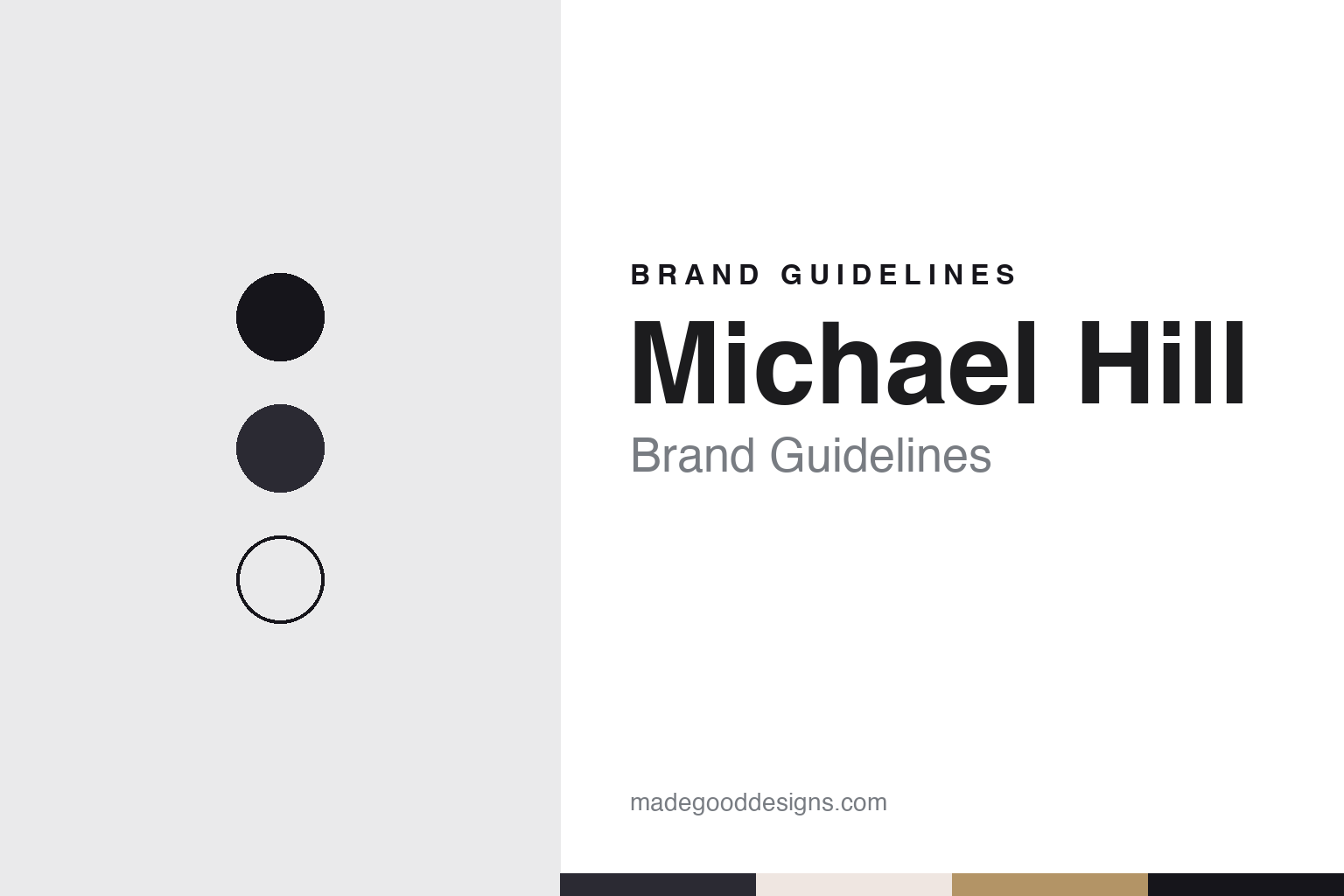
Michael Hill Brand Guidelines
A 1979 Whangārei shop turned trans-Tasman jewellery chain.
Aa
Two constants: a graphite, blush and soft gold palette and a geometric sans register. Abstract homage — not a Michael Hill product or mark; no jewellery, logo or shopfront is reproduced.
Whangārei
A jewellery shop in Northland, New Zealand.
Michael Hill began in 1979 in Whangārei, a town in Northland, New Zealand, when Michael Hill and his wife Christine Hill opened a jewellery shop there, English Wikipedia says. RNZ reported in April 2016 that the company had been founded by the jeweller in Whangārei 37 years earlier, and the Australian trade magazine Jeweller gave the same year and town in June 2016. English Wikipedia says the business gained national prominence for its distinct store design, its focus on jewellery alone and its heavy advertising, and that it began making its own jewellery in-house in 1981.
Growth came shop by shop. By 1987 there were ten stores, and that year the company listed on the New Zealand stock exchange, the NZX, and crossed the Tasman with four stores in Australia, according to English Wikipedia. Canada followed in 2002, with stores in Vancouver; the same source says the chain has since traded in British Columbia, Alberta, Saskatchewan, Manitoba and Ontario.
The company’s centre of gravity moved west across the Tasman. Jeweller reported in June 2016 that Michael Hill International had relocated its headquarters to Brisbane in 2005. RNZ said in April 2016 that the company made most of its sales in Australia and ran its head office and back-room operations there, describing it as “an Australian company in all but name.”
A move into the United States was shorter-lived. In September 2008 the company entered the American market by acquiring 17 stores in Illinois and Missouri from Whitehall Jewelers, English Wikipedia says; it announced the closure of eight US stores in 2010, and in April 2018 it closed its nine remaining stores there. Since then the chain has traded in three countries: Australia, New Zealand and Canada.
Colour
One name over the door and on the watch dial.
Michael Hill has long sold under its own name rather than as a multi-brand jeweller. English Wikipedia says that towards the end of 2006, after a five-year trial, the company launched watches under the Michael Hill name and phased out every outside watch label except Citizen by mid-2007; by mid-2008 only Michael Hill watches were on sale in its stores. A charms collection followed in 2009. In 2013, according to the same source, the company introduced a new global brand, adding bridal pieces and other jewellery described as more feminine.
The group has also run other names. English Wikipedia lists Emma & Roe and Medley among its brands, alongside Bevilles. Inside Retail reported in July 2026 that the group had confirmed in the opening half of its 2026 financial year that it would narrow its focus to two names, Michael Hill and Bevilles, cutting 60 per cent of its brand portfolio.
Some programmes extend the brand beyond the shop counter. In May 2023 Jeweller reported the launch of Re:cycle, a gold recycling programme run with the precious-metals firm Morris & Watson: customers collect a kit in store or order one online, send in broken or unworn gold jewellery, and receive its assessed value on a Michael Hill gift card.
The shops themselves have been updated too. Inside Retail reported in March 2026 that the company had opened three flagship stores, in Adelaide, Sydney and Toronto, ahead of the Christmas trading period.
The family stayed close to the board. English Wikipedia says Emma Hill, Michael Hill’s daughter, succeeded him as chair after the November 2015 annual general meeting, and RNZ quoted her as chair in April 2016. By April 2023 RNZ was quoting Rob Fyfe as chair.
Typography
Jewellery chains and their windows.
High-street jewellery chains sell from small, bright shops in town centres and shopping centres, and much of their identity work happens at close range. The fascia over the door, the window display, the ring tray on the counter, the gift box and the carrier bag carry the name more often than any advertisement does, and several chains are run side by side by one parent group, each with its own sign, colours and tone of voice.
The windows do much of the talking. Rings, watches and gifts are usually grouped in themed displays that change with the retail calendar, from engagement season to Christmas, while counter trays, pouches and boxes repeat the same colours and lettering at hand scale. Catalogues, once printed and now mostly online, follow a similar structure: collections set out in grids, with plain product descriptions of metal, stone and size.
Naming tends to be literal. Collections are often named for a material, a cut, an occasion or a designer, and stores for the town or shopping centre they stand in, so the house name does most of the brand work. Where a chain stocks other makers’ watches and jewellery, its own mark sits beside theirs, and the shop has to frame those names without competing with them.
Corporate pages tell a second story. Many chains publish heritage timelines naming founders and first shops, then explain which parent group owns them today, from family companies to listed groups. Reading a chain’s identity therefore means reading two layers: the shopfront a customer walks past, and the ownership history that decides how many names a group keeps, merges or retires.
Aa
A clean geometric sans for a name-over-the-door retailer. (Specimen set in Jost, a sans STAND-IN; NOT the Michael Hill logo.)
Michael Hill International
From the NZX to the ASX, and Bevilles.
The listing followed the head office. In April 2016 the company confirmed it would move its primary listing to the Australian Securities Exchange through a new Australian-incorporated parent, keeping a secondary listing on the NZX, RNZ reported. Jeweller reported in June 2016 that shareholders had voted 99 per cent in favour on 23 June, and that a scheme of arrangement would see the new parent acquire all existing shares one for one. English Wikipedia lists Michael Hill International Limited as traded on both the ASX and the NZX.
In April 2023 the company entered a binding agreement, subject to conditions, to take over Bevilles, a family-owned jewellery and watch retailer with 26 stores in three Australian states, RNZ reported. Jeweller described Bevilles as founded in Melbourne in 1934 by Leo and Raie Beville, and said it had entered voluntary administration in April 2014, with a 49 per cent stake sold three years later to India’s Tara Jewels. In May 2023 the magazine reported that the deal still needed approval from the Australian Competition and Consumer Commission and the Fair Work Commission. It reported on 5 June 2023 that Michael Hill had assumed operational control of its 26 stores in Victoria, New South Wales and South Australia, completing the deal.
As of March 2026, Inside Retail reported 285 stores across Australia, Canada and New Zealand; in July 2026 it reported 157 stores in Australia at the end of the financial year.
For a design guide, Michael Hill shows how a single founder’s name can carry a chain from one Northland town to three countries, from the shop sign to the watch dial. Compare Prouds and Angus & Coote, two other jewellery chains in Australia. For this guide we use graphite, blush and a soft gold with a sans, an unofficial interpretation; no product or logo is reproduced.
Explore & save
Keep Michael Hill’s identity on hand — save it to a board in the Made Good inspiration library.
Michael Hill identity set
Pin the Michael Hill graphite, blush and soft gold palette and the geometric sans register to your own board.