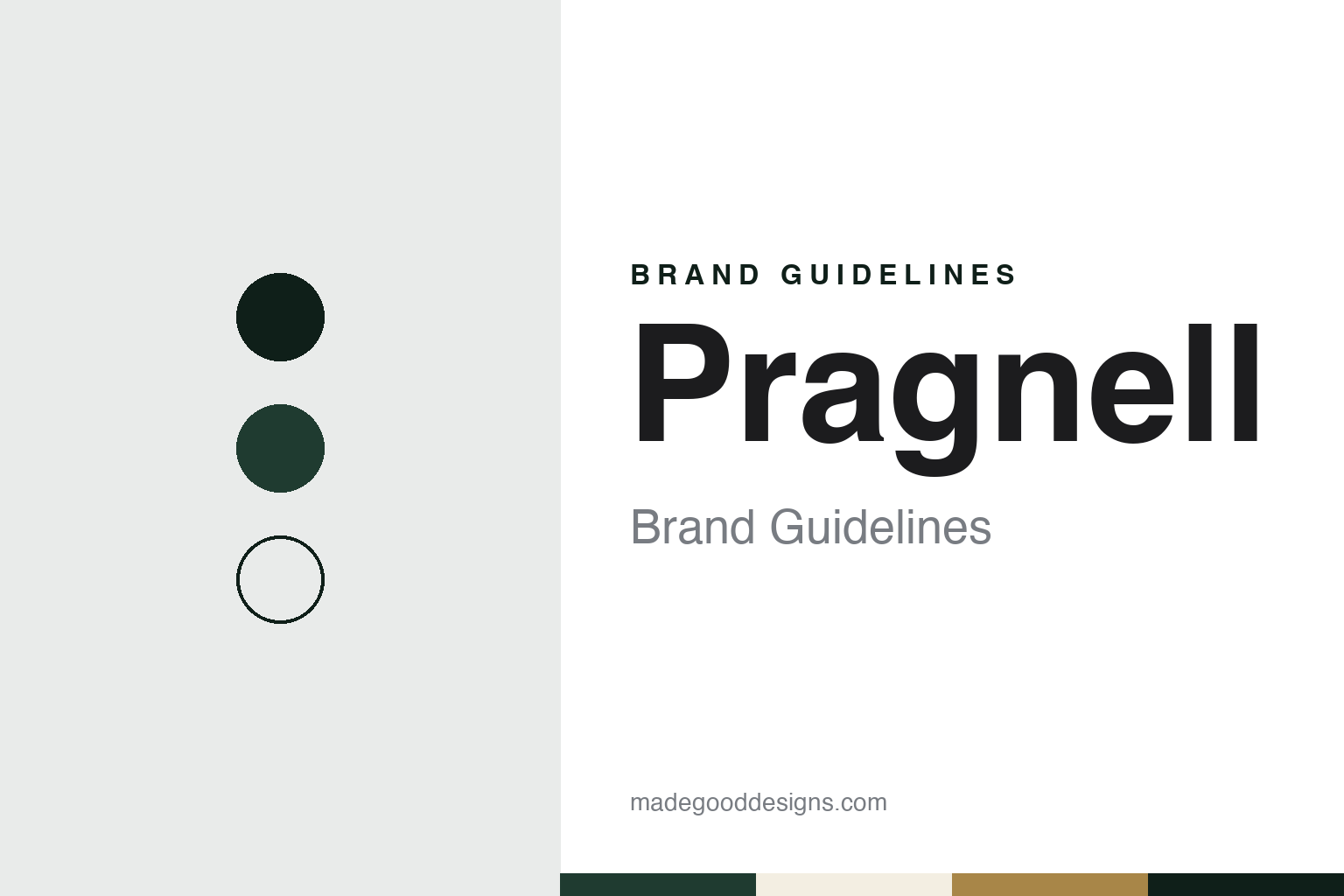
Pragnell Brand Guidelines
A 1954 Stratford-upon-Avon family jeweller and its Bond Street houses.
Aa
Two constants: a green, ivory and antique gold palette and a classic serif register. Abstract homage — not a Pragnell product or mark; no jewel, logo or seal is reproduced.
Wood Street
A jeweller’s shop and a family home in Shakespeare’s town.
Pragnell is a family jeweller from Stratford-upon-Avon, in Warwickshire. The company says George Pragnell founded it there in 1954, after beginning his career as an apprentice at Biggs of Maidenhead. The Stratford Observer gave the same founding year in April 2018, and the Stratford Herald described Pragnell that month as a 64-year-old firm based on Wood Street in the town centre. Companies House lists the trading company, George Pragnell Limited, as incorporated on 6 June 1956, with its registered office in Stratford-upon-Avon.
Wood Street has stayed the base. The company says George Pragnell and his young family moved into No. 5 Wood Street in 1954, as both shop and home, and that its headquarters are still in the building. It describes the house as a listed Tudor building put up in 1594 by Abraham Sturley, a friend of Shakespeare. In 1993, it says, the showroom was extended into the neighbouring No. 6.
The family line runs through marriage as well as descent. According to the company, George’s son Jeremy Pragnell married Jane Blott, whose family ran Waters & Blott, a Bond Street jewellery maker founded in 1850 which, the company says, was known for bespoke work by 1947, joining the two families’ jewellery histories. The company says Jeremy handed the managing director’s role to his son Charlie Pragnell in 2010. Both Stratford papers identified Charlie Pragnell in April 2018 as managing director and as the founder’s grandson.
Colour
Old houses, new showrooms and the Pragnell Seal.
Acquisitions brought older London and Midlands names into the business. Pragnell says it bought Philip Antrobus, a Bond Street jeweller founded in 1815, in 1991, building on the Blott family’s long work as a maker for that firm.” In 1996, the company says, it acquired George Tarratt, a family jeweller and silversmith in Leicester, whose mid-century modernist silver it credits to designers including Ernest Blyth and Geoffrey G. Bellamy.
The stock spans jewellery, watches and silver, antique and modern. The Stratford Observer described the company in April 2018 as a seller of rare natural gemstones handcrafted into jewellery, period jewellery and silver, and luxury watches and clocks. Its own site lists Rolex and Patek Philippe among its watch partners, alongside Cartier, Jaeger-LeCoultre and several small independent watchmakers, and says its fine jewellery is handcrafted in British workshops. Its one-off pieces, sold as Pragnell Masterpieces, are designed around individual gemstones, and the company says each is numbered and stamped with what it calls the Pragnell Seal.
Shakespeare is a recurring thread. The Stratford Observer reported in 2018 that the firm had secured rights to develop Shakespeare-inspired pieces, including a Patek Philippe clock and a silver inkwell-and-quill sculpture made to mark a 400th Shakespeare anniversary and presented on behalf of the town to the then Prince Charles.
Typography
Jewellery chains and their windows.
High-street jewellery chains sell from small, bright shops in town centres and shopping centres, and much of their identity work happens at close range. The fascia over the door, the window display, the ring tray on the counter, the gift box and the carrier bag carry the name more often than any advertisement does, and several chains are run side by side by one parent group, each with its own sign, colours and tone of voice.
The windows do much of the talking. Rings, watches and gifts are usually grouped in themed displays that change with the retail calendar, from engagement season to Christmas, while counter trays, pouches and boxes repeat the same colours and lettering at hand scale. Catalogues, once printed and now mostly online, follow a similar structure: collections set out in grids, with plain product descriptions of metal, stone and size.
Naming tends to be literal. Collections are often named for a material, a cut, an occasion or a designer, and stores for the town or shopping centre they stand in, so the house name does most of the brand work. Where a chain stocks other makers’ watches and jewellery, its own mark sits beside theirs, and the shop has to frame those names without competing with them.
Corporate pages tell a second story. Many chains publish heritage timelines naming founders and first shops, then explain which parent group owns them today, from family companies to listed groups. Reading a chain’s identity therefore means reading two layers: the shopfront a customer walks past, and the ownership history that decides how many names a group keeps, merges or retires.
Aa
A classic serif for an old-house jeweller. (Specimen set in Cormorant Garamond, a serif STAND-IN; NOT the Pragnell logo.)
Pragnell
From one town to Mayfair, Leicester and Guernsey.
For most of its history Pragnell traded from one town. The Stratford Observer reported in April 2018 that, under Charlie Pragnell, the company had put an international growth plan in place in 2014: training for existing staff, new multilingual staff, more rare gemstones and new product lines, an annual client event, a redesigned website with multilingual and video content, longer opening hours and new payment systems. It also reported that the firm had played up its links with Shakespeare to attract international customers.
New showrooms followed. The company says it opened a showroom on Mount Street in Mayfair, London, on 21 November 2017, and extended it into the neighbouring building in 2023, adding a vault and private consultation rooms; it describes the result as a relaxed townhouse style, with hand-painted wallpaper, and says the later Leicester showroom follows the same look. In Leicester, TheBusinessDesk reported in October 2023 that Pragnell had opened a two-floor showroom on Market Street, with Rolex and Patek Philippe on the ground floor and two workshops where visitors can watch goldsmiths and watchmakers at work; the company says it stands across the street from the site the Tarratt business had traded from for more than 110 years. The company says it opened The Embassy, a watch-only showroom in Stratford, in October 2024, with boutique-style areas for names such as Cartier, IWC, Tudor and Breitling, and added viewing windows onto its Stratford workshop the same year. Its showroom list also includes Guernsey, and as of November 2026 its website gave the total as five showrooms.
Wood Street itself has filled up with Pragnell shops. The Stratford Herald reported in November 2023 that the company had opened Number Forty-Three by Pragnell, a boutique for pre-owned watches, in Wood Street in October that year, in a small unit that had been a charity shop. The paper placed it directly opposite the company’s long-standing base at Nos. 5 to 7 and listed Rolex, Patek Philippe, Omega and Cartier among the makers on its shelves. It reported that watches sold there are checked by the firm’s own workshop staff, and serviced or fitted with a new strap where needed, before sale. The same article noted that Pragnell also had showrooms in Mayfair and Leicester at the time.
For a design guide, Pragnell shows how a family jeweller can build an identity from its town, its founder’s name and the archives of the older houses it has bought. Compare Goldsmiths and Beaverbrooks, two other British jewellers with long histories. For this guide we use a deep green, ivory and an antique gold with a serif, an unofficial interpretation; no product or logo is reproduced.
Explore & save
Keep Pragnell’s identity on hand — save it to a board in the Made Good inspiration library.
Pragnell identity set
Pin the Pragnell green, ivory and antique gold palette and the classic serif register to your own board.
Source & notes
Frequently Asked Questions
What font can I use to match the Pragnell look?
This guide describes Pragnell’s type as “A classic serif for an old-house jeweller”. Its type specimen is set in Cormorant Garamond from Google Fonts as a stand-in; Cormorant Garamond is not Pragnell’s own lettering.
What colours are in the Pragnell palette?
This guide’s Pragnell palette is Wood Street green #1F3B30, Deep forest #0F1F19, Ivory #F3EEE2, Antique gold #A88648 and Paper #FBF9F4. The tones are the guide’s own unofficial interpretation, not official Pragnell hex codes.
When was Pragnell founded?
Pragnell was founded in 1954, in Stratford-upon-Avon, England.
Who founded Pragnell?
Pragnell was founded by George Pragnell in 1954.


