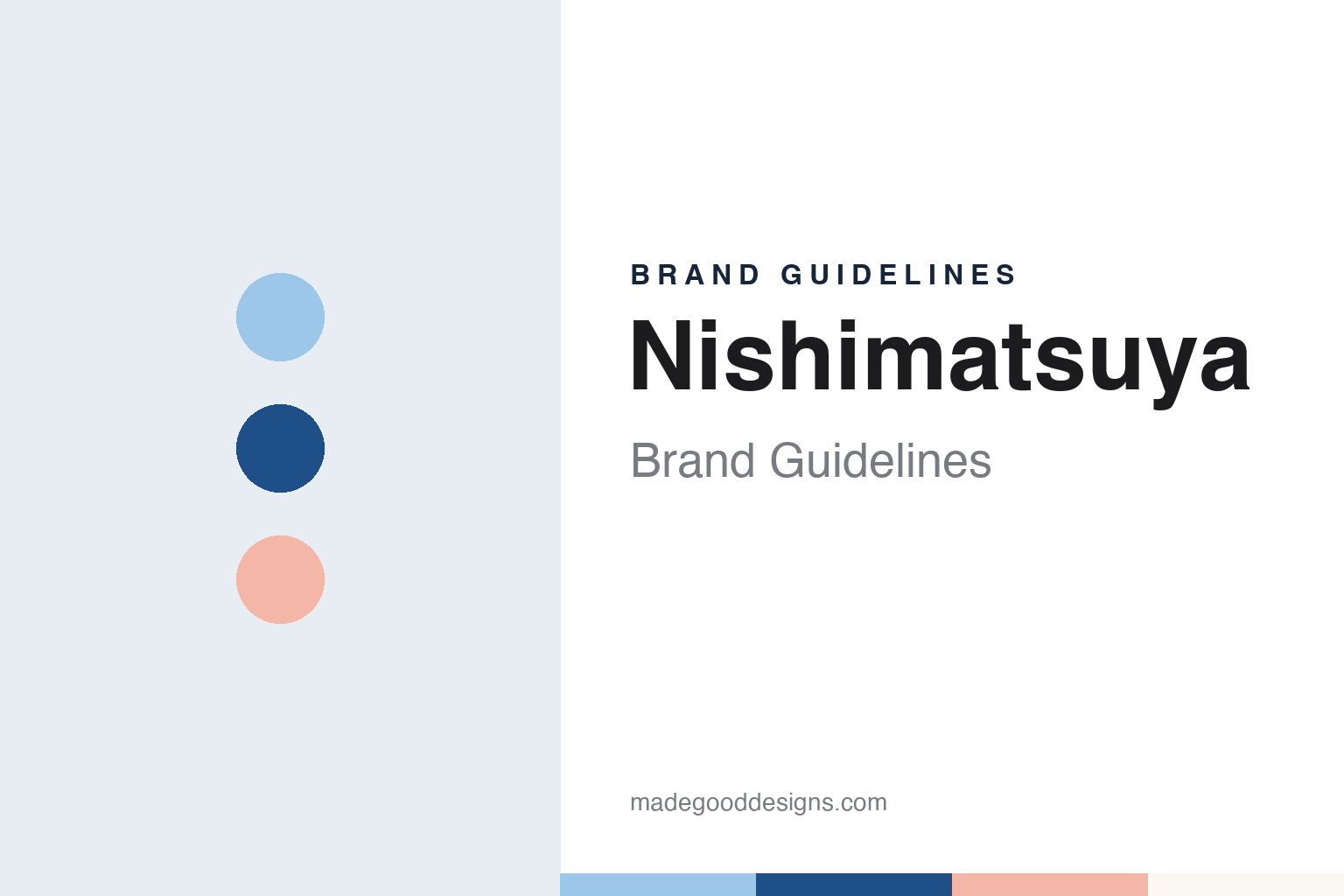
Nishimatsuya Brand Guidelines
The Himeji baby-goods chain that keeps its aisles wide and its own brands front and centre.
Aa
Two constants: a nursery blue, deep cradle blue and soft peach palette and a rounded sans register. Abstract homage — not a Nishimatsuya product or mark; no sign, logo or own-brand pack is reproduced.
A Shop for Shrine-Visit Robes
A kimono family’s baby shop in Himeji.
Nishimatsuya began in Himeji, in Hyogo Prefecture, as a sideline of a kimono business. Japanese Wikipedia says the kimono shop Kimono no Nishimatsuya was set up in 1950, and that in October 1956 it created a separate company for babies. The chain’s own history names that company Akachan no Nishimatsuya (“Nishimatsuya for babies”) and says it was founded by its present honorary chairman and his mother to sell omiyamairi robes — the outfits for a newborn’s first shrine visit — and supplies for a birth. Its first shop stood on Otemae-dori in Himeji.
The name changed as the business grew. The company became Nishimatsuya Store in March 1959, added children’s clothing in October 1965, opened in Osaka in November 1971 and took the name Nishimatsuya Chain in August 1979, the company says; the present spelling of the Japanese name dates from May 1997. In October 1979 it opened a suburban store with its own car park in Himeji, and in April 1988 a large suburban store in Kobe. Japanese Wikipedia says the chain traded only in Hyogo and Osaka until the end of the 1980s and grew quickly from the 1990s.
The kimono shop is still a separate business. Japanese Wikipedia says it keeps branches in Himeji, Kobe, Akashi, Kakogawa, Takasago and Tsuyama, and the website at nishimatsuya.co.jp belongs to that kimono and furisode shop, not to the baby-goods chain, whose own site is 24028.jp.
Colour
Wide aisles, few staff and two own brands.
The chain’s spread was steady and is well documented by the company. It reached Shikoku and the Kanto region in May 1997, Kyushu in 1998, the Chubu region in 1999, Tohoku in 2001 and Hokkaido in 2003; with stores in Okinawa in April 2004 it had a branch in all 47 prefectures. In December 2018 it reached 1,000 stores. The Kobe Shimbun reported the same milestone in June 2022, in a profile of the current president, Koichi Omura, who joined the company in 2014 and became head of the president’s office in January 2019, about a month after the thousandth store opened.
Japanese Wikipedia describes the store model under a nickname, garagara keiei — roughly “running empty stores.” It says the chain avoids sites on main roads, uses no mannequins or sale bins, keeps wide aisles for self-service and staffs a store with about two people; white reaching poles let shoppers lift goods down from high shelves, and when a store gets busy, a new one opens nearby to spread the crowd. The company’s overseas site describes its range in plainer terms: apparel such as pyjamas and underwear, consumables such as nappies and wet wipes, and baby items from pushchairs and bouncers to junior car seats.
Much of that range is sold under the chain’s own labels. Japanese Wikipedia names ELFINDOLL for clothing and SmartAngel for goods, a split also given by the Taiwanese business daily Commercial Times in April 2026, which said the company leads the planning, choice of materials and production for both. Clothing runs from newborn sizes to 150 cm, with some lines to 160 cm, Japanese Wikipedia says. The chain opened its own online store in November 2021.
Its advertising also grew from a regional base. Japanese Wikipedia says the chain’s television commercials first ran only on Osaka stations and on Sun TV, the Kobe broadcaster, before going national as the stores spread, and that since April 2018 it has sponsored the long-running animated series Sazae-san on Fuji TV, with a break in 2025.
The shares followed the stores. The company registered its shares for over-the-counter trading in July 1997, listed on the second sections of the Tokyo and Osaka exchanges in November 1999, moved to their first sections in February 2001 and, after the Tokyo exchange’s 2022 reorganisation, to the Prime Market in April 2022.
Typography
Discount stores, baby shops and drugstores.
Japan’s discount stores, value-apparel chains and drugstores tend to present themselves above all through the shop floor. At Don Quijote, Japanese Wikipedia describes a method called “compressed display,” with goods packed in so tightly that the store becomes half a maze, and price cards written by hand: each store employs its own POP writers, whose lettering the chain calls Donki moji. In these chains the sign on the shelf often does more identity work than the logo above the door.
Own-brand ranges are the second layer. Large groups sell their own lines under names that sit alongside the store name rather than replacing it; Pan Pacific International Holdings, the parent of Don Quijote, lists ranges such as Jonetsu Kakaku, launched in 2009, and EDRP, whose packs are printed in black and white to cut costs. Mascots work in the same way. Don Quijote’s penguin, Donpen, dates from 1998, and in 2021 the company set rules for how the character may appear in signs and illustrations.
Store names are usually plain. Some come from a founding family or an older family shop, others from a borrowed idea: the Don Quijote name comes from Cervantes’s novel, according to a company FAQ quoted by Unseen Japan in 2022. Many chains also run a second name for a format or a market, such as Don Don Donki for stores outside Japan.
Behind the stores sit corporate websites that set out founders, parent groups, timelines and stock-exchange listings, often in both Japanese and English. This guide uses those pages for dated company facts, adds encyclopaedia and press sources where they exist, and describes each chain only by what it sells, how its stores look and who owns it, with no claims about the products themselves.
Aa
A rounded sans — soft, clear lettering for a nursery-goods chain. (Specimen set in M PLUS Rounded 1c, a sans STAND-IN; NOT the Nishimatsuya logo.)
Nishimatsuya
From Himeji to Tainan.
The chain’s store count is published by the company. Its history page gave 1,181 stores as of 20 February 2026, spread from Hokkaido to Okinawa, with the Kanto region the largest group at 333 and the Kinki region, its home area, next at 219. The Kobe Shimbun reported in April 2026 that the number of stores had risen by 36 over the year to February 2026.
Earlier moves abroad were brief. Japanese Wikipedia says Nishimatsuya opened two test stores in South Korea in 2012 and withdrew in 2013. The company says it started an overseas business in 2019 built mainly on wholesale of its own-brand goods to other firms, and its overseas site lists trading partners in countries from Australia to Vietnam. In June 2025 it set up a wholly owned subsidiary in Taipei to run stores in Taiwan. On 20 March 2026 that business opened its first store at Mitsui Outlet Park Tainan, the Commercial Times reported, describing it as the company’s first directly run store outside Japan. In August 2026 the Taiwanese outlet Storm Media reported a Taipei store at Breeze Nanjing, which it counted as the fifth in Taiwan after Tainan, Taichung, Taoyuan and Linkou.
For a design guide, Nishimatsuya shows how a chain can make its store layout the message: wide, quiet aisles, a short list of own brands and a name carried over from a kimono shop. Compare Uniqlo, another Japanese clothing chain built on its own label, and Daiso, a Japanese variety-goods chain. For this guide we use a nursery blue, a deep cradle blue and a soft peach with a rounded sans, an unofficial interpretation; no product or logo is reproduced.
Explore & save
Keep Nishimatsuya’s identity on hand — save it to a board in the Made Good inspiration library.
Nishimatsuya identity set
Pin the Nishimatsuya nursery blue, deep cradle blue and soft peach palette and the rounded sans register to your own board.