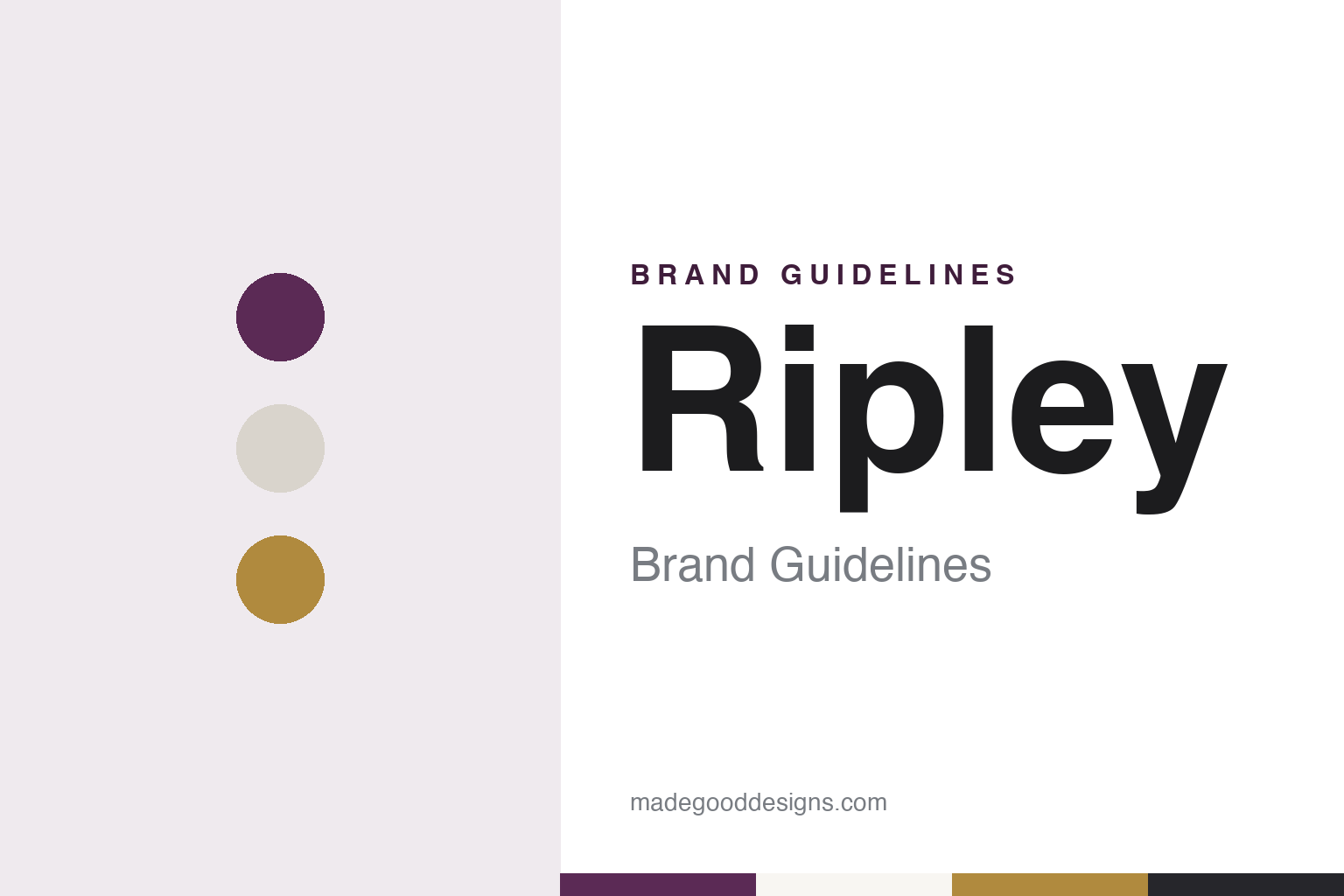
Ripley Brand Guidelines
A 1956 menswear business in Santiago that became a Chile and Peru department store.
Aa
Two constants: a plum, charcoal and brass palette and a shopfront serif register. Abstract homage — not a Ripley product or mark; no logo, sign or store design is reproduced.
Confecciones Calderón
A family menswear business in Santiago.
Ripley began in Santiago in 1956 as a clothing business run by the Calderón family. Diario Financiero reported in July 2016 that the company was founded by Alberto Calderón Crispín together with his brother, and that in 1956 they opened the first Calderón Confecciones. The retail trade site Perú Retail, in a September 2026 history marking the company’s 70 years, credits Marcelo Calderón with starting Confecciones Calderón, a business that made and sold menswear. Spanish Wikipedia names the owners simply as the Calderón brothers.
The Ripley name came later. Perú Retail says the first store called Ripley opened in central Santiago in 1964, and that in 1985 the company moved to a department-store format; Spanish Wikipedia places that first multi-department store, a multitienda, on calle San Diego in 1985, and the first store outside Santiago in Concepción in 1986.
The move into shopping centres followed. In 1993 Ripley opened at Parque Arauco, in Santiago’s eastern districts, its first store inside a mall; Perú Retail says that opening came with a thorough change of image and a rebranding. Four years later the company crossed the border into Peru.
For almost half a century Ripley was privately held. Spanish Wikipedia says it remained a closed company until 2005, when its shares began trading on the Bolsa de Comercio de Santiago, and Diario Financiero also dates the stock-market listing to 2005. The same year, Perú Retail says, the company opened an office in Hong Kong to work with suppliers and to support shipments from Asia to Chile and Peru.
Colour
Lima, and a short stay in Colombia.
Peru has been Ripley’s second home market since 1997, when it opened a store at the Jockey Plaza shopping centre in Lima, according to Spanish Wikipedia and Perú Retail. Spanish Wikipedia dates its first store outside Lima to 2006, at the Mall Aventura Plaza in Trujillo, and Perú Retail adds later stores in cities including Chiclayo, Arequipa and Piura. As of September 2026, Perú Retail said, the company had about 30 stores across 12 regions of Peru.
The Peruvian business also tried a second format. Spanish Wikipedia says that in 2002 Ripley opened a store called Max at the Megaplaza centre in northern Lima, aimed at a more popular market; only three Max stores were opened, and they closed in June 2019, apart from the Megaplaza store, which became a smaller, single-floor Ripley. In Peru the company also develops shopping centres under the Mall Aventura name, Spanish Wikipedia and Perú Retail say.
Colombia was a shorter chapter. Spanish Wikipedia says Ripley announced its entry in 2012 and opened its first Colombian store in April 2013, at the Cacique shopping centre in Bucaramanga, followed by stores in Bogotá. In February 2016 the company announced that it would leave the country. Perú Retail reported on 24 February 2016 that, according to a document the company sent to customers, its stores at the Centro Mayor centre in Bogotá, in Bucaramanga and in Medellín would close on 19 March, those in Villavicencio and Neiva on 18 April, and the department store at the Calima centre in Bogotá on 18 May 2016. Since then Chile and Peru have been its two markets, Perú Retail said in 2026.
On the shop floor, Perú Retail names the in-house labels Index, Marquis and Barbados among the clothing and footwear brands the company has developed, and Spanish Wikipedia lists promotional events such as “Días R” and “48 Horas” among its long-running sales campaigns.
Typography
Department stores in Mexico and Chile.
The department stores of Mexico and Chile are big, city-centre and shopping-mall businesses, and their identities are carried as much by buildings as by logos. Two of the oldest, Liverpool and El Palacio de Hierro, began as nineteenth-century clothing and fabric shops in the historic centre of Mexico City, and Liverpool’s corporate history page still traces the chain back to that first shop of 1847 and lists, year by year, its moves into shopping centres and other cities.
Store naming is often plain description or a borrowed place. El Palacio de Hierro, according to English Wikipedia, took its name from the iron-and-steel building that rose in the 1880s; Liverpool, Spanish Wikipedia says, was named after the English port its imported goods were shipped from. Branches then take the name of the district or mall they anchor, so a shopper meets the brand as “Liverpool Insurgentes” or “Liverpool Polanco,” and Spanish Wikipedia writes of “Palacio Polanco.”
The flagship façade does a great deal of the work. Downtown stores keep their early buildings, and newer flagships are built as architecture in their own right — El Palacio de Hierro’s Polanco store, reopened in 2015, has floors themed on districts of the city. Seasonal campaigns are just as visible: El Financiero has described Liverpool’s recurring Venta Nocturna sales, held over two or three days several times a year, and the Christmas tree that El Palacio de Hierro raises in front of its Polanco store with a luxury partner: Dior in 2025 and Swarovski in 2026.
Store cards carrying the chain’s name are part of the picture too: El Financiero notes that Liverpool pitches some sale offers to its own cardholders, though this guide does not describe the credit products themselves. Corporate pages also set out owners and listings: both Mexican groups have long been listed on the Mexican Stock Exchange, and Liverpool’s investor site carries its annual and quarterly reports beside a year-by-year history.
Aa
A shopfront serif for a 1964 store name. (Specimen set in Fraunces, a serif STAND-IN; NOT the Ripley logo.)
Ripley
A family company and a deal that ended.
Ripley has stayed under the control of the founding family. In July 2016 Diario Financiero reported that the Calderón Volochinsky branch of the family held 53 per cent of the company and had reached an agreement for the Mexican department-store group El Puerto de Liverpool to join its ownership: the family would keep its stake, and Liverpool would launch a public tender offer for the remaining shares.
That offer never began. In a filing to the Mexican stock exchange dated 19 May 2017, Liverpool said that the association agreement in Ripley Corp, announced on 5 July 2016, had been ended by mutual agreement with Ripley’s controlling companies. The deadline for launching the tender offer had already been extended twice, most recently to June 2017, and the filing cited changes in the economic conditions of the countries and markets in which both companies operate. Liverpool added that it would keep a close relationship with Ripley’s controlling shareholders.
The 2016 agreement also came a few months after the Colombian exit, which Diario Financiero noted in the same report: Ripley had left Colombia about two years after starting there. In the years since, the company has concentrated on department stores, online selling and shopping centres in Chile and Peru, Perú Retail said in its 2026 history.
The name itself carries the history. A family business that began under the Calderón surname was renamed Ripley in 1964, a rebranding accompanied the move into malls in 1993, according to Perú Retail, and the same name now appears over department stores in Chile and Peru.
For a design guide, Ripley shows how a store name chosen in the 1960s can outlast changes of format, from a menswear shop to a multi-department store and a mall anchor. Compare Falabella, the Santiago department store that also trades in Peru, and Liverpool, the Mexican group whose 2016 agreement with Ripley ended in 2017. For this guide we use plum, charcoal and brass with a serif, an unofficial interpretation; no product or logo is reproduced.
Explore & save
Keep Ripley’s identity on hand — save it to a board in the Made Good inspiration library.
Ripley identity set
Pin the Ripley plum, charcoal and brass palette and the shopfront serif register to your own board.