Truworths Brand Guidelines
The Cape Town fashion house that sells a family of labels under one roof.
Aa
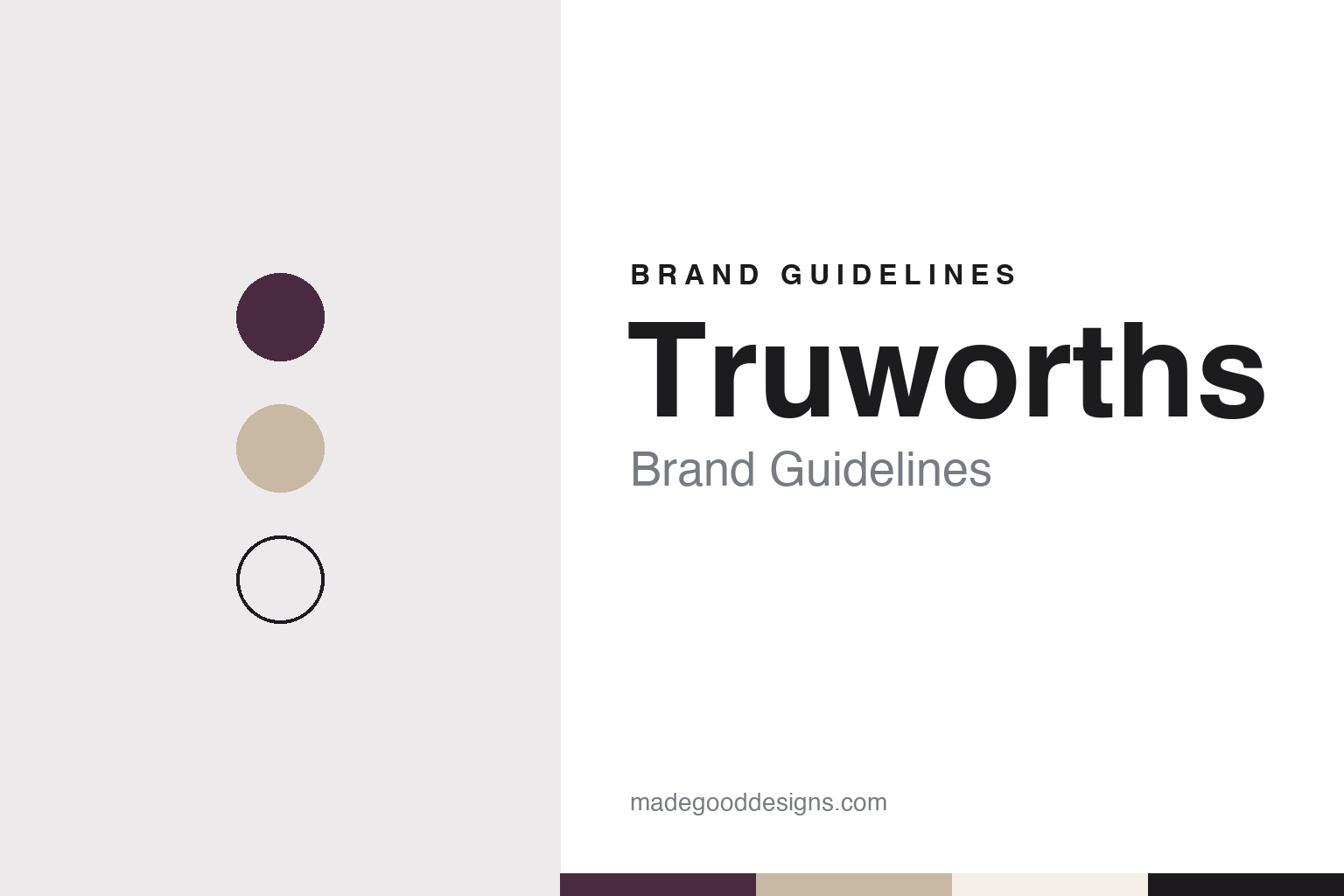
Two constants: a deep plum, warm stone and ivory palette and a fashion serif register. Abstract homage — not a Truworths product or mark; no logo, store fascia or garment is reproduced.
The Alliance Trading Company
A 1917 trading company that became a fashion chain.
Truworths is a South African clothing and footwear retailer based in Cape Town. Its listed parent, Truworths International Ltd, describes itself in its 2025 integrated report as an investment holding and management company with two main operating businesses: Truworths Ltd, trading in South Africa and the wider region, and Office Holdings Ltd, trading mainly in the United Kingdom. The shares are listed on the JSE in Johannesburg, on the Namibian Stock Exchange and on A2X Markets, the company says.
The business dates from 1917, when it was set up as The Alliance Trading Company. According to the company’s own history, which English Wikipedia follows, it was renamed Truworths Fashion House and then, in 1940, Truworths Ltd. The company says the chain had reached 80 stores across the country by the 1950s, and that by the late 1970s it had 280 of what it calls “specialised boutique stores.” By the turn of the century, it says, the footprint stood at 246 stores.
Store credit has been part of the model for most of that history. Truworths says it introduced customer accounts in 1955, and its 2025 report gives account management a section of its own, next to the brands, the supply chain and the stores. English Wikipedia, citing company figures, gives 2.9 million active account holders in 2024.
The name on the door has stayed the same for more than eight decades, while the business behind it has grown into a group of labels, store formats and, since 2015, a British footwear chain.
Colour
In-house labels under one fascia.
Truworths is less a single label than a stable of in-house brands sold under one store name. The company names Truworths and Truworths Man, launched in 1988, as its core brands, supported by labels it developed itself, among them Inwear (1986), LTD (1992), Ginger Mary (2004) and Fuel (2021). Inside its stores, smaller sub-brands carry names such as Outback Red, Hemisphere and Finnigans.
The French designer label Daniel Hechter has been sold under an exclusive long-term licence since 1984, the company says. Identity, launched in 1999, is aimed at a younger, value-conscious shopper and trades from its own stand-alone stores; ID Kids followed in 2019, and the company counted 256 Identity stores at the end of June 2025.
Some brands were bought rather than built. The company lists Young Designers Emporium, known as YDE, acquired in 2003; the menswear brand Uzzi in 2006; the ladieswear brand Earthaddict and the kidswear brands Earthchild and Naartjie in 2015; and the homeware and linen retailer Loads of Living in 2017.
The store format matters as much as the labels. Truworths says it began opening large “emporium” stores in 2004, putting several brands, fashion concepts and lifestyles into one big shop, and it now also runs 146 Kids Emporiums for LTD Kids, Earthchild and Naartjie. Its 2025 report says each brand has a defined “look and feel,” and that these brand profiles guide both product design and the way each label is presented across stores, window displays and digital platforms. At the end of June 2025 it reported 810 stores in its African business, 33 of them outside South Africa, in Namibia, Botswana, Eswatini, Zambia and Lesotho.
The company says it keeps an in-house design division. In September 2022, Moneyweb reported that Truworths had signed to house a new distribution centre at the King Air Industria development, within two kilometres of Cape Town International Airport; the company says the 52,000-square-metre centre began a phased go-live in November 2024.
Typography
How South African retailers present themselves.
South African retailers meet most of their customers in shopping centres, high streets and filling-station forecourts, so the store fascia does much of the identity work. A single group often runs several formats under related names, from large food halls and hypermarkets to small convenience shops and standalone clothing or liquor stores, and the name above the door usually tells the shopper which format they have walked into.
Own-label ranges carry the brand inside the store. Grocers and fashion chains sell food, clothing and homeware under their own names or under house labels, so the same letters, colours and type appear on shelf tickets, packaging, carrier bags and staff uniforms as well as on the shopfront. Loyalty cards and store cards extend that identity into wallets and phone apps.
Campaign graphics follow the retail calendar. Weekly specials, seasonal catalogues and back-to-school, holiday and sporting promotions are published in print, in store and online, and the companies’ own websites keep many of those leaflets and campaign pages available to browse. For a designer, these are the plainest record of how a chain uses its palette and type at speed.
The corporate side is just as public. Many of the large South African chains are listed on the JSE, and their investor websites publish annual reports, results presentations and history pages that name founders, parent groups, acquisitions and listing dates. Store counts and country lists in those reports are dated to a financial year, so they describe the business at that moment rather than for all time.
Aa
A high-contrast fashion serif — the register of a mall fashion house. (Specimen set in Playfair Display, a serif STAND-IN; NOT the Truworths logo.)
Truworths and Office
A Cape Town retailer with a London footwear chain.
Truworths moved beyond southern Africa in 2015. On 30 November that year, FashionUnited reported that the private equity firm Silverfleet Capital had agreed to sell Office, the British fashion footwear chain founded in 1981, to Truworths International, which would hold 88.9 per cent, with the Office management team keeping the rest; the deal needed approval from the South African Reserve Bank, and the trade paper described it as Truworths’ first move into Europe. The Guardian reported in March 2016 that Truworths had bought Office the previous December.
Office sells footwear from third-party brands rather than in-house labels, and at the end of June 2025 Truworths counted 87 Office and Offspring stores and concessions in the United Kingdom and Ireland. Since 2017 the chain has also traded in South Africa as Office London, selling branded athleisure and fashion footwear, the company says.
At the top, Moneyweb noted in August 2026 that chief executive Michael Mark had led the company for 38 years, and that in 2022, as part of a succession plan, Sarah Proudfoot and Emanuel Cristaudo became joint deputy chief executives.
Visually, the company presents Truworths through its stores more than through any single emblem. Its report describes the aim of placing its emporiums in the centre of the “fashion courts” of large malls, with each label inside keeping its own look.
For a design guide, Truworths shows how one retailer can run a whole family of labels under a single store name. Compare Foschini, another Cape Town fashion business that grew from a single chain into a group, and Edgars, another South African clothing retailer. For this guide we use a deep plum, warm stone and ivory with a serif, an unofficial interpretation; no product or logo is reproduced.
Explore & save
Keep Truworths’s identity on hand — save it to a board in the Made Good inspiration library.
Truworths identity set
Pin the Truworths deep plum, warm stone and ivory palette and the fashion serif register to your own board.