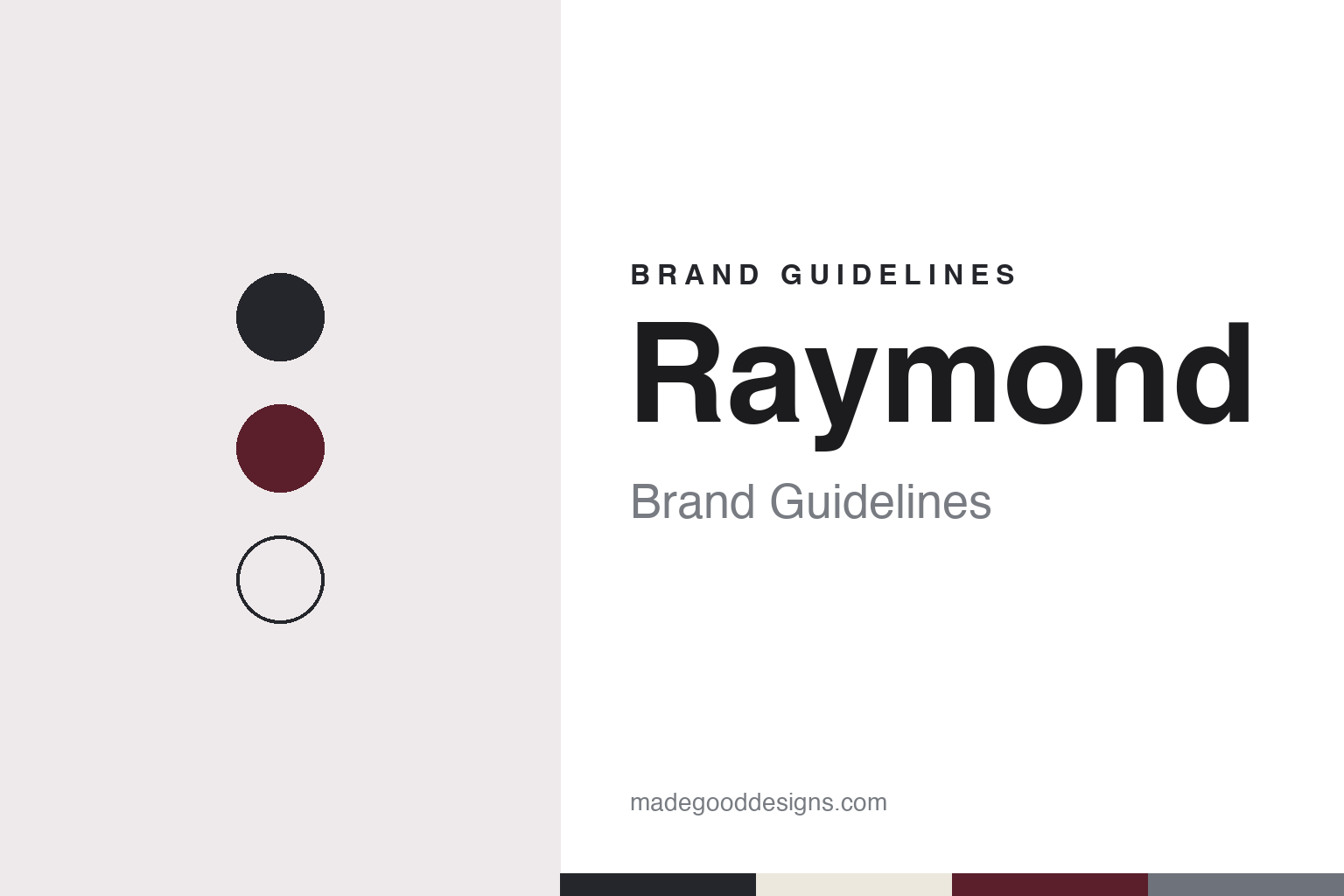
Raymond Brand Guidelines
The Thane woollen mill of 1925 behind India’s suiting name.
Aa
Two constants: a charcoal, wine and ivory palette and a tailored serif register. Abstract homage — not a Raymond product or mark; no fabric, logo or shop sign is reproduced.
A mill on Thane Creek
From woollen blankets to worsted suiting.
Raymond began as a woollen mill on the creek at Thane, near Bombay, the city now called Mumbai. The International Directory of Company Histories traces it to the Wadia Woollen Mill, set up there early in the twentieth century and later bought by the Sassoon family of Bombay, who reincorporated the business as Raymond Woollen Mill in 1925. English Wikipedia instead says the mill was incorporated in 1925 by Albert Raymond and Abraham Jacob Raymond, and a 2025 centenary feature in The Textile Magazine credits Albert Raymond alone; the accounts agree on the year and the place. In those early years, the Directory says, the mill made coarse woollen blankets and small amounts of low-priced wool cloth.
In 1944 the Singhania family’s J.K. Group, an industrial group built up around Kanpur with interests in chemicals and textile dyes, bought the mill and kept its name. The Directory names Kailashpat Singhania as the family member who led the purchase and who then set out to move the mill beyond cheap blankets. Through the 1950s the company invested in machinery, new wool grades and new colours, and set up its own research work on wool-based cloth. The first result, in 1958, was Terool, a wool-blended yarn. The same year Raymond opened its first shop, King’s Corner, in the J.K. Building at Ballard Estate in Mumbai.
The fabrics that followed built the name. Trovine, a lightweight wool blend meant to make wool wearable through the Indian summer, arrived in 1968 according to the Directory; English Wikipedia gives 1967. The company founded Raymond Apparel in 1969 to make finished clothing, began building a worsted mill at Jalgaon in Maharashtra in 1979 and added a third mill at Chhindwara, in Madhya Pradesh, in 1992. New cloth ranges kept coming: Lineage, a superfine pure wool, in 1995; Renaissance, mixing merino with polyester and other fibres, in 1996; and the Chairman’s Collection of fine cashmere and merino blends in 1999. By 2003 and 2004, the Directory says, the mills could weave the very fine Super 210s and Super 220s wool grades.
Colour
Shops, labels and a run of menswear campaigns.
Raymond sold cloth to the public through its own shops. After King’s Corner, the shops took the name Raymond Shops, the Directory says, and by the mid-2000s there were more than 320 of them in more than 150 Indian cities. The first Raymond shop outside India opened in Oman in 1990, a date English Wikipedia and the Directory share.
The clothing labels came in stages. Park Avenue arrived in 1985 as a formalwear line of suits, jackets, trousers, shirts and knitwear, and widened to ready-to-wear business clothing in 1986. Parx, a casualwear label that included denim, followed in 1999. In 2002 the company opened the first of its Be stores for Indian designer clothing; by 2005 there were 16. It bought the casualwear brand ColorPlus in 2003, according to the Directory — English Wikipedia says 2002 — and in 2005 opened a showroom in New Delhi for Manzoni, a new luxury label.
Its advertising changed with the decades, and the Directory sets out the sequence. In the 1950s and into the 1960s the campaigns used a “Chess King” motif aimed at upwardly mobile buyers. In the 1960s and 1970s they moved to an “ordinary man” character. The 1980s brought a “Guide to the well dressed male”, and the 1990s and 2000s “The Complete Man”. The phrase stayed with the group: the 2025 centenary feature in The Textile Magazine, which carries a message from the group’s executive chairman, still uses it to describe the brand’s positioning.
For a while the parent company spread well beyond cloth. Under Vijaypat Singhania, who formally took charge in 1980, it entered cement, files and tools, car components and, through a 1995 technical partnership with Allegheny Ludlum of the United States, steel; in 1996 it set up an air-charter business, Million Air. When Gautam Hari Singhania took over in 2000, the Directory says, the company sold most of these side businesses, including cement and, in 2002, steel, to concentrate on textiles and clothing.
Typography
Indian fashion and lifestyle brands.
Indian fashion and lifestyle brands tend to present themselves through what they make for particular moments. Ethnic-wear labels sort their ranges by garment, from kurtas, suit sets and sarees to sherwanis and lehengas, and by occasion, from festivals and office days to the separate ceremonies of a wedding. Western-wear and suiting labels lean instead on fabric, fit and the working week, and many companies now sell both kinds of clothing side by side.
Ownership is part of the story. Several names sit inside larger listed or private groups, such as Aditya Birla Fashion and Retail, Vedant Fashions, TCNS Clothing and Raymond, while others remain founder-run or family-run companies that have taken outside investors. Corporate and investor pages are usually the plainest record of this: they set out founders, subsidiaries, stock-exchange listings and the dates on which a label was launched, bought or merged, and those pages are a sensible place to start when tracing who owns a brand today.
Visual identity is mostly carried by the stores and the campaigns rather than by published brand manuals. Exclusive brand outlets in malls and high streets, shop-in-shops in department stores, cricket sponsorships, cinema spots and celebrity ambassadors do much of the work, and a company’s logo is often seen first on a shopping bag, a jersey or a billboard. Colour palettes and typefaces are seldom documented in public.
This guide follows that record. It sets out founding dates, owners and listings as the companies and dated press reports give them, names collections and campaigns only where a source names them, and treats the colours and type shown here as an unofficial interpretation rather than a brand standard.
Aa
A tailored serif for a suiting name. (Specimen set in Cormorant Garamond, a serif STAND-IN; NOT the Raymond logo.)
Raymond today
One name, split across listed companies.
Between 2023 and 2025 the group took itself apart into separate businesses. In April 2023, Business Today reported, Godrej Consumer Products agreed to buy the FMCG business of Raymond Consumer Care through a slump sale, taking the KamaSutra, KS and Premium marks and the Park Avenue trademark “for the FMCG category”, a business mainly in deodorants; Bar & Bench reported in May 2023 that Godrej had acquired the business.
The clothing and fabric side came next. Raymond shares traded without the lifestyle business from 11 July 2024, the record date for the demerger, with four shares of the new company for every five Raymond shares, Business Today reported. Raymond Lifestyle Limited, holding the retail and lifestyle division, listed on the Indian exchanges on 5 September 2024. The Raymond board had approved a further scheme on 4 July 2024 to place the real-estate business in a separate company, Raymond Realty; Outlook Business reported in June 2025 that this demerger had taken effect on 1 May 2025, leaving the group with three lines of business: lifestyle, real estate and engineering.
Besides Raymond itself, English Wikipedia lists group clothing names including Raymond Made to Measure, Parx, Ethnix and ColorPlus, sold through The Raymond Shop. The Raymond name on suiting belongs to this Indian company and is separate from the American lift-truck maker Raymond and from the Swiss watch house Raymond Weil, two unrelated businesses that share the word.
For a design guide, Raymond shows how a fabric maker can turn a mill name into a menswear label carried by its own shops and a long run of campaigns. Compare Peter England and Allen Solly, two other menswear names sold across India. For this guide we use charcoal, a deep wine and ivory with a serif, an unofficial interpretation; no product or logo is reproduced.
Explore & save
Keep Raymond’s identity on hand — save it to a board in the Made Good inspiration library.
Raymond identity set
Pin the Raymond charcoal, wine and ivory palette and the tailored serif register to your own board.
Source & notes
Frequently Asked Questions
What font can I use to match the Raymond look?
This guide describes Raymond’s type as “A tailored serif for a suiting name”. Its type specimen is set in Cormorant Garamond from Google Fonts as a stand-in; Cormorant Garamond is not Raymond’s own lettering.
What colours are in the Raymond palette?
This guide’s Raymond palette is Worsted charcoal #24262B, Mill wine #5A1F2B, Selvedge grey #6E737B, Ivory twill #EDE8DE and Shirting white #F7F5F0. The tones are the guide’s own unofficial interpretation, not official Raymond hex codes.
When was Raymond founded?
Raymond was founded in 1925 (as Raymond Woollen Mill), in Thane, near Mumbai, India.


