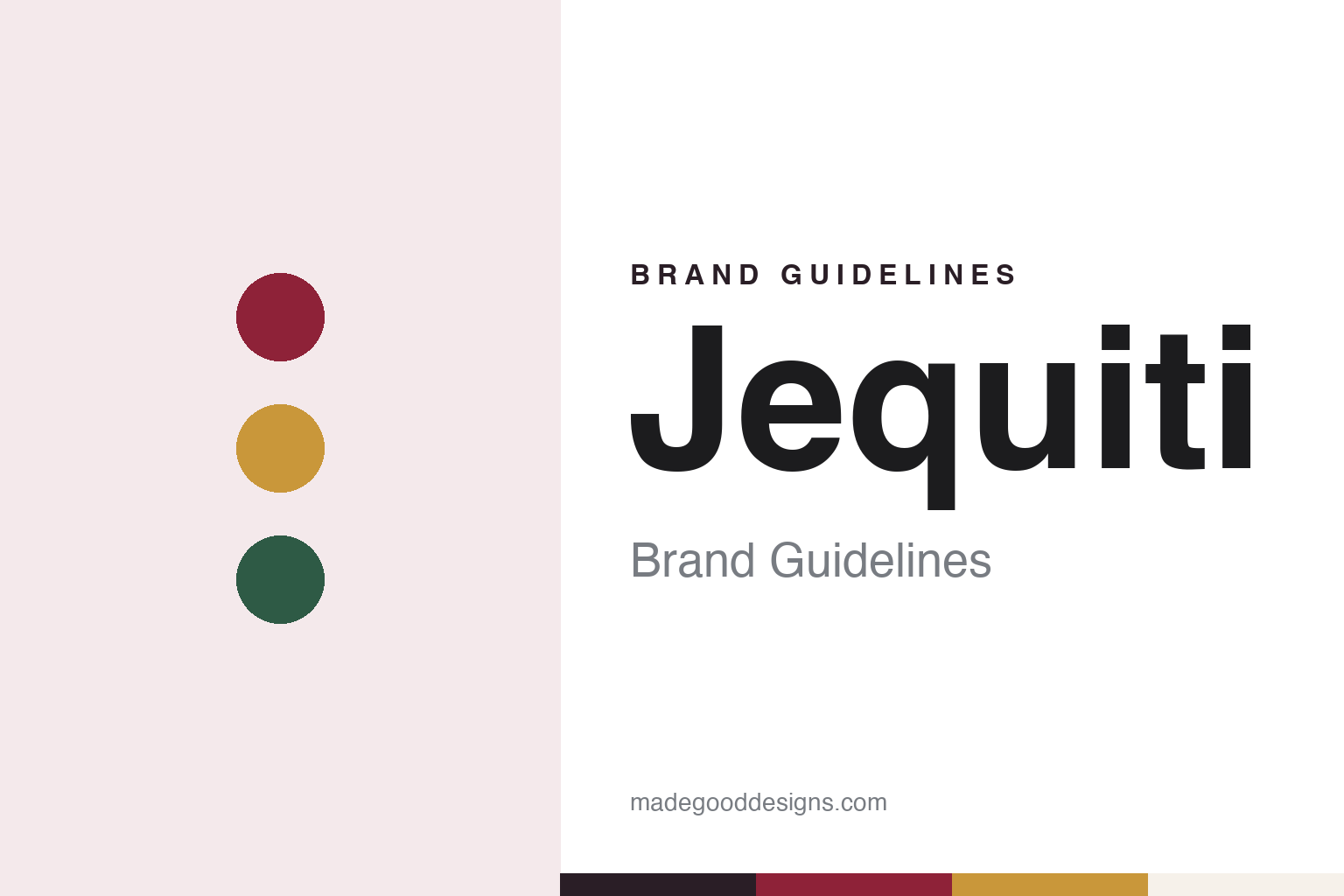
Jequiti Brand Guidelines
A cosmetics brand built inside a television group.
Aa
Two constants: a stage red, gold and green palette and a showtime serif register. Abstract homage — not a Jequiti product or mark; no pack, logo or programme set is reproduced.
A tree and a television group
Named after the jequitibá tree, launched in 2006.
Jequiti is a Brazilian cosmetics company owned by Grupo Silvio Santos, the business group founded by the television presenter and businessman Silvio Santos, whose holdings include the broadcaster SBT. Portuguese Wikipedia gives the launch date as 6 October 2006, names Silvio Santos as founder and places the head office in Osasco, in São Paulo state. In September 2017 the trade site Grandes Nomes da Propaganda described the brand as founded in 2006 by the SS group.
The name comes from a tree. Portuguese Wikipedia says it was inspired by the word jequitibá, the name of a tree, and Época Negócios reported in September 2017 that the company’s sales catalogue had long been called Colheita (“harvest”), a nod to the same tree.
From the start Jequiti sold through direct sales, with independent consultants taking orders from catalogues and online orders. Portuguese Wikipedia names Natura and O Boticário as its main competitors at launch and describes product lines for bath, body, face and hair, as well as perfumes. Época Negócios put the sales force at about 150,000 sellers in 2017 and noted that many consultants sold more than one brand at once; the head of the Brazilian direct-selling association told the magazine that winning consultants’ time was the sector’s main challenge.
The group’s television channel was part of the business from early on. Portuguese Wikipedia says SBT aired a Sunday programme about the products, Ganhe Mais Dinheiro com Jequiti, which left the air in May 2011, and that in September 2008 SBT began showing Roda a Roda Jequiti, a game show in which drawn customers and consultants of the brand can win prizes. Its presenters have included Rebeca Abravanel and Patrícia Abravanel, according to the same source.
Colour
Repositioned in 2017 around entertainment.
The brand’s present look dates from a repositioning in 2017. Época Negócios reported on 18 September 2017 that the work began after a 2016 report by the consultancy McKinsey found that the Jequiti name was widely known but not linked to any clear attributes. The company then hired a former communications director of Natura to build, in the magazine’s words, the first formal marketing strategy in its history; before that, campaigns had been made product by product.
The answer was to lean into the parent company. According to Época Negócios, the marketing team settled on the idea after visiting an exhibition about Silvio Santos at São Paulo’s Museu da Imagem e do Som early in 2017. The catalogue was renamed Jequiti Ao Vivo (“Jequiti Live”), sales cycles were renamed “episodes,” and familiar symbols of SBT programmes, such as the stage assistant Roque and the Porta da Esperança (“Door of Hope”), appeared on the catalogue cover. A new slogan tied the brand to dreams coming true.
Grandes Nomes da Propaganda reported on 25 September 2017 that the launch campaign was created by the agency BETC/Havas and built on three pillars the company named as cosmetics, entertainment and dreams. The same report said the campaign moved from a “popular” tone to a more “pop” one meant to reach younger buyers, and that it featured singers who sign Jequiti fragrances, including Anitta, Luan Santana and Ivete Sangalo, alongside consultants and staff.
The branding firm Ana Couto describes its part in its own case study: it says the design kept the brand’s handwritten wordmark, gave more weight to its typography, and drew a visual and verbal universe from television icons including the Door of Hope, the Roda a Roda wheel, backstage areas and sets, carried through a launch film and the product catalogue. Those are the agency’s descriptions of its own work.
Typography
Design and documentation.
The Brazilian beauty brands in this group introduce themselves through a small set of fixed elements: a short brand name, a plain wordmark, and named lines that run across perfume, make-up and body care, so that a fragrance family or a lipstick range can carry its own name under the house name. O Boticário took its name from the Portuguese word for an apothecary and began in 1977 as a compounding pharmacy in Curitiba; in 2026 one of its franchise shops was refitted with an interior modelled on the old boticas.
The way the products are sold shapes how the brands appear. Some grew through franchise shops and kiosks in shopping centres, others through direct sales, in which representatives order from a catalogue or a service centre and sell to their own customers, and most now combine shops, sellers and online stores. Campaigns follow the same channels, from television spots for Dia dos Namorados to launches timed to a fixed date such as the lipstick day on 29 July.
Group ownership is common, and this guide describes it plainly, by date. Grupo Boticário was formed as a holding company in 2010 and has since launched or bought brands including Eudora, Quem Disse, Berenice? and Vult. Where a brand has passed to another owner, including an international cosmetics group, the entry gives the owner and the date of the deal; where a brand remains independent, the guide says so only where a dated source does.
Each entry draws on corporate pages for founders, owners and franchise networks, and on dated independent press for anything beyond the company’s own word. Product lines are named as the companies publish them; the guide does not describe what the products do, and the palettes and typefaces shown are an unofficial interpretation rather than any brand’s own.
Aa
A warm, theatrical serif for a brand drawn from television. (Specimen set in DM Serif Display, a serif STAND-IN; NOT the Jequiti logo.)
Jequiti
From catalogues to shelves and kiosks.
Until 2019 Jequiti sold through direct sales and e-commerce. That began to change in December 2019, when Mercado&Consumo reported that the brand had agreed to sell perfumes, creams and gift kits through two fashion chains: 30 Pernambucanas stores, in a dedicated corner called Espaço Beleza with displays made for the category, and 216 Marisa stores in 22 states, from the end of 2019 and into 2020. The chief executive at the time told the publication that while everyone knew Jequiti, not everyone knew its products.
Mercado&Consumo reported on 8 December 2024 that in November 2024 the company had launched a sales app aimed at end customers. A year later, on 7 December 2025, the same publication reported the opening of the brand’s first two kiosks, at Shopping Grand Plaza in Santo André and Shopping Metrô Itaquera in the city of São Paulo, where visitors could sample fragrances and new launches.
In January 2026 the chief executive of Grupo Silvio Santos told IstoÉ Dinheiro that physical retail had started on a small scale at the end of 2024, that the two kiosks were run with a business partner, and that selected Jequiti products were also sold in Pernambucanas, Marisa and pharmacies. She said the consultant network remained central and was moving from printed catalogues to an app, with stores and pharmacy shelves meant to give buyers confidence to order from a neighbourhood consultant as well. The roles of each channel rest on what the company and its owner say.
For a design guide, Jequiti shows how a beauty brand can borrow an entire visual world from the media group that owns it, from game-show wheels to a renamed catalogue. Compare Natura, the direct-selling rival named at its launch, and O Boticário, the other rival Portuguese Wikipedia names. For this guide we use a stage red, a spotlight gold and a forest green with a serif, an unofficial interpretation; no product or logo is reproduced.
Explore & save
Keep Jequiti’s identity on hand — save it to a board in the Made Good inspiration library.
Jequiti identity set
Pin the Jequiti stage red, gold and green palette and the showtime serif register to your own board.
Source & notes
Frequently Asked Questions
What font can I use to match the Jequiti look?
This guide describes Jequiti’s type as “A warm, theatrical serif for a brand drawn from television”. Its type specimen is set in DM Serif Display from Google Fonts as a stand-in; DM Serif Display is not Jequiti’s own lettering.
What colours are in the Jequiti palette?
This guide’s Jequiti palette is Stage plum #2A1E26, Curtain red #8E2238, Spotlight gold #C9973A, Jequitibá green #2E5A45 and Programme paper #F6F1EA. The tones are the guide’s own unofficial interpretation, not official Jequiti hex codes.
When was Jequiti launched?
Jequiti was launched in October 2006, in Osasco, São Paulo state, Brazil.
Who owns Jequiti?
Jequiti is owned by Grupo Silvio Santos. Jequiti is known for Consultant sales, Roda a Roda Jequiti, fragrances.