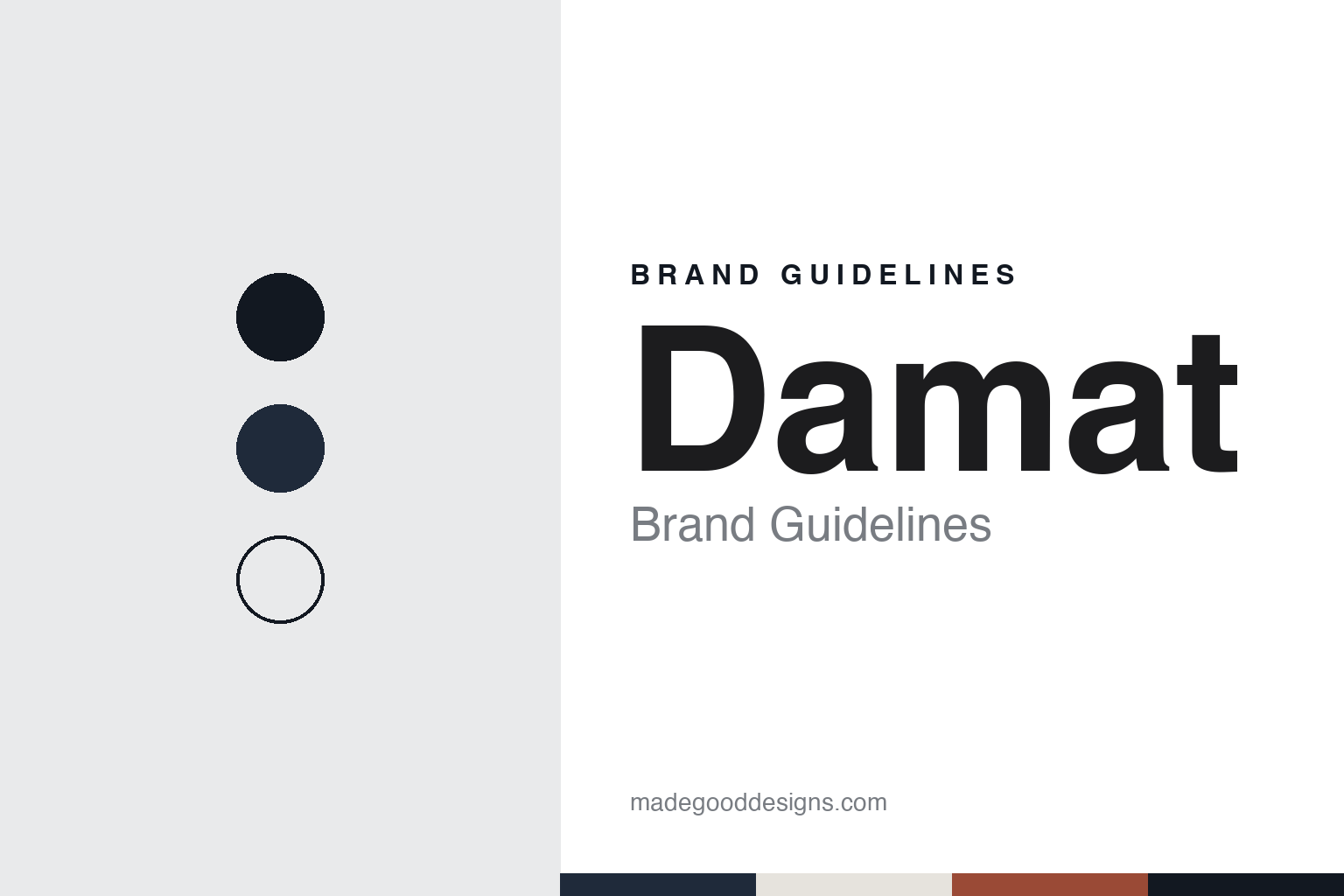
Damat Brand Guidelines
Orka’s 1986 Istanbul menswear name, sold with Tween.
Aa
Two constants: an ink blue, stone and brick palette and a geometric sans register. Abstract homage — not a Damat product or mark; no logo, label or garment is reproduced.
Orka, 1986
Two brothers and a menswear label.
Damat is the original label of Orka Holding, the Istanbul menswear group that also owns Tween and D’S Damat. Turkish Wikipedia says Orka Tekstil was founded in 1986 by Süleyman Orakçıoğlu and Halidun Orakçıoğlu as part of Orka Group, and the company’s own pages say it entered men’s ready-to-wear that year under the Damat name. Its online timeline opens in 1995 with the Damat brand in Osmanbey, in Istanbul’s Şişli district, and records that the firm took the name Orka Tekstil Sanayi ve Turizm Ticaret Anonim Şirketi in 2001, having started as a limited company.
The group built its range around three names. The company describes Damat in terms of quality fabrics and tailored style, says it then added Tween with what it calls original designs, and presents D’S Damat, its third label, as a range for a wider spread of sizes and budgets sold through a larger store network. In 2005 Hürriyet described the group as the maker of three labels, Damat, Tween and ADV, and stores of that period traded as Damat-Tween-ADV. Today, in stores and online, the first two are sold together as Damat Tween, while D’S Damat trades as a separate chain.
Turkish Wikipedia lists Tween stores in Spain, India, Dubai, Ukraine and Lebanon and showrooms in London, Moscow and the Benelux, and names trade fairs where the brands have shown, among them Pitti Immagine Uomo in Florence, CPD in Düsseldorf, Project in New York and Magic in Las Vegas. The company’s timeline adds its own dated steps: it says Tween was taken on by Harvey Nichols in London in 2008, that the label added a women’s collection in 2009, and that the same year it opened a single-brand Tween store in the Nişantaşı City’s mall.
Colour
Barcelona, Bucharest and beyond.
Damat went abroad early. In June 2005 Hürriyet reported that Orka’s general coordinator, Osman Arar, had opened a Damat-Tween-ADV store in Barcelona on 21 May through a franchise, bringing the count in Spain to seven and the total abroad to 43. In December 2010 the paper reported two openings in Bucharest at Baneasa Shopping City: a 200-square-metre Damat Tween store and, the next day, a 400-square-metre D’S Damat store.
In August 2013 Milliyet reported that Orka Holding had completed a two-year operational and legal audit by international firms, had its own companies in the UK, Spain, Romania and Poland and was setting one up in Russia, and that D’S Damat had become the official apparel sponsor of the Bucharest football club Dinamo. In December 2017 Anadolu Agency reported that the group had 160 stores abroad in 73 countries, 18 stores in Italy and a newly opened 350-square-metre D’S Damat flagship in Madrid. In the same interview the chairman said the group had entered Italy two years earlier, had opened a showroom in Milan and had opened two stores in Stuttgart in October 2017.
The same Milliyet report gives a snapshot of the group at that point. Osman Arar, by then Orka Holding’s general coordinator, said its stores abroad began in South Africa in 1995 and had reached 45 stores and 280 sales points in 37 countries, against 171 stores at home, 216 in all. He said the group had moved from franchising to directly operated stores abroad, with its own companies in the UK, Spain, Poland and Romania since 2008, and that it employed 1,890 people. Süleyman Orakçıoğlu told the paper that the strategic partnership with Investcorp, which Milliyet described as a Bahrain-origin, New York-based investment bank, had been agreed the previous year.
Ownership shifted twice. The company says its partnership with a foreign investor began in 2012, and Bloomberg HT reported on 30 May 2021 that Orka Holding had bought back the shares Investcorp held after Türkiye’s Competition Authority approved the transfer, leaving the group wholly Turkish-owned. In the statement reported that day, Orka’s chairman put the network at 431 stores in more than 80 countries and said the group had opened eight stores the previous year, in places including Poland, Nairobi, Tashkent and Bosnia.
Typography
Department-store and menswear identity in Türkiye.
Turkish fashion and menswear brands tend to present themselves through the things they make and the places they sell them. Tailored suits, shirts, knitwear, leather goods and womenswear lead the product pages, and many labels describe made-to-measure or ceremonial ranges, such as tuxedos for weddings, alongside everyday clothes. Product names and fabrics are usually given plainly, with the collection season as the main organising idea.
Retail format carries much of the identity. Some names began as department stores and now run several store formats under one roof, from full-line stores and single-brand boutiques to outlets and online shops. Others began as menswear makers and grew into chains of their own stores in shopping malls and on high streets. Flagship stores in Istanbul districts such as Nişantaşı and along the Bosphorus are often named in company histories, and the international shops, franchise partners and showrooms that companies publish give a sense of how far a label has travelled.
Group ownership is part of the picture and needs dated sources. Several labels sit inside holding companies: Boyner Group, built on the Altınyıldız textile business, runs department stores and menswear labels, while Orka Holding owns a family of menswear names. Ownership has changed over time through partnerships with foreign investors and later splits or buybacks, so the date of any ownership statement matters as much as the statement itself.
Corporate pages are the usual starting point for founders, owners and store counts. Company “about” and history pages give founding years, founders’ names and milestones in the company’s own words; national newspapers, news agencies and business press add dated reports on openings, partnerships and changes of control. For a designer, that mix explains why these identities often rest on a group name, a flagship address and a type of garment rather than on a single logo.
Aa
A clean geometric sans for a tailoring label. (Specimen set in Jost, a sans STAND-IN; NOT the Damat logo.)
Damat
Tailoring and the national teams.
Damat’s most visible tie in recent years is football. In March 2026 Damat Tween opened a joint store with Türkiye’s national football teams at the Turkish Football Federation’s training complex in Riva, Türkiye’de İş Dünyası reported. At the opening the federation’s president said Damat had been the national teams’ official fashion sponsor since 2017, supplying formal wear for referees, staff and representatives. The store sells team shirts and tracksuits alongside a capsule collection Damat Tween made for the national teams, as well as seasonal ranges.
The Damat Tween website shows how the label presents itself today. Its menus lead with suits, tuxedos for grooms and a made-to-measure service, then shirts, jackets, knitwear, shoes and accessories, and it now includes a women’s suit line and a national-team collection. The joint name runs across the site, the app and the stores.
For a design guide, Damat shows how a family menswear firm turns one tailoring name into a set of labels sold at home and abroad, with the founding brand still at the front of the shop sign. Compare Kiğılı, another Istanbul menswear chain, and Altınyıldız Classics, a menswear label from the Boyner side of Turkish textiles. For this guide we use an ink blue, stone grey and a brick red with a geometric sans, an unofficial interpretation; no product or logo is reproduced.
Explore & save
Keep Damat’s identity on hand — save it to a board in the Made Good inspiration library.
Damat identity set
Pin the Damat ink blue, stone and brick palette and the geometric sans register to your own board.
Source & notes
Frequently Asked Questions
What font can I use to match the Damat look?
This guide describes Damat’s type as “A clean geometric sans for a tailoring label”. Its type specimen is set in Jost from Google Fonts as a stand-in; Jost is not Damat’s own lettering.
What colours are in the Damat palette?
This guide’s Damat palette is Ink blue #1F2A3A, Charcoal #121821, Stone #E6E3DD, Brick #9A4A36 and Paper #F7F6F3. The tones are the guide’s own unofficial interpretation, not official Damat hex codes.
When was Damat founded?
Damat was founded in 1986, in Istanbul. Damat is known for Damat, Tween, D’S Damat.
Who founded Damat?
Damat was founded by Süleyman Orakçıoğlu and Halidun Orakçıoğlu in 1986.