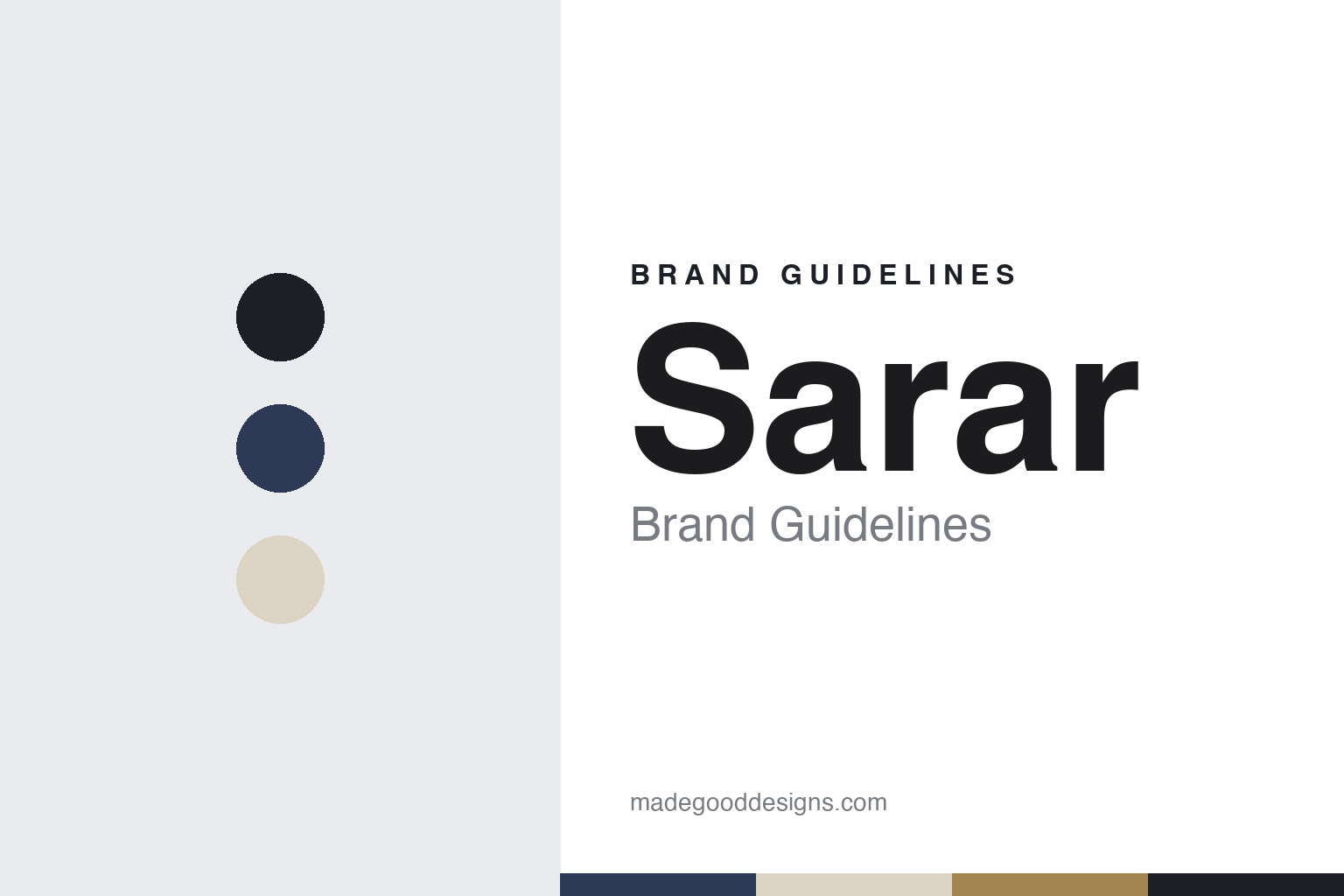
Sarar Brand Guidelines
A 1944 Eskişehir tailor’s shop that became a suit, shirt and home-textile group.
Aa
Two constants: a charcoal, ink blue and stone palette and a tailoring serif register. Abstract homage — not a Sarar product or mark; no garment, logo or label is reproduced.
A tailor’s shop in Eskişehir
From a twelve-square-metre shop to a factory town business.
Sarar began as a tailor’s shop in Eskişehir, the industrial city in north-west Turkey, in 1944. Turkish Wikipedia names the founder as Abdurrahman Sarar and says the business grew from that shop into home-textile and clothing factories built in the province. The company’s own history puts the size of the first shop at twelve square metres. Türkiye, the Istanbul daily, wrote in November 2026 that the firm founded by Hacı Abdurrahman Sarar grew in the following decades as a partnership of the brothers Cemalettin, Celaleddin and Sebahattin Sarar, and that the group today consists of seven companies and exports to 28 countries.
By the late 2000s Sarar was an industrial group. Capital, the Turkish business monthly, wrote in August 2008 that Cemalettin Sarar chaired the company and also served as president of the Eskişehir Chamber of Commerce, and that the group employed about 5,000 people. The magazine added that the group’s focus at that time was rapid growth of its own store network in Turkey and abroad. The company says its factories stand in the Eskişehir Organised Industrial Zone, where it makes Sarar and Sarev products and also carries out unbranded production for international textile and clothing brands.
Clothing is only part of the group. The company lists a car service business that it entered in 1997 with Toyota and has run for Renault and Dacia since 2016, an insurance agency founded in 1995, an IT sales and service business, fuel stations, a sports club founded in 1994 and the Sarar Bozüyük Outlet, a motorway rest stop and shopping centre that it says holds 91 shops. Para listed the group’s other interests in 2026 as automotive, energy, IT, insurance, real estate and tourism, and wrote that ready-to-wear has held a separate place in the group since its founding.
Colour
Suits first, then womenswear and the home.
The centre of the brand is tailoring. The company’s online shop is organised around men’s suits, tuxedos, shirts and jackets, with belts, wallets and casual shoes alongside and a children’s tuxedo range. Hürriyet summed up the brand in September 2005 as one that had made men’s suits for half a century, with its own patterns, fabrics and quality, and sold them at 41 points of sale across Turkey.
That Hürriyet article covered Sarar’s move into womenswear. A women’s label, Sarar Kadın, had been created the year before, led by a younger member of the founding family who had studied business in the United States, worked at the company for eight years and run its shirt factory for about three. The newspaper reported that a design team of eight, Turkish and foreign designers, coordinated the line; the autumn–winter collection that year ran to about 400 pieces on an aristocratic theme, with silk shirts and skirts printed with a matryoshka-doll motif. “We are really suit makers,” she told the paper, and the women’s collection was built heavily around suits as well. The newspaper noted that the fashion photographs for that collection were taken by Nihat Odabaşı, and that pieces were meant to move through the day: a work suit could become a cocktail outfit by taking off the jacket and adding a small fur collar. The label now trades as Sarar Woman, and the company’s shop lists women’s suits, evening dresses, shirts and skirts.
Home textiles sit under a second brand, Sarev, which the company says it has run since 2005 and which sells bedding sets and towels. In Turkey the group trades under several store names, including Sarar, Sarar Outlet and Sarev; the company’s own page gives 121 stores in Turkey and 16 in Europe, Asia and Africa. Para reported different overseas figures in September 2026: more than 120 stores in Turkey and 26 stores in 11 countries, among them Australia, Belgium, Azerbaijan and Turkmenistan.
Recent collections have used named collaborators. The company’s shop carries a range with the Turkish illustrator Robin Yayla, covering shirts, T-shirts, sweatshirts and suits, and a women’s capsule billed as Begüm Salihoğlu X SARAR, after the Turkish fashion designer, with jackets, dresses, trousers and capes. The brand writes its name in capitals, SARAR, across the shop and its collaboration titles.
Typography
Tailoring, retail and group ownership.
Turkish fashion and menswear brands tend to present themselves through the things they make and the places they sell them. Tailored suits, shirts, knitwear, leather goods and womenswear lead the product pages, and many labels describe made-to-measure or ceremonial ranges, such as tuxedos for weddings, alongside everyday clothes. Product names and fabrics are usually given plainly, with the collection season as the main organising idea.
Retail format carries much of the identity. Some names began as department stores and now run several store formats under one roof, from full-line stores and single-brand boutiques to outlets and online shops. Others began as menswear makers and grew into chains of their own stores in shopping malls and on high streets. Flagship stores in Istanbul districts such as Nişantaşı and along the Bosphorus are often named in company histories, and the international shops, franchise partners and showrooms that companies publish give a sense of how far a label has travelled.
Group ownership is part of the picture and needs dated sources. Several labels sit inside holding companies: Boyner Group, built on the Altınyıldız textile business, runs department stores and menswear labels, while Orka Holding owns a family of menswear names. Ownership has changed over time through partnerships with foreign investors and later splits or buybacks, so the date of any ownership statement matters as much as the statement itself.
Corporate pages are the usual starting point for founders, owners and store counts. Company “about” and history pages give founding years, founders’ names and milestones in the company’s own words; national newspapers, news agencies and business press add dated reports on openings, partnerships and changes of control. For a designer, that mix explains why these identities often rest on a group name, a flagship address and a type of garment rather than on a single logo.
Aa
A tailoring serif — the register of suits and shirts. (Specimen set in Playfair Display, a serif STAND-IN; NOT the Sarar logo.)
Sarar
A family group in its third generation.
Sarar remains a family business. Para introduced Sara Sarar in September 2026 as a member of the group’s third generation and a board member since 2018, responsible for brand strategy and for the Sarar Woman collections and home-textile lines. Turkish Wikipedia names Cemalettin Sarar as chairman of the board. The brand celebrated its 82nd year in 2026, according to Para, which described Sarar as one of Turkey’s long-established ready-to-wear names and noted that it now sells womenswear alongside its menswear.
Eskişehir stays central to the story. The founder’s shop, the factories in the organised industrial zone and the group’s outlet centre on the motorway at Bozüyük all sit in the same province, and the company still describes itself through that first tailor’s shop.
For a design guide, Sarar shows how a provincial tailoring business can carry one family name across men’s suits, womenswear and home textiles while keeping the tailor’s shop as its origin story. Compare Kiğılı, another Turkish menswear chain that grew out of a shop, and Altınyıldız Classics, a menswear name with textile-mill roots. For this guide we use charcoal, ink blue, stone and a brass accent with a serif, an unofficial interpretation; no product or logo is reproduced.
Explore & save
Keep Sarar’s identity on hand — save it to a board in the Made Good inspiration library.
Sarar identity set
Pin the Sarar charcoal, ink blue and stone palette and the tailoring serif register to your own board.
Source & notes
Frequently Asked Questions
What font can I use to match the Sarar look?
This guide describes Sarar’s type as “A tailoring serif — the register of suits and shirts”. Its type specimen is set in Playfair Display from Google Fonts as a stand-in; Playfair Display is not Sarar’s own lettering.
What colours are in the Sarar palette?
This guide’s Sarar palette is Suiting charcoal #1C1F26, Ink blue #2E3A55, Worsted stone #DCD3C4, Brass button #A3854F and Shirt white #F6F3EE. The tones are the guide’s own unofficial interpretation, not official Sarar hex codes.
When was Sarar founded?
Sarar was founded in 1944 (tailor’s shop), in Eskişehir, Turkey.
Who founded Sarar?
Sarar was founded by Abdurrahman Sarar in 1944 (tailor’s shop).
Who owns Sarar?
Sarar today: Sarar Group, Eskişehir (family owned). Sarar is known for Men’s suits, Sarar Woman, Sarev home textiles.


