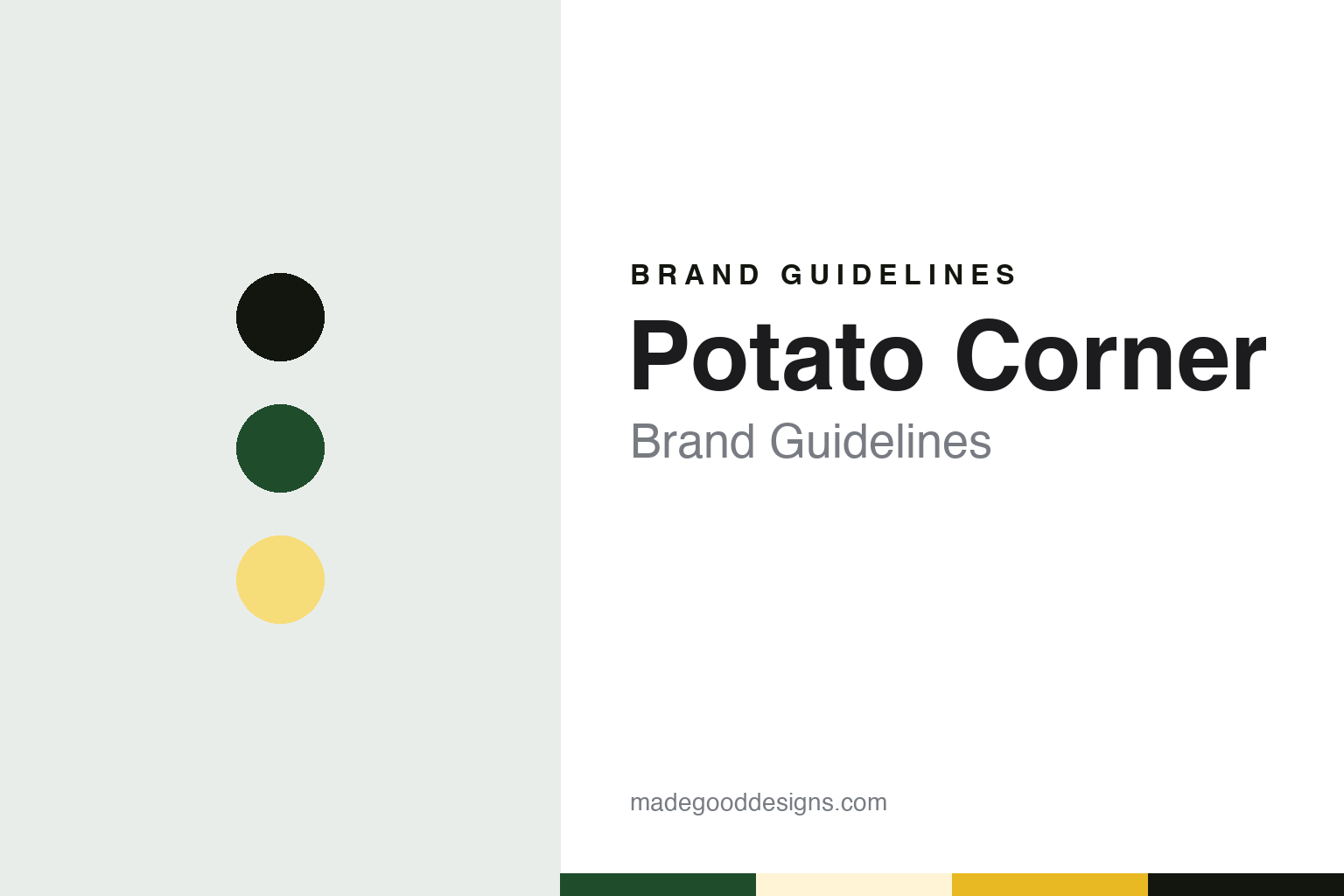
Potato Corner Brand Guidelines
A 1992 Megamall cart, flavoured fries and four founders.
Aa
Two constants: a Potato Corner fry yellow and deep green palette and a Rounded sans register. Abstract homage — not a Potato Corner product or mark; no cart, logo or mascot is reproduced.
Four partners and a cart
Flavoured fries at SM Megamall.
Potato Corner began as a single cart. Its first outlet opened in October 1992 at SM Megamall in Mandaluyong, Metro Manila — “only a cart,” co-founder Jose “Joe” Magsaysay Jr. told the Business & Leisure column of the Philippine Star in December 2016, because the partners could not afford anything bigger. English Wikipedia gives the opening day as 16 October 1992.
There were four founders. The Philippine Star named them as Magsaysay, his brother-in-law Ricky Montelibano, and their friends Danny Bermejo and George (Jorge) Wieneke. Montelibano already sold flavoured popcorn in two flavours, barbecue and cheese, and that business served as the model: the new idea was flavoured fries. Magsaysay had worked at Wendy’s for nine years and, the paper reported, left that job to run the new venture. The four put up the starting capital together, each borrowing his share, and the paper reported that the loans were repaid within 30 days of opening.
Wieneke gave his own account in February 2023 to The Independent Investor, a Philippine business publication. He said the idea came to him on a drive during Holy Week, after noticing that children always ordered fries with their burgers, and that he took it first to Bermejo, his close friend, and then to Montelibano, whose popcorn business was called George Popcorn. In that telling, Montelibano’s flavouring supplier provided the seasoning, a relative of Bermejo arranged the fabrication of the cart, and the partners’ small orders of frozen fries were shipped alongside larger importers’ orders, because frozen fries were then hard to buy in Manila.
Colour
Franchising on a handshake.
Franchising came early and informally. The Philippine Star reported in 2016 that franchising was still a novel idea in the country when the partners began, that Magsaysay knew its mechanics from his years at Wendy’s, and that their first franchise agreement was a document copied from the internet. The first three franchises, he recalled, were closed on handshakes, with no manuals; the franchised network then grew faster than the company-owned stores, which the founders saw as the way to raise money for expansion.
The brand went abroad in 2006, when a former student in Manila brought it to Indonesia, and reached the United States in 2010, the paper reported; by December 2016 it counted more than 100 stores in Indonesia and 45 in the United States, with others in countries including Panama. English Wikipedia records a first Hong Kong franchise, in Tsim Sha Tsui, in April 2017.
The product has stayed close to the cart. English Wikipedia lists cheese, barbecue and sour cream as the first flavours. When the brand opened in Taiwan, at the Uni-President Department Store in Taipei’s Xinyi District, with a grand opening on 4 August 2025, Taiwan News reported that the fries are cooked after each order and the flavour powder is shaken in front of the customer, and that the store offered sour cream and onion, barbecue, cheese and chili barbecue, alongside curly fries and chicken pops. The Taiwan launch was led by a local partner, the Fujin Tree Group, the paper said.
Typography
Design and documentation.
The Philippines’ restaurant, bakeshop and snack chains tend to present themselves through a small set of recurring elements: a shop name and sign that customers can spot in a mall or on a busy road, menus organised around named dishes and named cakes, and packaging that travels home with the order. Some brands take their names from a place or a founder; Red Ribbon, by its own account, takes its name from the ribbon once tied around its cake boxes.
Many of these chains now sit inside a few restaurant groups. Jollibee Foods Corporation, which adopted “Jollibee Group” as its corporate brand in July 2025 according to BusinessWorld, owns brands including Jollibee, Chowking, Greenwich, Red Ribbon and Mang Inasal. Max’s Group, which traces itself to the Max’s Restaurant fried-chicken café of 1945, runs another portfolio of casual-dining brands, according to its own website.
Franchising is the usual route to growth, at home and abroad. Group and brand websites publish franchising pages for the Philippines and, in several cases, for international partners, and some chains have opened abroad. Red Ribbon is one example: it opened in California in 1984, according to English Wikipedia, and had 39 stores in the United States by October 2022, The Philippine Star reported.
This guide sets out what can be checked about each brand: who founded it, when and where, who owns it now, and how its own pages and the Philippine press describe its menu, stores and franchise network. Counts of stores are given with the date of the source, and claims that rest only on a company’s own word are marked as such.
Aa
A rounded sans — a cart-and-kiosk register. (Specimen set in Fredoka, a sans STAND-IN; NOT the Potato Corner logo.)
Potato Corner
Four strands of hair.
The founders sold the business in the early 2020s. On 24 December 2021, Shakey’s Pizza Asia Ventures Inc. — the Philippine operator of the Shakey’s pizza chain, owned by the Po family — announced that it was acquiring Potato Corner, Rappler reported. The deal covered the assets and intellectual property of the business, and Shakey’s would own and operate the company stores and act as brand owner and franchisor for franchised stores at home and abroad. At the time Potato Corner had more than 1,000 outlets, Rappler said. The Independent Investor reported in 2023 that the acquisition, made together with the subsidiary Wow Brand Holdings, took place in March 2022 and included shares in a Singapore entity.
Under its new owner the network kept growing abroad. In July 2025 the Philippine Star reported that Shakey’s Pizza Asia Ventures counted Potato Corner in 15 markets outside the Philippines, with about 400 stores internationally. The company’s own website now speaks of branches in 15 countries.
The visual identity has a documented origin, by Wieneke’s account. He told The Independent Investor that he and his wife coined the name to claim a “corner,” or niche, for potatoes, and that Grace Marci, a creative director at the agency Lintas Manila, drew the logo and the cart design herself. The mascot, then called Spudster, has four strands of hair on its head, the publication said: one for each founder. In Taipei, Taiwan News described the new store in the brand’s “classic bright yellow design,” with a stage-like counter.
For a design guide, Potato Corner shows how a kiosk brand can carry one product, one colour and one small ritual — the shaking of the flavour — from a mall cart to many countries. Compare Jollibee, another Philippine fast-food name that began in Metro Manila, and Greenwich Pizza, a Philippine pizza chain. For this guide we use a fry yellow and a deep green with a rounded sans, an unofficial interpretation; no product or logo is reproduced.
Explore & save
Keep Potato Corner’s identity on hand — save it to a board in the Made Good inspiration library.
Potato Corner identity set
Pin the Potato Corner fry yellow and deep green palette and the Rounded sans register to your own board.
Source & notes
Frequently Asked Questions
What font can I use to match the Potato Corner look?
This guide describes Potato Corner’s type as “A rounded sans — a cart-and-kiosk register”. Its type specimen is set in Fredoka from Google Fonts as a stand-in; Fredoka is not Potato Corner’s own lettering.
What colours are in the Potato Corner palette?
This guide’s Potato Corner palette is Deep green #1F4D2B, Ink #12160F, Fry yellow #E8B923, Cream #FFF4D6 and Paper #FBFAF4. The tones are the guide’s own unofficial interpretation, not official Potato Corner hex codes.
When was Potato Corner founded?
Potato Corner was founded in October 1992, in SM Megamall, Mandaluyong.
Who founded Potato Corner?
Potato Corner was founded by Jose Magsaysay Jr., Ricky Montelibano, Danny Bermejo and Jorge Wieneke in October 1992.
Who owns Potato Corner?
Potato Corner is owned by Shakey’s Pizza Asia Ventures Inc. (since 2022).


