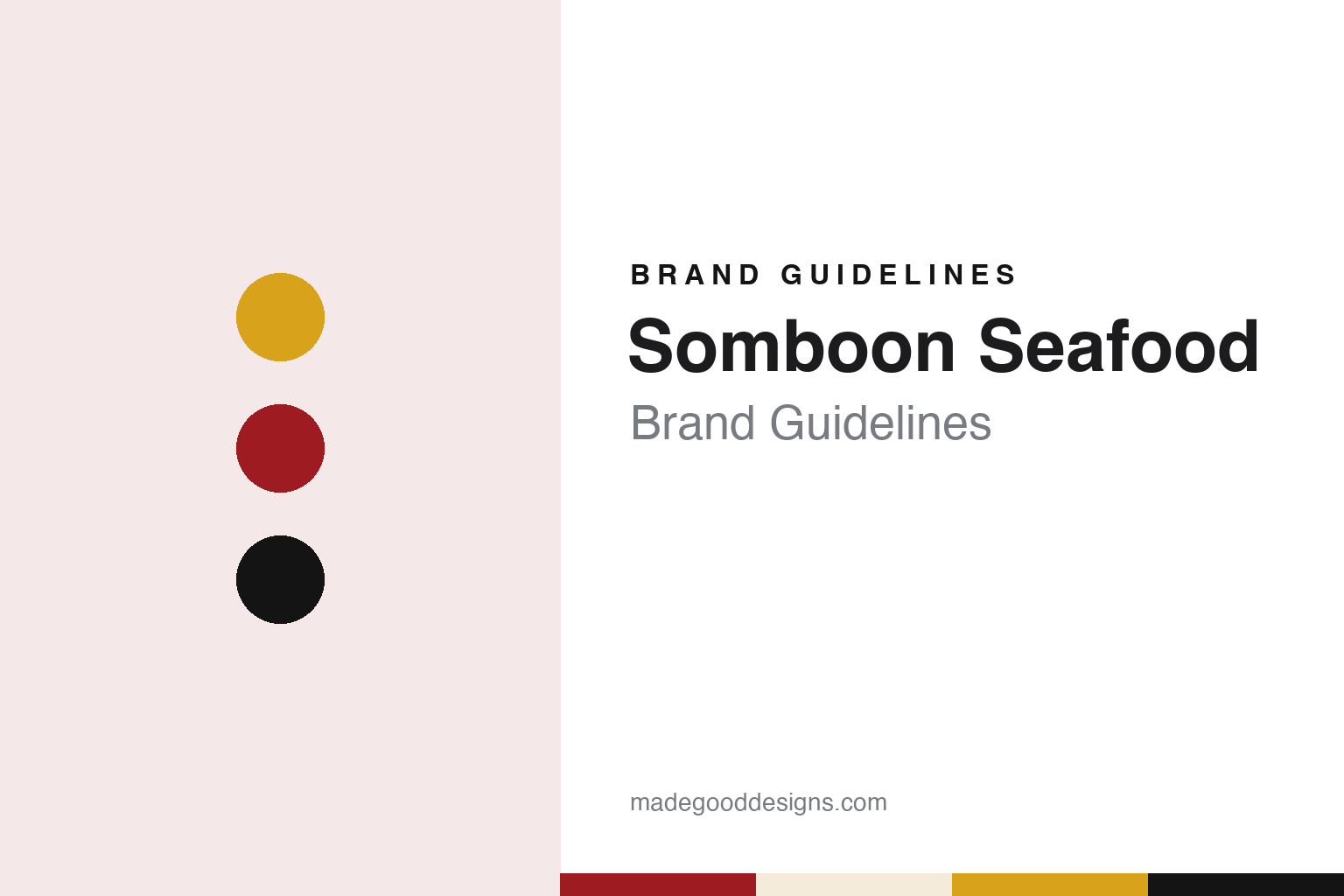
Somboon Seafood Brand Guidelines
The 1969 Sam Yan curry-crab house with eight branches.
Aa
Two constants: a Somboon Seafood curry gold and deep red palette and a display serif register. Abstract homage — not a Somboon Seafood product or mark; no logo, dish or sign is reproduced.
Somboon Phochana
A Sam Yan shophouse, 1969.
Somboon Seafood dates its restaurant to 1969, when it opened in a single-storey shophouse next to Chulalongkorn University’s Faculty of Commerce and Accountancy in Sam Yan, Bangkok, according to the company. The Michelin Guide’s Thailand listing also ties the restaurant’s reputation to 1969, and BK Magazine described it in March 2007 as having been in business since that year.
The family trade is older than the restaurant. In a January 2022 interview with the newspaper Bangkok Biznews, owner Somboon Sricharoensukying said his grandparents, Teochew migrants from Shantou, ran a crushed-ice business around Sam Yan, supplying restaurants, and that his grandmother then opened a duck rice-porridge and dessert shop called Ueng Kiang Heng. His parents, Pichai and Chitra Sricharoensukying, turned it into a made-to-order restaurant, one of several such shops in the area, and named it after their son. The company’s own website names Khun Pichai and Khun Chitra as the founders.
The restaurant’s Thai name is Somboon Phochana, and it is still the Thai name on the company’s website. Somboon Sricharoensukying told Bangkok Biznews that while he was at university, as more foreign visitors arrived, he asked his father to replace the word “Phochana” with “Seafood” so that foreign diners would understand it. That is how the restaurant came to carry separate Thai and English names, one for Thai diners and one for visitors.
The paper described a shop that grew room by room: the owner said the restaurant expanded from a single shophouse unit to two before the move that shaped its later network.
Colour
Mud crab in a curry-powder sauce.
The dish that carries the brand is fried curry crab, poo pad pong karee. In the Bangkok Biznews account, the restaurant’s regular customers — lecturers, students and traders — kept asking for something new, and Pichai Sricharoensukying tried a curry-powder crab made with large sea crab rather than the blue swimmer crab then common in Bangkok’s rice-and-curry shops, working the recipe out by trial and error with his wife and son. The curry paste is Khun Chitra’s own recipe, known to only a few people in the restaurant, the paper reported. The company calls its Sam Yan shophouse the birthplace of the dish as it serves it.
The company describes the dish as crab fried in a curry sauce with scallions and cayenne pepper, served with jasmine rice, and offers it both as whole crab and as crab meat. The Michelin Guide notes that diners can choose roe crab or meat crab, depending on the day and the season. BK Magazine in 2007 called the yellow curry crab the restaurant’s saving grace in an otherwise mixed review, and Time Out Bangkok in December 2024 described a Thai-Chinese seafood restaurant, established 50 years earlier, whose tom yum kung is “perennially popular,” as is its curry crab.
Around the crab the menu stays Thai-Chinese. The company lists tom yum goong, deep-fried sea bass with fish sauce, roasted freshwater prawns with glass noodles and eggplant with salted fish among its recommended dishes, and says the prawn and glass-noodle dish has been recognised in the Michelin Guide Bangkok since 2018. The owner told Bangkok Biznews that several dishes, such as garlic-steamed prawns and salt-and-chilli prawns, came from his parents’ trips to Hong Kong, where his mother worked out recipes she had eaten there and adapted them.
Typography
Thai restaurant and café chains.
Thailand’s restaurant, bakery and café chains tend to present themselves through the places where people meet them: shopping centres, hypermarkets, community malls and their own stand-alone sites. Thai Wikipedia says most MK Suki branches sit in shopping centres and community malls, and in 2015 the Bangkok Post described MK Restaurant Group opening a food mall of its own in Bangkok, London Street, with five of its brands under one roof.
Menus are published by named dishes and drinks rather than by abstract promises. Chains sort their websites into sets, single dishes, desserts and drinks, run seasonal promotions around one dish or sauce, and tie repeat visits to member cards; MK and Yayoi, for example, share the MKONE card. Shopfronts, mascots and packaging are described brand by brand in each guide, as far as dated sources and the companies’ own pages show them.
Ownership is often layered. Several chains in this series sit inside larger groups, among them MK Restaurant Group, PTT OR, the CP group and Food Passion, and some international brands reach Thailand under licence: Yayoi, a Japanese set-meal chain, is run in Thailand by MK Restaurant Group under rights from the Japanese company Plenus, the Bangkok Post reported in 2017. Thai chains also go abroad through franchisees and joint ventures, as MK did in Japan, Vietnam and Singapore.
Corporate pages usually tell a founder story, a list of milestone branches and a record of franchise partners, and listed companies add filings with the Stock Exchange of Thailand. This guide separates what independent, dated sources record (founding dates, owners, listings, branch counts as of a stated date) from what rests only on a company’s own pages, and attributes the latter plainly.
Aa
A display serif for a family restaurant name. (Specimen set in DM Serif Display, a serif STAND-IN; NOT the Somboon Seafood logo.)
Somboon Seafood
Eight Bangkok branches and a red logo.
The restaurant moved before it multiplied. According to the company, a second branch opened on Surawong Road in 1990, and in 1991, when the lease on the original site with Chulalongkorn University ended, the first restaurant moved to Banthat Thong Road. Somboon Sricharoensukying told Bangkok Biznews the family rented the Surawong shophouse after hearing the university planned to take back the Sam Yan land, and that the university offered a site on Banthat Thong. The company dates its Cantonese restaurant, Somboon Chinese, on Banthat Thong to 1993, followed by branches at Ratchada in 1996 and Udom Suk in 2001.
The next phase went into shopping centres. In 2008 the restaurant returned to Sam Yan, in the new Chamchuri Square building on its original site, the company says; the owner described it to Bangkok Biznews as the family’s first branch inside a mall, chosen because his father wanted to go back to where the business began. Central Embassy and Siam Square One followed in 2014, and CentralWorld in 2017 as the eighth branch, according to the company. The owner told the paper that his father’s generation had opened four branches and that he had opened four more.
The network has stayed in the capital. As of 2025 the company’s website says it runs eight branches, all in Bangkok, with none in other provinces or abroad. BK Magazine counted four outlets in 2007, and Bangkok Beyond, a tour operator’s blog, counted seven in December 2016 and noted that other Bangkok restaurants trade under similar names. The owner told Bangkok Biznews in 2022 that approaches to open abroad, from Japan and elsewhere in Asia, had not been taken up, and that each cook trains for at least a year.
On branding, he linked the fried curry crab with the restaurant’s red logo when he spoke to the paper. In 2007 BK Magazine noted staff in bright yellow T-shirts and tanks of live seafood at the front of the Surawong branch. The company’s present website, in Thai, English, Japanese and Chinese, credits its design to Craftsmanship Co.
For a design guide, Somboon Seafood shows how one dish and one red mark can carry a family restaurant name across eight branches without leaving its home city. Compare MK Restaurants, another Bangkok restaurant name, and S&P, the Bangkok bakery-restaurant chain. For this guide we use a curry gold, a deep red and ink with a serif, an unofficial interpretation; no product or logo is reproduced.
Explore & save
Keep Somboon Seafood’s identity on hand — save it to a board in the Made Good inspiration library.
Somboon Seafood identity set
Pin the Somboon Seafood curry gold, deep red and ink palette and the display serif register to your own board.
Source & notes
Frequently Asked Questions
What font can I use to match the Somboon Seafood look?
This guide describes Somboon Seafood’s type as “A display serif for a family restaurant name”. Its type specimen is set in DM Serif Display from Google Fonts as a stand-in; DM Serif Display is not Somboon Seafood’s own lettering.
What colours are in the Somboon Seafood palette?
This guide’s Somboon Seafood palette is Curry gold #D9A21B, Deep red #9E1B22, Ink #141414, Jasmine rice #F4EBDA and Paper #FAF7F1. The tones are the guide’s own unofficial interpretation, not official Somboon Seafood hex codes.
When was Somboon Seafood founded?
Somboon Seafood was founded in 1969, in Sam Yan, Bangkok.
Who founded Somboon Seafood?
Somboon Seafood was founded by Pichai and Chitra Sricharoensukying in 1969.