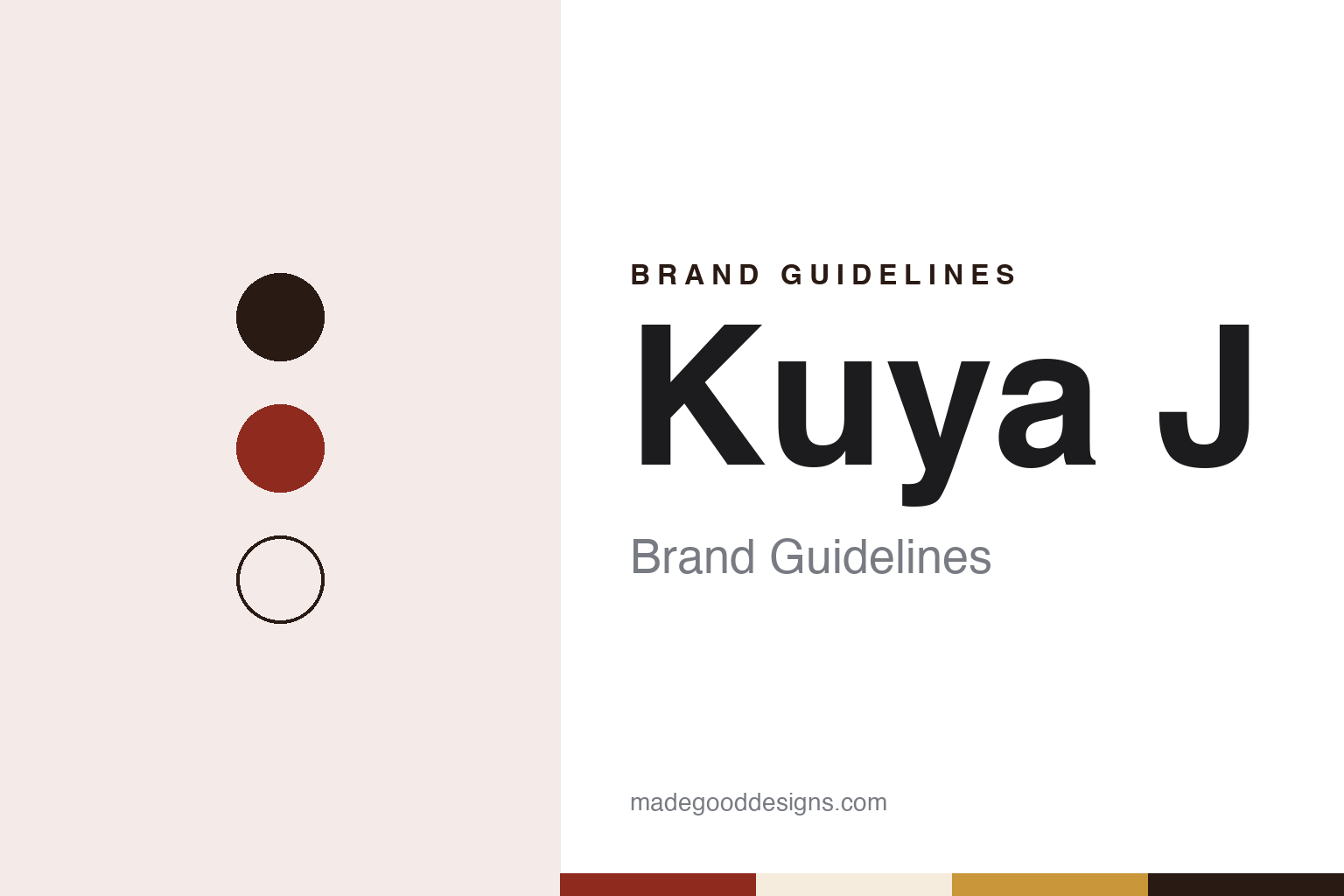
Kuya J Brand Guidelines
A Cebu grill eatery grown into a Filipino mall restaurant chain.
Aa
Two constants: a Kuya J tomato red and cream palette and a Warm slab serif register. Abstract homage — not a Kuya J product or mark; no dish, logo or signage is reproduced.
Kan-anan ni Kuya J
A grill in Capitol Site.
Kuya J began as a small eatery in Cebu City. Kuya is the Filipino word for an older brother; the J, Context.ph reported in August 2024, stands for Jonathan, a Cebuano basketball player who grilled food for his teammates and later sold his hand-fanned grilled dishes to neighbours in Capitol Site, near the Fuente Osmeña landmark, according to the group’s chief operating officer, Don Tirol. The eatery was called “Kan-anan ni Kuya J,” Kuya J’s place to eat, and baked scallops began as a side business there.
The dates for the move from eatery to chain come in two versions. The Philippine Star, in February 2019, traced the restaurant to an old house on Orchid Street in Cebu City in 2000, and quoted its chief operating officer at the time, Richard Joseph Li, as saying Kuya J opened as a new brand on Escario Street, Cebu, in 2012. Context.ph reported in 2024 that the business was taken over by Lowell Yu and Winglip Chang in 2013. Li said the chain reached Manila about three years after its Cebu start.
Chang comes from an older Cebu restaurant family. The Freeman, the Cebu paper of the Philstar group, reported in May 2024 that Majestic Restaurant, a Chinese restaurant in Cebu, was established in 1952 by Chang’s family and a group of Chinese immigrants from Hong Kong, first opening beside the old Oriente Theater on Colon Street; the paper placed Majestic in the same group of companies as Kuya J. BusinessWorld named Chang as president of the Kuya J group in April 2025.
Colour
From one Cebu store to a mall chain.
Growth came quickly and then reset. In February 2019 the chain opened its 107th branch, at SM City Urdaneta Central in Pangasinan, a 124-seat store that The Philippine Star said was its 50th inside an SM mall. Most branches, Li told the paper, were in malls, “where people converge,” though some stood outside them. Context.ph wrote in 2024 that the chain had been about 100 stores strong at one point before 2020.
Franchising followed. The 2019 report said the company had waited until it reached its 100th store before offering franchises; BusinessWorld in April 2025 dated the start of franchising for Kuya J Restaurant to 2020. In August 2024 BusinessWorld counted 86 branches nationwide, 15 franchised and 71 company-owned, including a new 64-seat branch at Robinsons Antipolo. Fajardo told the paper that most franchise inquiries came from the Middle East, while noting that pork dishes sit at the centre of the menu. Tirol told the paper that the chain had once grown rapidly “from one to 100.” In April 2025 the same paper put the count at 81 stores, with the company saying it was putting the renovation of existing stores ahead of new openings.
The menu is Filipino home-style cooking with a grill at its root. The Philippine Star listed crispy pata, creamy grilled scallops, kaldereta, kare-kare and a halo-halo espesyal in 2019, and BusinessWorld reported in 2024 that pork, with crispy pata, is the core of the menu. Context.ph reported that the chain adds new dishes month by month, recently with more seafood and tuna, and that it had started a coffee offer for the quiet mid-afternoon hours, which the executives called the “2 PM market.”
Typography
Filipino dining chains.
The Philippines’ restaurant, bakeshop and snack chains tend to present themselves through a small set of recurring elements: a shop name and sign that customers can spot in a mall or on a busy road, menus organised around named dishes and named cakes, and packaging that travels home with the order. Some brands take their names from a place or a founder; Red Ribbon, by its own account, takes its name from the ribbon once tied around its cake boxes.
Many of these chains now sit inside a few restaurant groups. Jollibee Foods Corporation, which adopted “Jollibee Group” as its corporate brand in July 2025 according to BusinessWorld, owns brands including Jollibee, Chowking, Greenwich, Red Ribbon and Mang Inasal. Max’s Group, which traces itself to the Max’s Restaurant fried-chicken café of 1945, runs another portfolio of casual-dining brands, according to its own website.
Franchising is the usual route to growth, at home and abroad. Group and brand websites publish franchising pages for the Philippines and, in several cases, for international partners, and some chains have opened abroad. Red Ribbon is one example: it opened in California in 1984, according to English Wikipedia, and had 39 stores in the United States by October 2022, The Philippine Star reported.
This guide sets out what can be checked about each brand: who founded it, when and where, who owns it now, and how its own pages and the Philippine press describe its menu, stores and franchise network. Counts of stores are given with the date of the source, and claims that rest only on a company’s own word are marked as such.
Aa
A warm slab serif — an older-brother name and a single initial. (Specimen set in Bitter, a slab serif STAND-IN; NOT the Kuya J logo.)
Who is Kuya J?
A nickname as a brand.
The name carries a well-known mix-up. Many diners, Context.ph wrote in 2024, assumed the J referred to the actor Jericho Rosales, who is in fact the chain’s brand ambassador, as The Philippine Star also reported in 2019. Carlo Fajardo, chief operating officer of the franchise business, told Context.ph the company was in no hurry to correct the impression; the paper added that the dish Rosales likes to order there is pinakbet, the vegetable stew.
Store design has become part of the brand’s recent story. Tirol told Context.ph in 2024 that the chain was changing its store look, with sturdier and more pleasing furniture, and updating its kitchens with new equipment that takes up less space. BusinessWorld reported in April 2025 that the group saw renovation as more useful than expansion for the time being. The 2024 Antipolo branch, at 218 square metres, shows the smaller store size the company described.
In Kuya J’s case the sources describe a neighbourhood cook, a nickname and a few signature dishes, then owners from a Cebu restaurant family who took the name into malls and, from 2020, to franchisees. What has stayed constant is the name itself, an older-brother title and a single initial; Li told The Philippine Star in 2019 that the company tries to treat diners the way a family treats guests at home.
For a design guide, Kuya J shows how a nickname can carry a brand from a neighbourhood grill to a national mall chain. Compare Mang Inasal, a grilled-chicken chain from the Visayas, and Gerry’s Grill, a Quezon City grill that rebranded for families. For this guide we use a tomato red, a smoked brown and a rice cream with a serif, an unofficial interpretation; no product or logo is reproduced.
Explore & save
Keep Kuya J’s identity on hand — save it to a board in the Made Good inspiration library.
Kuya J identity set
Pin the Kuya J tomato red and cream palette and the Warm slab serif register to your own board.
Source & notes
Frequently Asked Questions
What font can I use to match the Kuya J look?
This guide describes Kuya J’s type as “A warm slab serif — an older-brother name and a single initial”. Its type specimen is set in Bitter from Google Fonts as a stand-in; Bitter is not Kuya J’s own lettering.
What colours are in the Kuya J palette?
This guide’s Kuya J palette is Tomato red #8E2A1E, Smoked brown #2A1A14, Rice cream #F6ECDD, Calamansi gold #C9963A and Paper #FBF7F0. The tones are the guide’s own unofficial interpretation, not official Kuya J hex codes.
When was Kuya J founded?
Kuya J was founded in 2000 eatery; 2012 brand, in Cebu City, Philippines.
Who owns Kuya J?
Kuya J is owned by Lowell Yu and Winglip Chang (from 2013, per Context.ph).