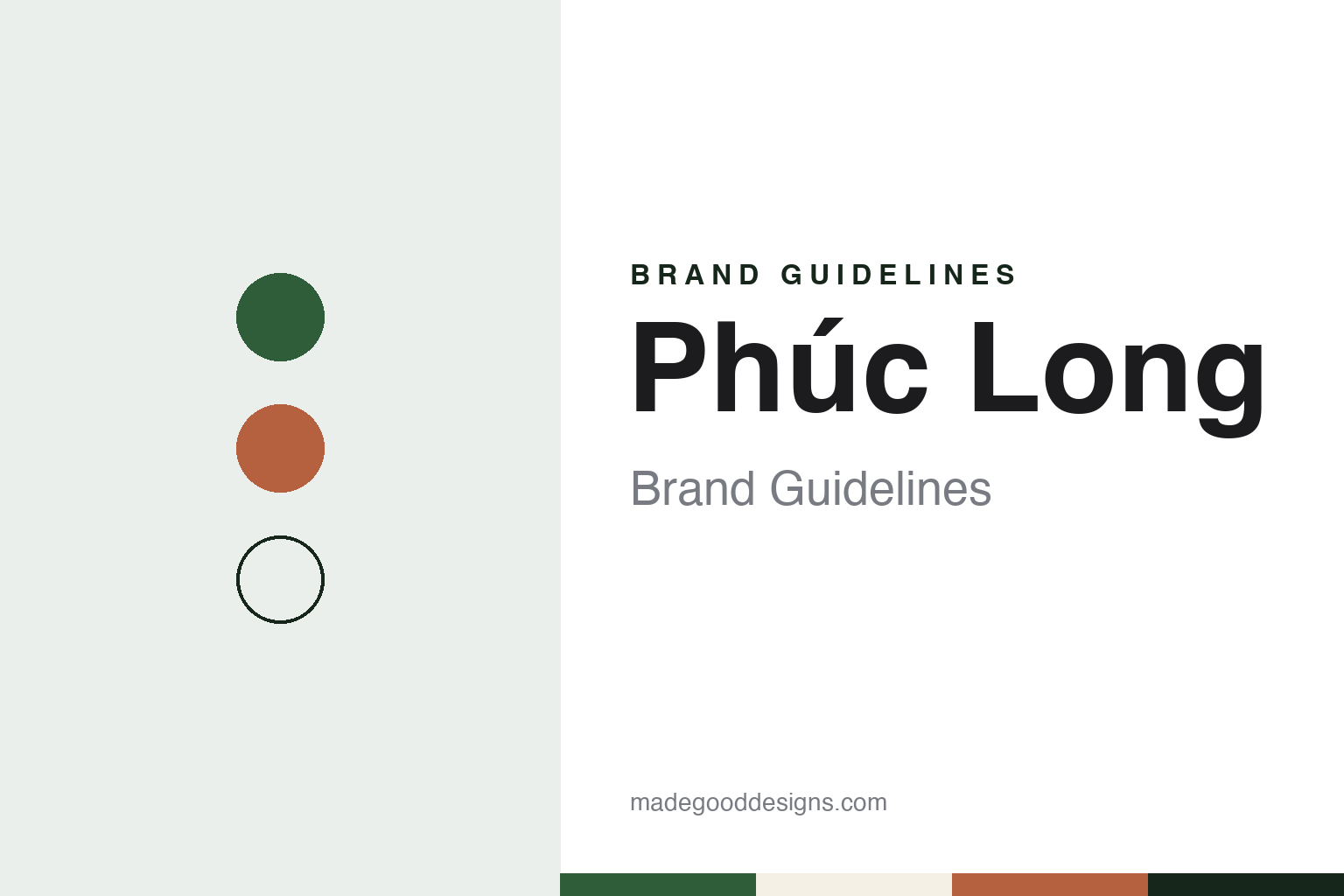
Phúc Long Brand Guidelines
A highland tea house from 1968 that became a city chain of tea and coffee stores.
Aa
Two constants: a green and terracotta palette and a tea-house serif register. Abstract homage — not a Phúc Long product or mark; no cup, logo or shopfront is reproduced.
Bảo Lộc, 1968
A tea business from the highlands.
Phúc Long began in 1968 in Bảo Lộc, in the Central Highlands province of Lâm Đồng, an upland area known for its tea. Viet Nam News gave that origin in May 2021, and VnExpress International also dated the company’s establishment to 1968 in Lâm Đồng when it reported on the brand in February 2022. Its founder is Lâm Bội Minh, named by Viet Nam News as founder of the company behind the brand, Phúc Long Heritage.
The brand reached the city early. Vietnam Investment Review, introducing an interview with the founder in January 2024, said the idea for Phúc Long dates from 1968 and that by the 1980s he had opened three Phúc Long stores in Ho Chi Minh City. Viet Nam News likewise said the business opened its first retail store in Ho Chi Minh City and began supplying coffee and tea products that kept a traditional Vietnamese taste in a modern style.
The chain of tea and coffee stores that most customers know today is much younger. According to VnExpress International, the company launched its tea and coffee chain in 2012, with its first store in Ho Chi Minh City. From there the brand built its name in the south: Tuoi Tre News described it in December 2022 as a tea and coffee brand that was popular with young people and, until Masan’s investment, had been seen as a speciality found mainly in Ho Chi Minh City.
Its drinks span both sides of the name. The chain sells coffee alongside fruit teas and milk teas, and, as Tuoi Tre News reported in February 2026, loose-leaf varieties such as Shan Tuyết, Pu-erh and Dragon Claw at its Hanoi flagship; in July 2025 The Investor reported that it had added food, including bread, pastries and ice cream, to its menu.
Colour
Kiosks, then flagship stores.
Phúc Long’s recent history is a story of formats. In May 2021, Viet Nam News reported, the Masan Group subsidiary Sherpa agreed to buy a 20 percent stake in Phúc Long Heritage, and the two sides agreed to develop Phúc Long Kiosks inside the group’s VinMart+ convenience stores, later renamed WinMart+. The kiosks spread quickly: VnExpress International reported in November 2023 that within 12 months of the May 2021 launch there were more than 700 of them.
Under Masan the brand spread across the country. Tuoi Tre News reported in December 2022 that Phúc Long had reached 27 provinces and cities, and that its network had grown from 72 stores in January 2022 to 860 points of sale by the end of that September, counting flagship stores, mini shops and kiosks in WIN and WinMart+ shops.
The kiosk model was then cut back. Since the end of 2022, VnExpress International reported in November 2023, Masan had shut 150 kiosks and turned to standalone stores, leaving Phúc Long with 92 kiosks and 147 outlets at that time. By July 2025, The Investor reported that the company had shifted its focus to standalone flagship outlets and that its store count had risen from 158 in 2024 to 237 by mid-2025, of which 184 were flagship locations. The same report said it had no plans for franchising in Vietnam but had two franchised stores operating in California.
The stores carry the identity. Tuoi Tre News reported in February 2026 that the brand was opening its Phúc Long Dragon flagship in Hanoi’s Old Quarter, and described a design inspired by Vietnamese tea culture that combined warm tones with the brand’s signature green and terracotta, natural materials and Vietnamese handcrafted details, with artworks tracing tea from the hills to the cup and a Tea Master corner for guided tastings. Another Hanoi store, near West Lake, features a display of Bát Tràng ceramics, the same report said; at that point the chain had 29 outlets in Hanoi.
Typography
Vietnam’s café and restaurant chains.
Vietnam’s café and restaurant chains grew up in a country with a deep street culture of coffee, tea and noodle soup, and most of them present themselves through the shop itself. A chain’s identity is carried by its shopfronts and seating, by the cup a drink is handed over in, and by the bags of ground coffee and boxes of tea sold at the counter or in supermarkets.
Menus are built around named drinks and dishes rather than abstract promises. Coffee chains list house blends, iced coffee with condensed milk and ice-blended drinks; tea chains list fruit teas, milk teas and loose-leaf varieties from Vietnam’s highland growing areas; phở, pizza and hot-pot chains name their broths, toppings and set menus. Store formats vary too, from large flagship cafés to kiosks placed inside supermarkets, and the press has followed which formats the chains keep and which they close.
Ownership is often part of the story. Several of the chains in this set belong to wider groups: Highlands Coffee sits under SuperFoods, in which the Philippine group Jollibee Foods holds a stake, alongside Phở 24; Phúc Long is a subsidiary of the Vietnamese consumer group Masan; others covered here belong to the restaurant group Golden Gate or the retail group Seedcom, as their own guides set out. Store counts change quickly, so each guide gives its figures with the date and the publication that reported them.
Each guide sets out what can be checked about a brand from independent, dated reporting by publications such as VnExpress International, Tuoi Tre News, Viet Nam News and Vietnam Investment Review: who founded it, who owns it, how it trades and what its stores and products look like, with company statements marked as the company’s own word.
Aa
A tea-house serif with a calm, traditional voice. (Specimen set in Playfair Display, a serif STAND-IN; NOT the Phúc Long logo.)
Masan
From a minority stake to a subsidiary.
Masan’s investment came in steps. The first, in May 2021, was the 20 percent stake bought through Sherpa, Viet Nam News reported. In February 2022, VnExpress International reported, Masan raised its ownership from 20 to 51 percent, making Phúc Long a consolidated subsidiary, and Tuoi Tre News reported in December 2022 that further purchases that year had taken Masan’s holding to 85 percent. Phúc Long Heritage JSC is described by The Investor in July 2025 as a beverage subsidiary of Masan Group, and Tuoi Tre News said in February 2026 that the brand had been a member of Masan Group since 2022.
The ownership change tied the brand to Masan’s retail network. Tuoi Tre News reported in December 2022 that the tie-up also put Phúc Long’s packaged tea and coffee into Masan’s WIN and WinMart+ shops. When the kiosks were later scaled back, the brand’s weight moved to its own stores, as VnExpress International and The Investor reported.
The push into the north is the latest chapter. Tuoi Tre News described the Hanoi flagship as part of a wider refresh of the brand’s image and customer touchpoints, and as the start of the company’s development in Hanoi and northern Vietnam; at the time the brand had more than 200 stores in Ho Chi Minh City, the same report said.
For a design guide, Phúc Long shows how a tea brand with highland roots can carry its origin into city stores through colour, material and craft rather than through its logo alone. Compare Highlands Coffee, another Vietnamese café chain that grew from packaged products, and Trung Nguyên, the Buôn Ma Thuột coffee house. For this guide we use a tea-hill green and terracotta with a rice-paper cream and a serif, an unofficial interpretation; no product or logo is reproduced.
Explore & save
Keep Phúc Long’s identity on hand — save it to a board in the Made Good inspiration library.
Phúc Long identity set
Pin the Phúc Long green and terracotta palette and the tea-house serif register to your own board.
Source & notes
Frequently Asked Questions
What font can I use to match the Phúc Long look?
This guide describes Phúc Long’s type as “A tea-house serif with a calm, traditional voice”. Its type specimen is set in Playfair Display from Google Fonts as a stand-in; Playfair Display is not Phúc Long’s own lettering.
What colours are in the Phúc Long palette?
This guide’s Phúc Long palette is Tea-hill green #2F5D3A, Terracotta #B5603E, Young leaf #8DAA7A, Rice paper #F5F0E6 and Deep leaf ink #16261B. The tones are the guide’s own unofficial interpretation, not official Phúc Long hex codes.
When was Phúc Long founded?
Phúc Long was founded in 1968, in Bảo Lộc, Lâm Đồng, Vietnam.
Who founded Phúc Long?
Phúc Long was founded by Lâm Bội Minh in 1968.
Who owns Phúc Long?
Phúc Long today: Phúc Long Heritage JSC, a Masan Group subsidiary.