Pineda Covalin Brand Guidelines
Two designers, a museum shop and Mexico printed on silk.
Aa
Two constants: a Pineda Covalin cochineal, jade and marigold palette and a museum serif register. Abstract homage — not a Pineda Covalin product or mark; no print, scarf or logo is reproduced.
A museum commission
Ties and scarves for the National Museum of Anthropology.
Pineda Covalin is the fashion and accessories house of two Mexican designers, Cristina Pineda and Ricardo Covalín, who gave the business their surnames and describe themselves as its co-owners, the business site El CEO reported in July 2023. Forbes México dated the brand to 1996 in December 2014, and El CEO, citing Forbes, gave the same year; English Wikipedia says the company was established in Mexico City in 1995. Both founders studied at the Universidad Iberoamericana in Mexico City, El CEO says: Pineda in textile design, later adding a master’s degree in art history from the Universidad Anáhuac, and Covalín in industrial design.
The brand grew out of a commission. In 1996, as the two were finishing their degrees, they were asked to produce a freelance project of ties and silk scarves with Mexican indigenous designs for sale at the National Museum of Anthropology, Covalín told the outlet Enlace Judío in an interview that El CEO summarised. Forbes México describes Pineda Covalin as the result of a collaboration between the two designers and Mexico’s National Institute of Anthropology and History, known as INAH. When the dealings with the institute did not take off at first, El CEO says, the pair launched the products on their own and left ties and scarves on consignment in the institute’s museums.
Museums gave the brand its early audience. English Wikipedia and El CEO both name the National Museum of Anthropology and the Palacio de Bellas Artes in Mexico City as early places of sale. English Wikipedia, citing a 2011 book published by Fundación Telefónica, adds that the company made cufflinks and ties for corporate clients, among them Coca-Cola and Volkswagen, to fund its own design projects. The same article, citing the writer Elena Poniatowska in La Jornada in 2016, says the first silk scarf grew out of a month Pineda spent in Dzoncauich, in Yucatán, where she worked with a henequen dyer on early designs for bags and accessories. Hotel shops followed, El CEO reports, and then a duty-free shop of the brand’s own at Mexico City’s airport, because the founders saw their products as keepsakes for visitors.
Colour
Codices, butterflies and Tehuana women on silk.
The designs draw on Mexico’s pre-Hispanic and popular culture. In December 2014 Forbes México wrote that the brand translates architecture, sculpture, painting and codices into textile designs and fashion accessories, with motifs such as Huichol art, shamans, Tehuana women and monarch butterflies. English Wikipedia names the Huichol, Maya and Zapotec peoples among its sources and gives silk as its main material. Covalín told Forbes that every object tells a story: that of the people who took part in making it, and of the generations who kept the techniques alive.
Craft collaborations sit alongside the prints. English Wikipedia, citing La Jornada in 2016, says the brand has worked for more than 15 years with artisan families in Arrazola, Oaxaca; Xalitla, Guerrero; and Real de Catorce, San Luis Potosí. Forbes México reported in 2014 that one Pineda Covalin clothing line used weaving by Otomí women from Querétaro, made through the association Mäka.
The shops took on a museum role of their own. In December 2014 Forbes México reported that Pineda Covalin had opened its first “tienda-museo,” a shop-museum, in Querétaro, showing work by artisans of the region beside the brand’s products, with the displays changed every six months. English Wikipedia, citing La Jornada, put the brand’s outlets in Mexico at more than 40 as of 2016, and records boutiques or projects in New York’s SoHo, Panama and Qatar.
The range has spread from neckwear into a wider catalogue. El CEO listed it in 2023 as accessories such as fans, brooches, hats and wallets; bags, clothing, jewellery and footwear; home decoration and crafts; and corporate gifts such as personalised ties. It also named tequilas made in collaboration with José Cuervo.
Typography
Catalogues, kits and silk.
Mexican fashion and footwear brands reach their customers in several different ways, and their identities follow from that choice. Some sell mainly through printed and digital catalogues carried by networks of independent sellers; others sell through chains of their own stores, department-store counters or, in a few cases, museum and hotel shops. A catalogue brand’s pages, a sportswear maker’s team kits and a silk house’s scarf prints each do the work that a shop window does elsewhere.
León, in the state of Guanajuato, is the centre of much of the footwear trade. Business titles such as Alto Nivel and El CEO describe the city as home to shoe and sportswear makers including Andrea, Charly and Pirma, and to many small and medium producers of leather goods. Several companies started elsewhere and moved there: Andrea began in Mexico City in 1973 and moved its making to a León factory in 1981, according to Alto Nivel.
Ownership is usually private, and often in the hands of founders or families. Company pages and the business press describe founders, holding companies and store networks in different levels of detail, and branch, affiliate and outlet counts change from year to year, so each figure in these guides carries the date of the source that gave it. Where a brand’s own website is the only source for a statement, the guide says so.
This guide sets out what can be checked about each brand: who founded it and when, who owns it, where its products are made as far as dated sources say, and how it presents itself through catalogues, kits, prints and stores. The colours and typefaces shown are an unofficial interpretation, not the brands’ own.
Aa
A refined, museum-label serif. (Specimen set in Cormorant Garamond, a serif STAND-IN; NOT the Pineda Covalin logo.)
Pineda Covalin
Collections named like exhibitions.
The name is the identity’s starting point: two surnames joined, with no word for fashion, silk or Mexico. As of November 2026 the company’s own online shop is organised around the product types that began the business, with mascadas (scarves) and corbatas (ties) first, followed by bags and eyewear. Its collections carry titles that read like exhibition names, among them Historias del Desierto (Stories of the Desert), Monos, Guardianes de la Selva (Monkeys, Guardians of the Jungle) and Arte Efímero (Ephemeral Art).
Individual pieces are named after their subject, in the same museum-label manner. The shop lists scarves and ties with titles such as Lucha Libre, Grecas Prehispánicas (pre-Hispanic frets) and Chiles de México, and some ties are offered in more than ten colourways. Pineda has also developed Xico, an art project for young artists whose mascot is a Xoloitzcuintle, the Mexican hairless dog, according to English Wikipedia and El CEO. The approach matches the one Forbes México described in 2014, when it wrote that the brand sets out the mythology and indigenous roots of Mexico in textile designs.
For a design guide, Pineda Covalin shows how an accessories brand can borrow the language of a museum, from its first shops to the names of its collections. Compare El Palacio de Hierro, another Mexico City name, and Andrea, a Mexican fashion brand built on catalogues. For this guide we use cochineal red, jade, marigold and a deep indigo with a serif, an unofficial interpretation; no product or logo is reproduced.
Explore & save
Keep Pineda Covalin’s identity on hand — save it to a board in the Made Good inspiration library.
Pineda Covalin identity set
Pin the Pineda Covalin cochineal, jade and marigold palette and the museum serif register to your own board.
Source & notes
Frequently Asked Questions
What font can I use to match the Pineda Covalin look?
This guide describes Pineda Covalin’s type as “A refined, museum-label serif”. Its type specimen is set in Cormorant Garamond from Google Fonts as a stand-in; Cormorant Garamond is not Pineda Covalin’s own lettering.
What colours are in the Pineda Covalin palette?
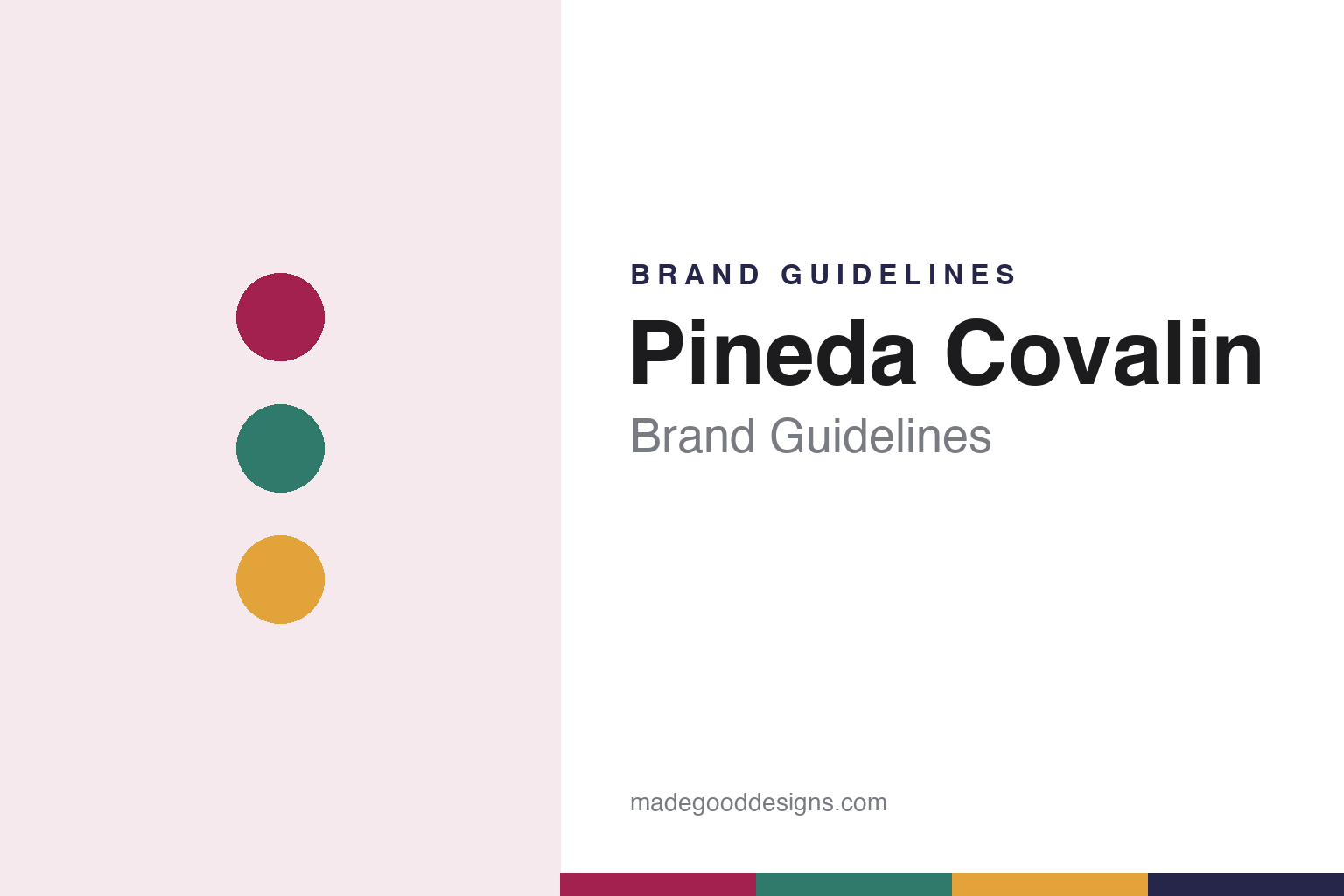
This guide’s Pineda Covalin palette is Cochineal #A3214F, Jade #2F7A6B, Deep indigo #25264A, Marigold #E3A33B and Silk white #F7F3EC. The tones are the guide’s own unofficial interpretation, not official Pineda Covalin hex codes.
When was Pineda Covalin founded?
Pineda Covalin was founded in 1996 (English Wikipedia gives 1995), in Mexico City, Mexico.
Who founded Pineda Covalin?
Pineda Covalin was founded by Cristina Pineda and Ricardo Covalín in 1996 (English Wikipedia gives 1995).
Who owns Pineda Covalin?
Pineda Covalin is owned by its two founders. Pineda Covalin is known for Silk scarves and ties with Mexican motifs.