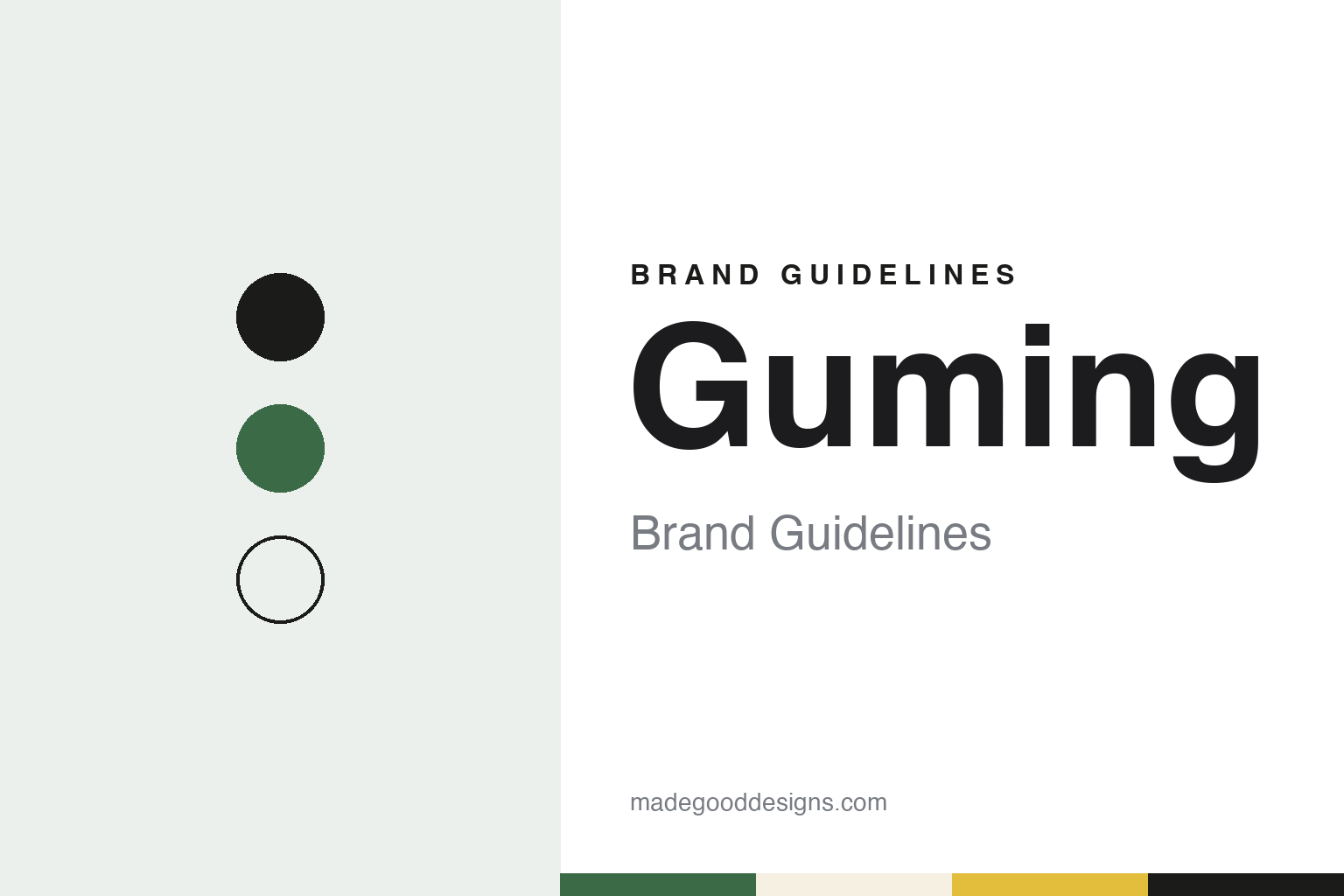
Guming Brand Guidelines
Good me, a 2010 Daxi milk-tea start and a 2025 Hong Kong listing.
Aa
Two constants: a Guming leaf green, cream and lemon palette and a Rounded sans register. Abstract homage — not a Guming product or mark; no cup, logo or shopfront is reproduced.
Daxi
A milk-tea start in a Zhejiang town.
Guming, written 古茗 and trading in English as Good me, is a tea-drink chain from Zhejiang province in eastern China. The group behind it is Guming Holdings, listed on the Hong Kong Stock Exchange, and its own website places the brand under Guming Technology Group. English Wikipedia says the Chinese name means roughly “ancient tea,” and that the company was founded in 2010 by Wang Yun’an.
The story starts in Daxi, a town in Wenling, a county-level city in Taizhou. Accounts of the very first outlet differ. A China Daily regional report for Zhejiang in February 2025 describes the founder selling milk tea from a modified tricycle in Daxi in 2010. China Daily’s Hong Kong edition, in a report the same month that cites Taizhou Daily, describes a small shop of about 30 square metres, where he developed recipes by tasting them himself, many times a day. The company’s own timeline says only that in 2010 “a few young people” started a milk-tea business in a small town in southern Zhejiang.
Franchising came early. Guming’s timeline dates its first franchised store to 2011, the same year it says it slimmed down its menu to focus on better ingredients. China Daily’s Hong Kong edition wrote that the founder guided the first franchisee himself, and that he believed a small-town shop did not need luxurious decor to stand out: bright lighting was enough to draw attention. That idea, it said, laid the ground for later growth. The company says it unified the look of its shops in 2014 so that customers could recognise a Guming at a glance, and set up a training centre with standard operating courses in 2016.
Where the business is based depends on the source. The February 2025 China Daily regional report describes Guming Holdings as headquartered in Taizhou; English Wikipedia gives Hangzhou, the provincial capital, where the company’s timeline says it opened a branch company in 2018.
Colour
A truck called Big White.
Much of Guming’s own history is about logistics rather than shopfronts. Its timeline says that in 2013, to keep shops supplied, it bought its first delivery truck, which it nicknamed “Dabai,” or Big White. The China Daily regional report also dates the move beyond Daxi to 2013, and says the company built a supply chain with its own delivery model, processing facilities and warehouses across the country.
Fresh fruit drove the next stage. The company dates its move into fresh fruit tea to 2017, together with cold-chain delivery and a system of interviews for screening new franchisees. In 2018 it opened a fruit purchasing centre, and in 2019, it says, deliveries to stores went from once a week to every two days. China Daily’s Hong Kong edition described this tightly integrated cold-chain system as a key part of how the chain kept stores supplied with fresh ingredients. The company’s website now lists 24 warehouse bases across the country, its own cold-chain logistics and its own lemon-growing base.
The menu today spans fruit tea, milk tea and coffee, according to English Wikipedia; the company’s website promotes freshly ground coffee alongside its tea drinks. Ordering moved onto phones as well. Guming says it launched its own ordering mini-program nationwide in 2020, and its website says the mini-program had more than 200 million members by the end of 2025. The company’s closing line for the brand is “Have a good day,” which it presents as the encouragement behind every cup, and the English trade name, Good me, appears as GOODME in the website’s copyright line.
Two identity points recur across the sources. The company stresses one consistent shop image, introduced in 2014 so that a Guming could be recognised at a glance, and China Daily stresses bright lighting over expensive interiors as the founder’s early way of making a small-town shop visible from the street.
Typography
Design and documentation.
China’s tea-drink, coffee, burger and restaurant chains present themselves first at street level. A shopfront, a cup and a paper bag are often the first things a customer sees of the brand, and many chains add a mascot, a theme song or a recurring character that appears on signs, packaging and social media at the same time. Some keep their shops small and built for takeaway; others put the same care into seating, lighting and a bakery counter as into the drinks.
Menus are usually organised by named drinks and dishes rather than by codes. Fruit teas, cheese-topped teas, lemon drinks, soft-serve ice cream, fried chicken and hotpot appear under house names, and chains that move abroad often add local flavours while keeping the core list the same. The names, the cups and the colours of the shop carry the brand from one city to the next.
The size of a network is something these companies publish themselves, in annual reports, listing documents and on their own sites, and the press repeats those counts with a date attached. Some chains run every shop directly; others rely mainly on franchisees, and several have moved from one model to the other. Store networks now reach Southeast Asia, Australia, Europe and North America as well as the home market.
Ownership is usually set out plainly on corporate pages: who founded the business and where, which group owns it now, and whether its shares trade in Hong Kong, on a mainland exchange or in New York. This guide follows those published facts, attributes counts to dated sources, and treats each chain’s visual identity as a design subject rather than a claim about its food or drinks.
Aa
A rounded sans — “Have a good day.” (Specimen set in Nunito, a sans STAND-IN; NOT the Guming logo.)
Guming
Smaller cities, province by province.
Guming’s expansion has followed a regional pattern. China Daily’s Hong Kong edition reported in February 2025 that franchising was the core of its business, and that by the end of September 2024 it had 9,778 locations, about 80 percent of them in lower-tier cities and townships. The company’s timeline says it passed 6,000 stores in 2021, the same year it says its first smart in-store products appeared, and that in 2022 it set up regional branch companies to give local franchise partners faster support.
The listing followed in early 2025. China Daily reported that Guming Holdings made its debut on the Hong Kong Stock Exchange in February 2025; its Hong Kong edition, dated 18 February, said the shares had begun trading the previous week. English Wikipedia gives the stock code as 1364. Guming’s own website now says that, as of 31 December 2025, it had more than 13,000 franchise stores in 17 provinces and over 230 cities, among them Zhejiang, Fujian, Jiangxi, Guangdong and Sichuan.
For a design guide, Guming shows how a franchise chain can build recognition from a simple, repeatable shop image, bright lighting and a delivery network rather than from grand interiors. Compare it with Mixue, a Chinese tea-drink chain that China Daily discussed alongside Guming in its 2025 coverage, and with Chagee, another Chinese tea-drink chain. For this guide we use leaf green, ink, milk cream and a lemon yellow with a rounded sans, an unofficial interpretation; no product or logo is reproduced.
Explore & save
Keep Guming’s identity on hand — save it to a board in the Made Good inspiration library.
Guming identity set
Pin the Guming leaf green, cream and lemon palette and the Rounded sans register to your own board.
Source & notes
Frequently Asked Questions
What font can I use to match the Guming look?
This guide describes Guming’s type as “A rounded sans — “Have a good day.””. Its type specimen is set in Nunito from Google Fonts as a stand-in; Nunito is not Guming’s own lettering.
What colours are in the Guming palette?
This guide’s Guming palette is Tea leaf green #3B6A47, Ink #1B1C1A, Milk cream #F5F0E2, Lemon #E3BE3C and Paper #FBF9F3. The tones are the guide’s own unofficial interpretation, not official Guming hex codes.
When was Guming founded?
Guming was founded in 2010, in Daxi, Wenling, Taizhou, Zhejiang.
Who founded Guming?
Guming was founded by Wang Yun’an in 2010. Guming is known for Fruit tea, milk tea, coffee.