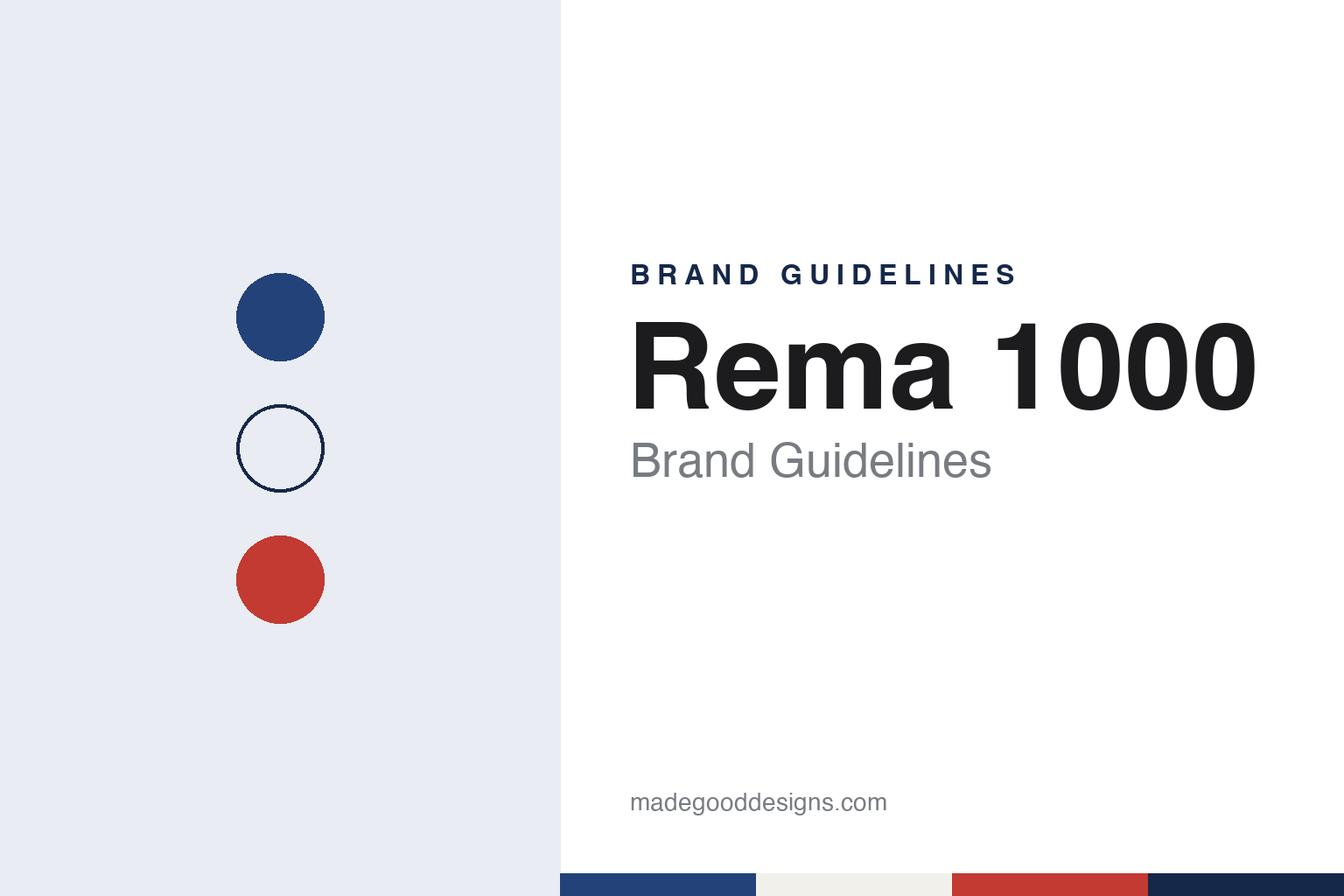
Rema 1000 Brand Guidelines
A Trondheim family shop, an Aldi study trip and a number in the name.
Aa
Two constants: a blue, white and red palette and a condensed sans register. Abstract homage — not a Rema 1000 mark; no logo, sign or pack is reproduced.
Reitan Mat
A family grocer, a study trip and a short range.
Rema 1000 grew out of a family grocery business in Trondheim. Store norske leksikon, the Norwegian encyclopaedia, says Ole Reitan founded the grocery shop O. Reitan Kolonial in the city in 1948 and opened a supermarket in 1963. His son Odd Reitan started a shop of his own, called Sjokkpris, in 1972, and through the 1970s the two built up a small chain of shops around Trondheim.
The model came from Germany. Store norske leksikon says the operating concept was strongly inspired by Aldi, which Odd Reitan had visited on a study trip in 1977, and Danish Wikipedia describes the plan as “translating” the Aldi idea into Norwegian. English and Norwegian Wikipedia both give the date of the first store as 15 February 1979; Norwegian Wikipedia places it at Bromstad in Trondheim and says Odd Reitan opened it together with his father.
The name took a few attempts. Norwegian Wikipedia says Rema comes from the words Reitan and mat, the Norwegian for food, and the number referred to the size of the range. Store norske leksikon gives the sequence as Remi 500 (for “Reitan minipris”) in 1979, then Rema 600, and Rema 1000 from 1981. English Wikipedia tells it slightly differently: the first shops carried 500 to 600 products, the range proved too narrow, and the third shop, opened at Mo i Rana on 8 May 1980 with about 1,000 products, led to the Rema 1000 name. Both accounts agree that the figure described the number of products on the shelves, and English Wikipedia notes that the range has since grown well beyond it while the name stayed the same.
The chain is run through franchising. Store norske leksikon says Rema 1000’s growth was based entirely on franchising, with each store run by a local merchant who rents the name and the store profile, and Danish Wikipedia says every Rema 1000 store is run as a franchise owned by an independent merchant. The chain sits inside Reitan, the family-owned group that Store norske leksikon says is organised into Reitan Retail, Reitan Eiendom (property) and Reitan Kapital.
Colour
Plain stores, own labels and a comedian.
The discount idea shows in the stores. Store norske leksikon describes Rema 1000’s original profile as low-priced, with a standardised range and simple fittings. English Wikipedia says the shops are known for spending little on decoration: products are often set out in their crates or even on pallets, while wide aisles and clear signs are meant to make shopping simple.
The chain is organised from Oslo. Norwegian Wikipedia says Rema 1000 Norway has its head office at Ensjø in Oslo, with regional offices that handle local marketing and new store openings, and a set of distribution centres; the head office runs joint marketing and purchasing, finance and IT. Norwegian Wikipedia notes that the name is styled REMA 1000 and lists own labels sold under names such as REMA 1000, Prima, Softstyle and Fiskeriet. It also lists a number of suppliers in which the group holds stakes, among them the chicken producer Solvinge and the fruit-and-vegetable group BAMA, in which it gives Reitan a minority share.
Advertising gave the chain a well-known British face. Norwegian and Danish Wikipedia both say the British comic actor Rowan Atkinson appeared as Mr. Bean in Rema 1000 commercials in the 1990s, including three films made in 1994, with Mr. Bean shown shopping at Rema 1000, according to Danish Wikipedia.
The store count passed a round number in 2020. Norwegian Wikipedia says that in October 2020 the chain had 1,001 stores, 649 in Norway and 352 in Denmark, after store number 1,000 opened at Ranheim in Trondheim on 1 October 2020 at 10.00, followed by number 1,001 a minute later. Store norske leksikon gives more than 1,000 stores in Norway and Denmark as of 2022.
Typography
Signs, own labels and group pages.
Europe’s supermarket, discount and variety chains show themselves first through the shop sign. A short name, a monogram or a block of colour has to work on a high-street fascia, a carrier bag, a trolley and a staff uniform at once. When Rewe renamed its Austrian Merkur stores Billa Plus in April 2021, the Austrian broadcaster ORF listed exactly those items — logos, shop fronts, bags and work clothing — as the things to be changed over. Albert Heijn’s lower-case “ah” monogram has been used since 1966.
Own-label packaging carries the identity onto the shelf. Chains name their ranges in their own words, from organic lines to entry labels and delicatessen ranges, and heritage archives such as the Stichting Albert Heijn Erfgoed foundation keep older packs that show how those labels looked decades ago. A change of colour or logo usually reaches packs, shelves, store interiors and campaigns in stages, as Billa’s yellow-and-white scheme did in the Czech Republic from 2024.
Formats and networks are part of the picture too. Many chains run several store types under one name — a neighbourhood supermarket, a larger flagship, a convenience shop at a station or filling station, and home delivery — and publish their store and country counts on their own corporate pages. Those counts change often, so this guide gives each one with the date of its source.
Ownership varies widely. Some chains still carry a founder’s name; others belong to listed retail groups, to family holdings or to co-operatives owned by their members or retailers, and several have been bought, merged or renamed over the decades. Corporate pages on founders, owners and retail groups set out those structures, and each guide here states them as dated facts, separating what independent sources record from what the companies say about themselves.
1000
A tall, condensed sans for a number-led name. (Specimen set in Barlow Condensed, a sans STAND-IN; NOT the Rema 1000 logo or any store sign.)
Rema 1000
Norway, Denmark and the Aldi stores.
The chain tried several countries. Store norske leksikon says Rema 1000 grew quickly in the 1980s and expanded abroad in the 1990s, then sold its stores in Hungary in 2002, in Poland in 2003 and in Sweden in 2012. Along the way the wider group bought other businesses: in 1998 Rema 1000 took over much of the wholesale operations of R. Kjeldsberg AS, in 2001 the group bought the kiosk and food-to-go company Narvesen, and in December 2009 it bought the Norwegian and Danish parts of the Uno-X fuel chain, according to the encyclopaedia. Norwegian Wikipedia says Rema 1000 signed a contract on 14 March 2008 to take over Lidl’s business in Norway.
Denmark became the second home market. Store norske leksikon says the first two Danish stores opened in 1994; Danish Wikipedia says Odd Reitan formed REMA 1000 Danmark A/S that year in partnership with Løvbjerg Holding, and that 43 Løvbjerg and Prisa stores were converted to Rema 1000 in 1994 and 1995. By the end of 2024 the chain had 423 stores in Denmark, according to Store norske leksikon.
The main Danish expansion came in 2023. Denmark’s Competition and Consumer Authority says its Competition Council approved the merger of Rema 1000 and parts of Aldi Danmark on 30 August 2023, after Rema 1000 committed to sell stores in Bjerringbro, Hadsund and Væggerløse; Store norske leksikon says Rema 1000 bought Aldi’s Danish stores and rebranded several of them as Rema 1000.
For a design guide, Rema 1000 shows how a plain store format and a name built from a family surname and a product count can carry a chain across two countries. Compare Kiwi, another Norwegian grocery chain, and Aldi, the German discounter whose format inspired it. For this guide we use a fjord blue, a white and a price-tag red with a condensed sans, an unofficial interpretation; no product or logo is reproduced.
Explore & save
Keep Rema 1000’s identity on hand — save it to a board in the Made Good inspiration library.
Rema 1000 identity set
Pin the Rema 1000 blue, white and red palette and the condensed sans register to your own board.
Source & notes
Frequently Asked Questions
What font can I use to match the Rema 1000 look?
This guide describes Rema 1000’s type as “A tall, condensed sans for a number-led name”. Its type specimen is set in Barlow Condensed from Google Fonts as a stand-in; Barlow Condensed is not Rema 1000’s own lettering.
What colours are in the Rema 1000 palette?
This guide’s Rema 1000 palette is Fjord blue #24427A, Ink blue #16284A, Shelf white #F2F0EA, Price-tag red #C23A31 and Paper #F8F7F4. The tones are the guide’s own unofficial interpretation, not official Rema 1000 hex codes.
When was Rema 1000 founded?
Rema 1000 was founded in 1979, in Trondheim, Norway. Rema 1000 is known for Franchised discount stores in Norway and Denmark.
Who founded Rema 1000?
Rema 1000 was founded in 1979 by Odd Reitan, with his father Ole Reitan.
Who owns Rema 1000?
Rema 1000 is part of Reitan, Oslo. Rema 1000 is known for Franchised discount stores in Norway and Denmark.