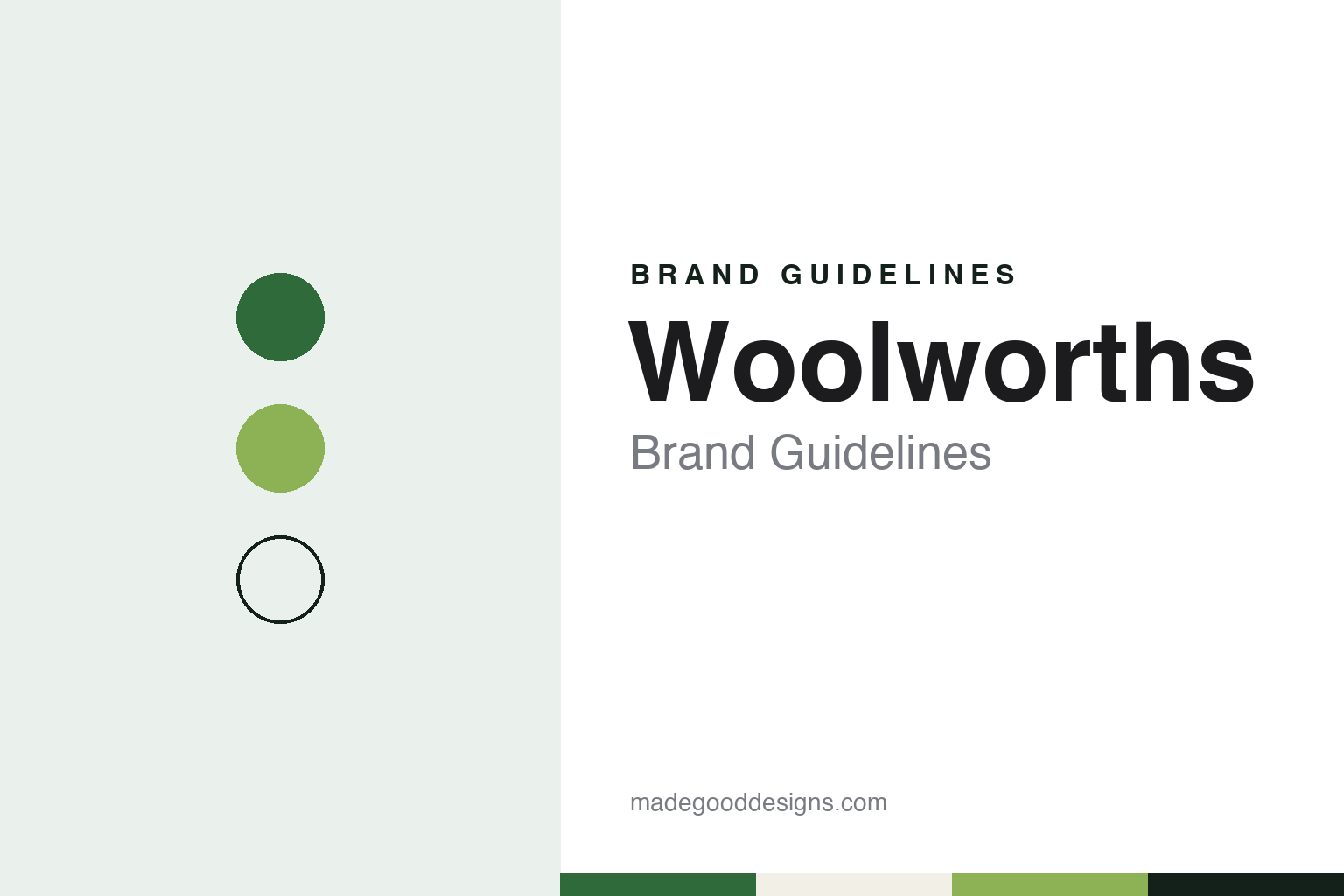
Woolworths Brand Guidelines
A 1924 Sydney bargain basement that became a trans-Tasman supermarket group.
Aa
Two constants: a green, leaf and linen palette and a rounded retail sans register. Abstract homage — not a Woolworths sign, product or mark; no logo or packaging is reproduced.
The Stupendous Bargain Basement
Five founders and a borrowed name.
Woolworths in Australia opened its first store on 5 December 1924: the Woolworths Stupendous Bargain Basement, in the old Imperial Arcade off Pitt Street, Sydney, where Westfield Sydney stands today, English Wikipedia says. It names five founders, Percy Christmas, Stanley Chatterton, Cecil Scott Waine, George Creed and Ernest Williams, among the 619 people who took up shares in the new company.
The name was borrowed. The draft prospectus, English Wikipedia says, used “Walworth’s Bazaar,” a play on the name of F.W. Woolworth, whose chain traded in the United States and Britain; according to Williams, Christmas dared him to register “Woolworths” instead, and he did so after finding the name was free to use in New South Wales. English Wikipedia is plain that the Australian company is named in tribute to the American business but is unrelated to it. It is also a different company from the South African retailer Woolworths, which was founded in Cape Town in 1931 and is now part of a separate group.
The early stores were variety stores. English Wikipedia says a second Sydney store followed in the late 1920s, along with stores in Brisbane, Perth and Wellington, in New Zealand; by the end of 1933 there were 23, and that year the first Melbourne store opened. Adelaide followed in 1936, after the purchase of eight stores from Edments, and with Hobart in 1940 Woolworths had a store in every Australian state. Its 200th store opened in Canberra’s Civic Centre in 1955. Woolworths Group dates its first New Zealand store, in Wellington, to 1929, RNZ reported in July 2023.
Colour
From variety store to supermarket.
Food came late to Woolworths. Its first food store opened at Dee Why, in Sydney, in 1957, and its first purpose-built supermarket at Warrawong, New South Wales, in 1960, English Wikipedia says; the company’s own history describes the Warrawong format as food and variety goods under one roof, with parking alongside. The first Big W discount department store opened in Tamworth, New South Wales, in 1976, the company says.
The 1980s reshaped the business. In 1985 Woolworths bought the 126 Australian stores of the American chain Safeway, which the company says had traded in Australia since 1963; English Wikipedia adds that Safeway Inc took a 20 per cent interest in Woolworths, and that the Safeway name stayed on most Victorian stores until the last one, in Wodonga, was rebranded Woolworths in 2017. In 1989 the last Woolworths Variety stores closed, and the “Family Centres” were split into Big W stores and Woolworths supermarkets. That year Industrial Equity Limited completed a compulsory acquisition of the remaining shares, on 28 April 1989, the company says, and Woolworths left the stock exchange; it was floated again in 1993.
Own labels grew alongside. The company says it introduced its first range of own brands in 1973, followed about ten years later by Home Brand, around 150 basic lines in plain black-and-white packs with a red-and-white Home Brand logo, and in 2005 by Woolworths Select, a more premium range. In 1987 it launched the “Fresh Food People” campaign after reworking buying, merchandising and training in its fresh food departments, the company says. In 2005 Woolworths returned to New Zealand by buying Progressive Enterprises, the owner of Countdown, English Wikipedia says; the Woolworths and Foodtown supermarkets there were rebranded Countdown by November 2011.
Typography
Supermarket identity.
Supermarket chains in the Philippines, Thailand, Taiwan, Australia, New Zealand and the United States present themselves through a small set of fixed things: the name on the store sign, the colours of the fascia and the carrier bag, the layout of the shop floor and the names of their own-label ranges. These are the parts of a grocery identity that shoppers meet every week, and they are the parts this guide describes.
Names often carry a group with them. In the Philippines, SM Supermarket and SM Hypermarket put the initials of the SM Group ahead of a plain descriptive word, and the SM Bonus own label repeats the same two letters, while Savemore, a third format in the same family, has a name of its own. Elsewhere, a chain may keep a founder’s name, a place name or an English word written in a local script, and this guide gives each as the company or a dated source shows it.
Ownership takes several forms. Some chains belong to listed retail groups or family conglomerates with interests far beyond food; others are run as co-operatives owned by their store operators, or as businesses owned by their employees. Where a chain has changed hands, merged or been demerged, this guide gives the owner and the date from a dated source, and describes any deal not completed as pending.
Store formats, networks and own-label ranges are given in the companies’ own terms and with their dates, because networks change quickly and a store count is only true on the day it was published. Founders, owners and retail groups are named as corporate pages and the press record them. Colours and typefaces are treated as an unofficial interpretation unless a source documents them, and no sign, logo or package is reproduced.
Aa
A rounded retail sans for signs, carts and shelf edges. (Specimen set in Nunito Sans, a sans STAND-IN; NOT the Woolworths logo.)
Woolworths
A green W, launched in January 2009.
The supermarket’s current mark dates from 12 January 2009, when Woolworths launched a corporate rebrand with a new logo, Australian Food News reported that day, calling it the biggest change to how the brand was presented since “The Fresh Food People” line arrived just over two decades earlier. The logo, created by Hans Hulsbosch of the Hulsbosch agency, was described as a stylised W resembling a green apple being peeled, with an abstract leaf for fresh food, and as recalling a Woolworths logo of the 1970s; it was also meant to suggest a person with outstretched arms. At launch it already appeared at 30 stores, out of the 780 supermarkets the chain then ran, and the report named own-label goods such as Woolworths Select among the things that carried the new mark.
The company has changed shape since. Its shareholders approved a change of name from Woolworths Limited to Woolworths Group Limited in December 2017, the company says, and in February 2022 the group took a new corporate logo designed by Re, a business design division of M&C Saatchi, English Wikipedia says. In June 2021 the drinks and hotels businesses, including Dan Murphy’s and BWS, were demerged as Endeavour Group, and Woolworths sold the last of its stake in August 2024, the same source says. The group is run from Bella Vista, in Sydney, and also owns Big W and the Everyday Rewards loyalty programme.
Across the Tasman the name has come back. In July 2023 the group announced that its 194 Countdown supermarkets in New Zealand, with 22,000 staff, would be rebranded Woolworths, alongside a new Everyday Rewards programme there, RNZ reported on 18 July 2023. English Wikipedia now lists Woolworths NZ as the group’s main New Zealand supermarket chain, next to the franchised SuperValue and FreshChoice stores.
For a design guide, Woolworths shows how a single colour and a simple letterform can carry a supermarket name across two countries and several owners. Compare Coles, its long-standing Australian rival, and New World, a New Zealand supermarket chain run by Foodstuffs. For this guide we use produce green, leaf and linen tones with a sans, an unofficial interpretation; no product or logo is reproduced.
Explore & save
Keep Woolworths’s identity on hand — save it to a board in the Made Good inspiration library.
Woolworths at a glance
First store 5 December 1924 in Sydney’s Imperial Arcade; first supermarket at Warrawong in 1960; Safeway stores bought in 1985; green W logo by Hulsbosch launched January 2009; company renamed Woolworths Group in 2017.
Source & notes
Frequently Asked Questions
What font can I use to match the Woolworths look?
This guide describes Woolworths’ type as “A rounded retail sans for signs, carts and shelf edges”. Its type specimen is set in Nunito Sans from Google Fonts as a stand-in; Nunito Sans is not Woolworths’ own lettering.
What colours are in the Woolworths palette?
This guide’s Woolworths palette is Produce green #2F6B3A, Forest ink #14211A, Leaf #8DB255, Market linen #F2F0E6 and Shelf white #FAFAF6. The tones are the guide’s own unofficial interpretation, not official Woolworths hex codes.
When was Woolworths founded?
Woolworths was founded on 5 December 1924, in Imperial Arcade, Sydney, Australia.
Who founded Woolworths?
Woolworths was founded by Percy Christmas, Stanley Chatterton, Cecil Scott Waine, George Creed and Ernest Williams on 5 December 1924.