Buffalo Exchange Brand Guidelines
A Tucson shop that buys, sells and trades clothes.
Aa
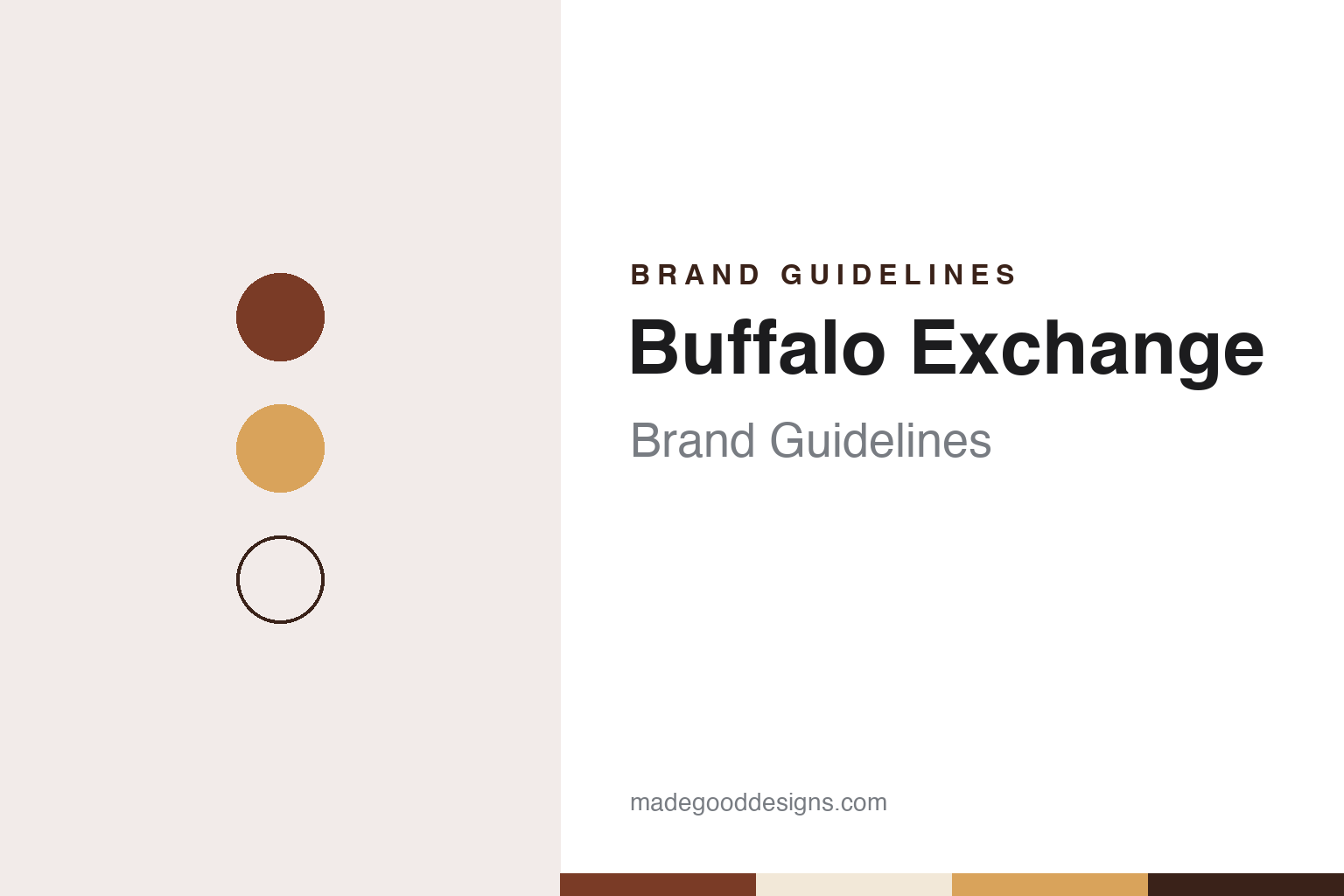
Two constants: a clay, sand and ochre palette and a western slab register. Abstract homage — not a Buffalo Exchange product or mark; no sign, logo or tag is reproduced.
Tucson, 1974
A small shop near the university, stocked from one wardrobe.
Buffalo Exchange started in Tucson, Arizona, in a shop of about 400 square feet. The company says Kerstin Block and her husband Spencer Block rented the space in 1974 and filled it at first with pieces from Kerstin’s own wardrobe; English Wikipedia gives the same year and founders. The sources differ by a year on the opening: a 2004 article in The State Press, the Arizona State University newspaper, said the Blocks opened a single Tucson storefront in 1973. The company itself dates its trading “since 1974”.
The shop stood in Tucson’s university district, 3Story Magazine reported in February 2014. Kerstin had come from Sweden to study at the University of Arizona, the company says, and had long been a keen thrift-store shopper; her idea was a second-hand shop where the sorting had already been done. In the company’s account she ran the register and did all the buying, while Spencer worked behind the scenes, building clothing racks out of water pipes and keeping the accounts. 3Story reported that the store took off within months, that Spencer soon left his job, and that the couple expanded into the space next door.
The name is part of the founding story. According to the company, Kerstin chose “Buffalo” because she liked the way it evoked the American West, and Spencer supplied “Exchange”, because exchanging was exactly what the shop would do. The result is a two-word name that pairs a regional image with a plain description of the business.
That business was the buy-sell-trade model. Buffalo Exchange buys clothing and accessories from members of the public across a counter, paying either in cash or in store trade, and resells them in the same shop. 3Story described the model as what set the company apart from thrift and consignment stores; The State Press called it a fresh idea for the time in its 2004 report.
Colour
From Arizona to the Bay Area, then across the country.
Expansion began close to home. The company says its next stores were in Tempe and a second one in Tucson; 3Story reported that within a few years there were eight, including stores in Phoenix and Tempe and in the San Francisco Bay Area, where the company says it opened several locations in the 1980s. Between 1990 and 1999, according to the company, the Blocks opened 19 new locations across California, the Southwest and the Northwest.
By its 30th anniversary the chain had grown well beyond Arizona. The State Press reported in April 2004 that Buffalo Exchange had more than 25 company stores and franchises around the United States, with Kerstin Block as president, and that she and Spencer were touring stores across the country to mark the anniversary. An assistant manager at the Tempe store on University Drive told the paper that its success depended on keeping up with fashion and on the large student population nearby, renewed each year with a new freshman class.
Ten years later the scale was larger again. In February 2014 3Story Magazine counted 49 stores in 17 states — 46 owned by the company and three franchised — and about 750 employees. Tucson by then had a fourth store, Buffalo Trading Post, which the magazine described as an “older sibling” to the original, selling clothes for older women. The company also ran two thrift outlets, in Nogales and San Antonio, which did not buy or trade. Head office occupied seven rehabilitated houses a couple of miles from the first shop, and the magazine reported that Kerstin Block still visited prospective sites herself, looking for an urban, artistic population close to a university or a city centre.
Later counts are a little lower. Writing for Forbes in May 2024, the retail columnist Walter Loeb counted about 40 Buffalo Exchange stores in the United States, and as of November 2026 the company’s website said it had over 40 stores.
Typography
Second-hand and resale chains.
Second-hand and resale chains present themselves in two broad ways. Some, such as Savers and its Value Village banner in North America, run large thrift stores stocked with donated goods that the company buys from charity partners; in Australia, Savers signs its larger shops as “thrift superstores” and has added a smaller inner-city “thrift boutique.” Others run buy-and-sell counters, where shoppers bring in their own clothes, games or equipment and are paid on the spot, as Plato’s Closet describes its stores.
Ownership shapes how these names look. Franchise systems such as Winmark’s resale brands, among them Plato’s Closet and Once Upon A Child, keep one name, one buying routine and one website across hundreds of shops that are each independently owned, as Plato’s Closet’s own pages state. Company-run chains can instead carry several regional names under one owner: Savers trades as Savers, Value Village, Village des Valeurs and Unique in different markets.
The companies in this group, in North America, the United Kingdom, Australia and Japan, range from family-founded businesses to franchisors and listed groups with private-equity owners. Their corporate pages usually tell a founding story, name the current owner and explain how the buy or donation counter works; logos, shop signs and colour schemes are shown as the companies publish them on their own sites and storefronts.
These guides set out what can be checked about each chain — who founded it, who owns it now, how its stores and counters are described, and which of those descriptions rest only on the company’s own word — and suggest an unofficial palette and a stand-in typeface for designers studying the category.
Aa
A sturdy slab serif for a name that evokes the American West. (Specimen set in Zilla Slab, a serif STAND-IN; NOT the Buffalo Exchange logo.)
Buffalo Exchange
A family company with a second generation in charge.
Buffalo Exchange has stayed in the family. 3Story Magazine reported in 2014 that Rebecca Block, Kerstin and Spencer’s daughter, had helped in the business from the age of nine, worked in the Tucson stores through high school and college, and then moved into administration; by 2014 she and her mother ran the company together from the Tucson head office. As of November 2026 the company’s website names Rebecca Block as chief executive, and English Wikipedia describes the company as owned and operated by her.
The company’s anniversaries have doubled as brand events. For its 40th birthday in 2014, 3Story reported, staff took a vintage Airstream trailer on a two-and-a-half-month road trip to every store, filling it at each stop with vintage western clothing to run it as a roving pop-up shop. Ten years earlier, The State Press reported, the founders marked the 30th anniversary by touring the stores in person.
The look of the stores is deliberately local. 3Story observed in 2014 that, despite the chain’s size, each of its stores managed to look like a small, independent business, reflecting its own neighbourhood while following shared company principles. The company’s website describes its stock in broad terms — current trends, designer pieces, everyday clothes and vintage — and says the stock is hand-selected by its buyers, most of it bought from the local community. Its online history is illustrated with archive photographs, including the founders in Tucson in the 1970s, a seller at the buy counter in 1991, the Berkeley store in 1982.
The name and the trading phrase do most of the identity work. “Buffalo” carries the western reference Kerstin Block wanted, and the words buy, sell and trade appear across the company’s pages and its in-store banners as a description of what happens at the counter. The palette in this guide is our own interpretation, drawn from the desert setting of the first shop rather than from any company material.
Forbes grouped Buffalo Exchange in 2024 with Crossroads Trading, a San Francisco chain founded in 1991 with a similar counter model, as two national chains that buy clothes from the public and resell them. Online resale, such as ThredUp, works by mail and app instead of across a counter.
For a design guide, Buffalo Exchange shows how a regional image and three plain verbs can carry a chain from one Tucson shop to stores across the country; compare it with Crossroads Trading and ThredUp. For this guide we use desert clay, adobe sand and a sunset ochre with a slab serif, an unofficial interpretation; no product or logo is reproduced.
Explore & save
Keep Buffalo Exchange’s identity on hand — save it to a board in the Made Good inspiration library.
Buffalo Exchange identity set
Pin the Buffalo Exchange clay, sand and ochre palette and the western slab register to your own board.
Source & notes
Frequently Asked Questions
What font can I use to match the Buffalo Exchange look?
This guide describes Buffalo Exchange’s type as “A sturdy slab serif for a name that evokes the American West”. Its type specimen is set in Zilla Slab from Google Fonts as a stand-in; Zilla Slab is not Buffalo Exchange’s own lettering.
What colours are in the Buffalo Exchange palette?
This guide’s Buffalo Exchange palette is Desert clay #7A3B26, Saddle brown #3A2219, Adobe sand #F2E8D8, Sunset ochre #D9A35B and Shop paper #FAF5EC. The tones are the guide’s own unofficial interpretation, not official Buffalo Exchange hex codes.
When was Buffalo Exchange founded?
Buffalo Exchange was founded in 1974 (company); 1973 in a 2004 report, in Tucson, Arizona.
Who founded Buffalo Exchange?
Buffalo Exchange was founded by Kerstin Block and Spencer Block in 1974 (company); 1973 in a 2004 report.