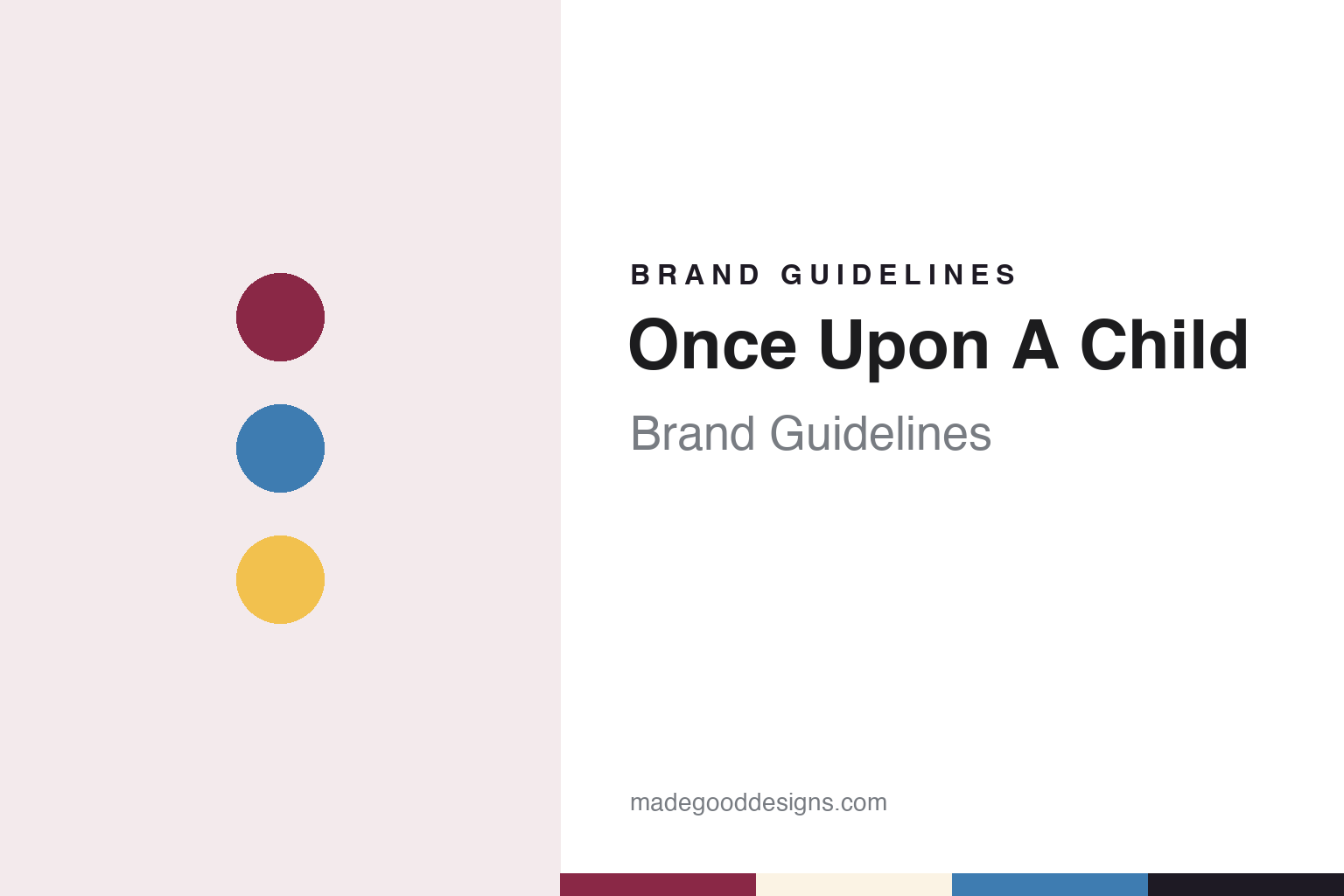
Once Upon A Child Brand Guidelines
A Perrysburg kids’ resale shop turned Winmark franchise.
Aa
Two constants: a berry, sky blue and sunny yellow palette and a Rounded sans register. Abstract homage — not a Once Upon A Child product or mark; no logo, sign or shop fitting is reproduced.
Perrysburg, Ohio
A family idea from a house full of outgrown clothes.
Once Upon A Child is a chain of resale shops for children’s clothing, shoes, toys and baby gear, run in the United States and Canada by franchisees under a brand owned by Winmark Corporation of Minneapolis. Its website describes the model plainly: the shops buy gently used kids’ items from parents and sell them on, paying sellers on the spot or letting them trade the value toward things they need now, with no appointment needed. Each shop is independently owned and operated, the website footer says, and the name is a registered trademark of Winmark.
The business began in Ohio with Dennis and Lynn Blum. The company’s founders page, published on the website of one of its Columbus shops, says Lynn Blum opened the first store in Perrysburg, Ohio, in 1984, near Toledo; the same page also gives 1985 as the founding year and describes the couple as “of Columbus, Ohio.” English Wikipedia uses 1984 in its article on the chain and 1985 in its article on Winmark. Both accounts agree on Perrysburg as the place where the first shop opened.
The idea came from the Blums’ own household. The founders page says Lynn Blum had three growing boys and knew the frustration of buying toys, clothing and equipment only to see them outgrown before they were worn out; she wanted a place where parents could buy and sell nearly new kids’ items, making and saving money at the same time. English Wikipedia’s Winmark article, citing American newspaper reports from 2002 and 2005, adds that she had been selling her sons’, friends’ and neighbors’ clothes at weekly garage sales from her house, that the idea took shape after the couple saw Goodwill accepting and selling used baby clothes, and that Dennis Blum left his job in 1989 to work in the business with her.
Colour
Franchising rights sold in 1992.
The chain became a franchise in 1992. That year, the founders page says, the Blums sold the franchising rights to Growbiz International, “now known as Winmark Corporation.” English Wikipedia dates that franchisor to 1988, when Ron Olson and Jeffrey Dahlberg incorporated it in Minneapolis as Play It Again Sports Franchise Corporation, after buying the franchise rights to the used sporting-goods chain Play It Again Sports from its founder, Martha Morris. It took the name Grow Biz International in June 1993, listed its shares on Nasdaq that August, and renamed itself Winmark in 2001.
The parent changed course in the early 2000s. English Wikipedia says John Morgan replaced Dahlberg as chief executive in March 2000, closed failing Play It Again Sports stores, sold the Retool, Computer Renaissance and Disc Go Round franchises around 2002, and moved the company from owning stores itself to having franchisees own all of them. Brett Heffes succeeded Morgan as chief executive in February 2016, the same article says.
The Blums kept their own link to the brand as operators. The founders page says they continue to own and run eight Once Upon A Child stores in the Columbus and Toledo areas, along with other resale concepts not affiliated with Winmark. They also started a second chain, Plato’s Closet, for teenagers and young adults, which Winmark bought from them in 1998, according to English Wikipedia.
Winmark now franchises five resale brands — Plato’s Closet, Once Upon A Child, Play It Again Sports, Music Go Round and Style Encore — according to its website. English Wikipedia, citing a 2011 report in the Pennsylvania newspaper Times Leader, gives Once Upon A Child 240 locations in the United States and 24 in Canada that year. In its results release of 14 October 2026, Winmark said there were 1,398 franchises in operation across its five brands at 26 September 2026, with a further 79 awarded but not yet open; the release did not break the figure down by brand.
Typography
Design and documentation.
Second-hand and resale chains present themselves in two broad ways. Some, such as Savers and its Value Village banner in North America, run large thrift stores stocked with donated goods that the company buys from charity partners; in Australia, Savers signs its larger shops as “thrift superstores” and has added a smaller inner-city “thrift boutique.” Others run buy-and-sell counters, where shoppers bring in their own clothes, games or equipment and are paid on the spot, as Plato’s Closet describes its stores.
Ownership shapes how these names look. Franchise systems such as Winmark’s resale brands, among them Plato’s Closet and Once Upon A Child, keep one name, one buying routine and one website across hundreds of shops that are each independently owned, as Plato’s Closet’s own pages state. Company-run chains can instead carry several regional names under one owner: Savers trades as Savers, Value Village, Village des Valeurs and Unique in different markets.
The companies in this group, in North America, the United Kingdom, Australia and Japan, range from family-founded businesses to franchisors and listed groups with private-equity owners. Their corporate pages usually tell a founding story, name the current owner and explain how the buy or donation counter works; logos, shop signs and colour schemes are shown as the companies publish them on their own sites and storefronts.
These guides set out what can be checked about each chain — who founded it, who owns it now, how its stores and counters are described, and which of those descriptions rest only on the company’s own word — and suggest an unofficial palette and a stand-in typeface for designers studying the category.
Aa
A rounded sans — a family shop’s friendly register. (Specimen set in Nunito, a sans STAND-IN; NOT the Once Upon A Child logo.)
Once Upon A Child
Buy, sell or trade, with no appointment.
The franchised model shows most clearly at street level. In July 2026 News 12 Connecticut reported the opening of a Once Upon A Child on Westport Avenue in Norwalk, describing it as a children’s resale store that specialises in gently used kids’ items and pays parents cash for pieces their children have outgrown, and as part of Winmark’s franchise network; the report named a local owner, in line with the footer note that each franchise is independently owned and operated.
How a shop decides what to buy is set out in local terms. English Wikipedia, citing a store’s own question-and-answer page, says items are checked against guidelines on condition, style and brand that vary by location, and that clothes, shoes and accessories are normally accepted only if they are no more than about five years old, though this too varies by item and shop. The brand’s website keeps its language short and family-facing — buy, sell, trade, save — and uses the registered line “Kids’ Stuff With Previous Experience.” Its founders page carries photographs captioned “Original Signage” from the early shops. Winmark, in turn, presents itself across its five brands as “the Resale Company.”
For a design guide, Once Upon A Child shows how a family shop’s idea can travel through a franchise system while its founders keep running stores under the same name. Compare Plato’s Closet, the Blums’ second chain, also franchised by Winmark, and Goodwill, whose sale of used baby clothes, English Wikipedia says, helped prompt the Blums’ idea. For this guide we use a berry, a sky blue and a sunny yellow with a rounded sans, an unofficial interpretation; no product or logo is reproduced.
Explore & save
Keep Once Upon A Child’s identity on hand — save it to a board in the Made Good inspiration library.
Once Upon A Child identity set
Pin the Once Upon A Child berry, sky blue and sunny yellow palette and the Rounded sans register to your own board.
Source & notes
Frequently Asked Questions
What font can I use to match the Once Upon A Child look?
This guide describes Once Upon A Child’s type as “A rounded sans — a family shop’s friendly register”. Its type specimen is set in Nunito from Google Fonts as a stand-in; Nunito is not Once Upon A Child’s own lettering.
What colours are in the Once Upon A Child palette?
This guide’s Once Upon A Child palette is Berry #8A2846, Ink #1E1A24, Sky blue #3E7CB1, Sunny yellow #F2C14E and Paper #FBF7EF. The tones are the guide’s own unofficial interpretation, not official Once Upon A Child hex codes.
When was Once Upon A Child founded?
Once Upon A Child was founded in 1984 first shop (company also gives 1985), in Perrysburg, Ohio.
Who founded Once Upon A Child?
Once Upon A Child was founded by Dennis and Lynn Blum in 1984 first shop (company also gives 1985).