Mothercare Brand Guidelines
The 1961 Surrey nursery shop that became a franchise brand.
Aa
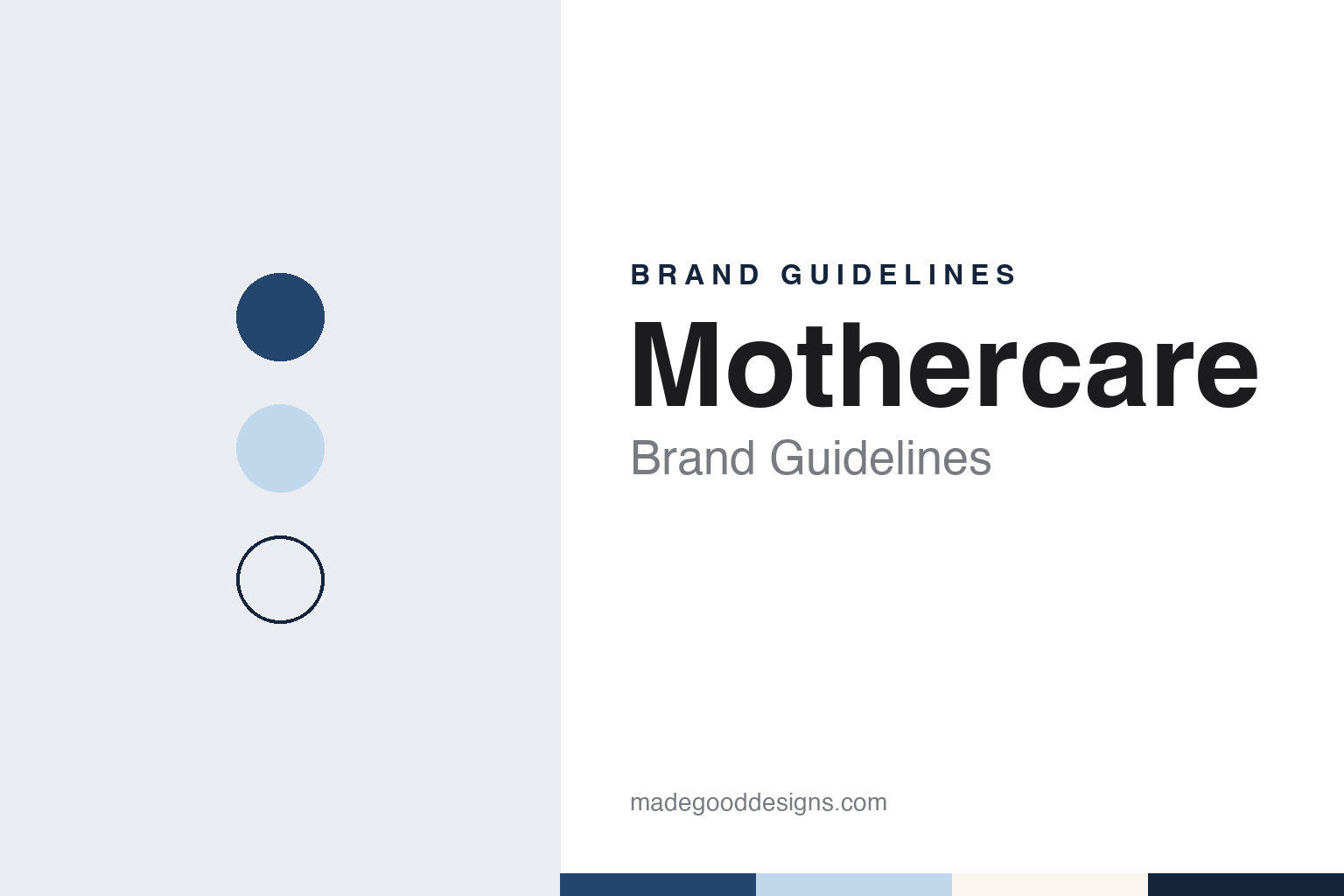
Two constants: a navy, pale sky and cream palette and a friendly sans register. Abstract homage — not a Mothercare product or mark; no logo, shopfront or catalogue is reproduced.
A shop in Surrey
Pushchairs, nursery furniture and maternity clothes.
Mothercare opened its first shop in 1961 in Surrey, England, the company says; its own history page shows a Kingston shopfront from that year. The first stores concentrated on pushchairs, nursery furniture and maternity clothing. The retail news site TheIndustry.fashion, in a timeline published in November 2019, names the founders as the entrepreneurs Selim Zilkha and Sir James Goldsmith.
The business grew quickly beyond the shop floor. Mothercare says it started a mail-order business in 1962, and its history pictures catalogues from the autumn of that year onwards. The range was later widened to clothing for children up to the age of five, and then up to eight, the company says.
Corporate changes followed. The company became public in 1972, Mothercare says, and in 1982 merged with the Habitat home-furnishings chain to form Habitat Mothercare plc. In 1986 that group joined British Home Stores under the Storehouse name. The group was rationalised in the 1990s, the BHS and Habitat businesses were sold off separately, and in 2000 Mothercare became the sole brand, with the holding company renamed Mothercare plc, according to both the company and TheIndustry.fashion.
Franchising began early. Mothercare says it started to expand abroad in 1984 through franchise arrangements with selected partners in chosen countries, and that franchises are awarded to one partner per territory. At home, the group bought Chelsea Stores Holdings, owner of the Early Learning Centre toy chain, in June 2007; by then, TheIndustry.fashion reported, Mothercare had more than 350 outlets in the UK.
Colour
The UK chain closed; the brand carried on.
The British store estate shrank through the 2010s. TheIndustry.fashion reported that by November 2017 Mothercare had 152 UK stores, and that in May 2018 creditors approved a Company Voluntary Arrangement, a form of restructuring; 55 stores eventually closed under the plan and its later extension. In December 2018 it sold and leased back its UK head offices. In March 2019 it agreed to sell the Early Learning Centre brand to the toy retailer The Entertainer, which the company says then ran the toy offer in Mothercare stores and online; Mothercare called the sale the “next step towards being free of bank debt,” TheIndustry.fashion reported. In July 2019 the retailer warned that UK margins were improving more slowly than it had forecast.
On 4 November 2019 Mothercare said it would file a notice to appoint administrators for its UK retail business, which then had 79 shops and about 2,500 staff, TheIndustry.fashion reported. The company’s history records that Mothercare UK Limited entered administration in November 2019 and that all UK stores and the UK online shop closed in early January 2020. The Mothercare shop chain on British high streets has not traded since then.
The company keeps a visual record of that high-street period. Its history page shows catalogues from 1962, 1972, 1987, 1999, 2007, 2012 and 2017, and shopfronts in Kingston in 1961, Barnstaple in 1991, Grays in 1997, Northampton in 2007 and Plymouth in 2018, a record that spans almost six decades of British stores.
What survived was the brand and the international business. Mothercare plc owns Mothercare Global Brand Limited, which the company says designs, sources and supplies clothing and baby, nursery, bath-time and play-time products to franchise partners. The partners run the shops under the Mothercare trade mark. The company describes formats that range from small shop-in-shop units to mid-sized high-street stores and larger out-of-town or shopping-mall stores, with ranges adjusted for local climates and customers.
Typography
How nursery chains present themselves.
Baby and nursery store chains in the UK, France, Germany, Italy, the United States and Australia sell to families at the same moment in life, but each presents itself in its own way. The shop sign and logo are the first point of contact, and the same name is carried onto catalogues and websites; Mothercare’s history page, for example, shows its catalogues from 1962 onwards beside shopfronts from Kingston in 1961 to Plymouth in 2018. Colour schemes are each company’s own choice.
Store formats run from large nursery superstores to high-street shops and shop-in-shop counters inside other retailers. Mothercare describes a range from small shop-in-shop units to mid-sized high-street stores and larger out-of-town or shopping-mall stores, while PRG Retail Group describes Prénatal’s Italian network as a mix of shops and megastores, including a two-floor store near Milan shared with the Toys Center banner.
Franchising is one route abroad. Mothercare says it began franchising in 1984 and awards one partner per territory, so the same name can appear over stores run by different companies in different countries. Own-label ranges sit beside branded nursery goods, and the companies name and describe those ranges themselves on their websites and in their catalogues.
Corporate pages tell the rest of the story: founders, owners and changes of ownership. Mothercare and Prénatal have both passed through mergers, private-equity ownership or sale, and Mothercare’s British shops closed after its UK arm entered administration in 2019. For a design reader, these pages are a direct record of how a name, a sign and a palette have travelled through those changes.
Aa
A plain, friendly sans for a high-street name. (Specimen set in DM Sans, a sans STAND-IN; NOT the Mothercare logo.)
A franchise brand
Boots, Reliance and ebebek.
Back in Britain, Mothercare named Boots UK as its exclusive UK franchise partner in autumn 2020, the company says. That arrangement ended at the close of 2025, FashionUnited reported in August 2026, and the company said it was in negotiations for a new retail distribution partner for the UK market.
Abroad, the model has narrowed and shifted. In 2022 franchise operations in Russia were suspended and the brand was later withdrawn from the territory, Mothercare says. In October 2024 it completed a joint venture with Reliance Brands, a subsidiary of India’s Reliance Industries, covering the Mothercare brand in South Asia, with Reliance holding 51 per cent and Mothercare keeping 49 per cent, FashionUnited reported. FashionUnited reported in September 2025 that Mothercare had also signed a ten-year licence agreement with the Turkish retailer ebebek.
The partners’ store count has fallen. FashionUnited reported that franchise partners ended the year to March 2026 with 331 Mothercare stores, down from 372 a year earlier, with the end of the Boots arrangement and instability in Middle Eastern markets named as the main pressures. FashionUnited also reported that the company is moving to an asset-light franchising model and expects ongoing sourcing fees alongside returns from its stake in the South Asian joint venture.
For a design guide, Mothercare shows a brand that has outlived its own shops: a name built on British high streets that now reaches customers through partners who run stores, shop-in-shops and websites under the Mothercare trade mark. Compare Mamas & Papas, another British nursery name, and Babies “R” Us, an American baby-store name whose home chain also closed. For this guide we use a navy, a pale sky blue and a cream with a sans, an unofficial interpretation; no product or logo is reproduced.
Explore & save
Keep Mothercare’s identity on hand — save it to a board in the Made Good inspiration library.
Mothercare identity set
Pin the Mothercare navy, pale sky and cream palette and the friendly sans register to your own board.
Source & notes
Frequently Asked Questions
What font can I use to match the Mothercare look?
This guide describes Mothercare’s type as “A plain, friendly sans for a high-street name”. Its type specimen is set in DM Sans from Google Fonts as a stand-in; DM Sans is not Mothercare’s own lettering.
What colours are in the Mothercare palette?
This guide’s Mothercare palette is Harbour navy #24466E, Night ink #14243A, Pale sky #BFD8EC, Nursery cream #FAF6EF and Apricot #E9A27C. The tones are the guide’s own unofficial interpretation, not official Mothercare hex codes.
When was Mothercare founded?
Mothercare was founded in 1961, in Surrey, England.
Who founded Mothercare?
Mothercare was founded by Selim Zilkha and Sir James Goldsmith in 1961.