Aubert Brand Guidelines
The Alsace pram seller that became a French nursery chain.
Aa
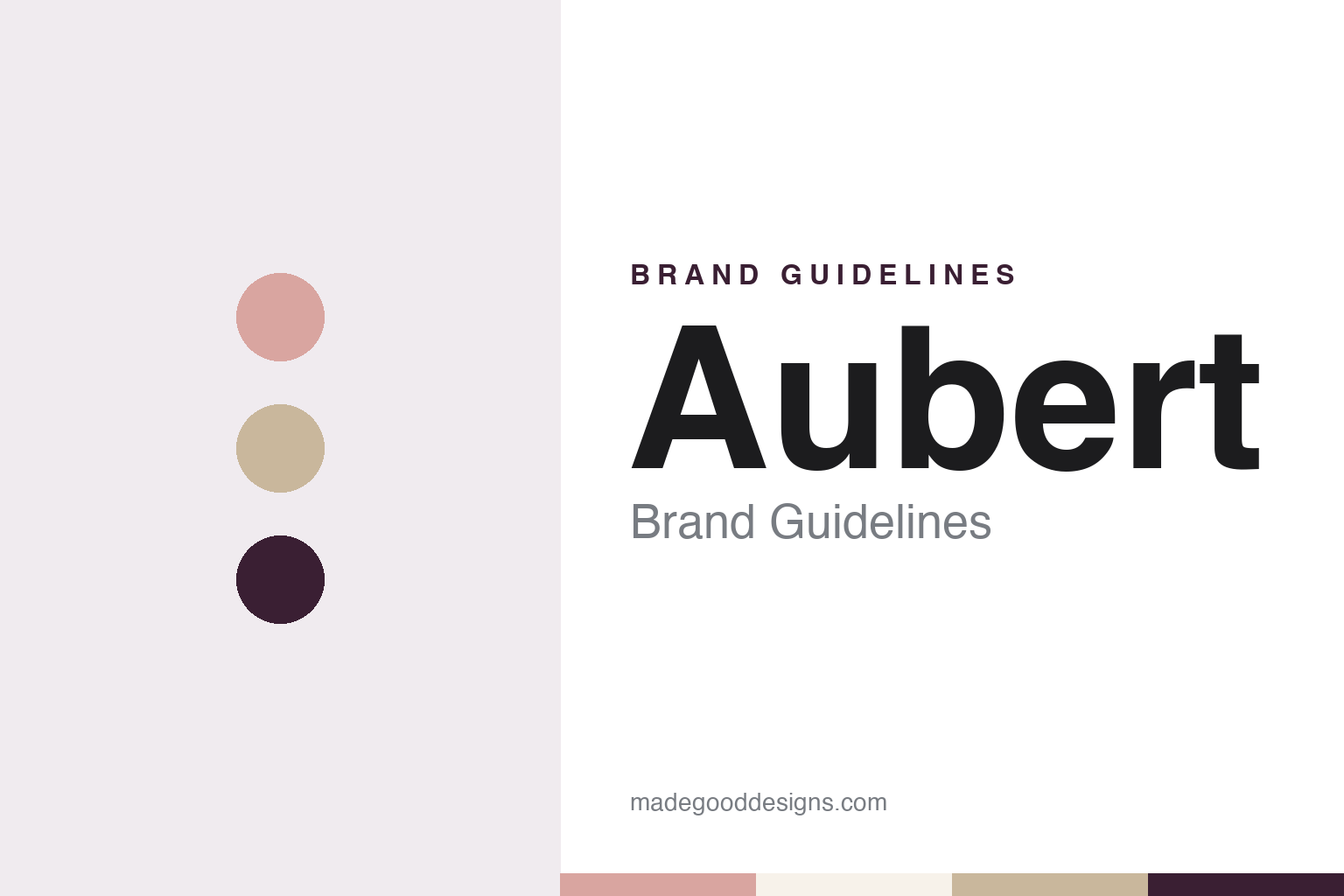
Two constants: a soft rose, warm sand and plum palette and a bookish serif register. Abstract homage — not an Aubert product or mark; no logo, sign or packaging is reproduced.
Cernay, 1931
A family business in Alsace.
Aubert is a French chain of nursery stores based in Cernay, a town in the Haut-Rhin department of Alsace. The company dates its history to 1931, when, it says, M. Aubert founded the family business in Cernay; the French brand encyclopedia Bible des marques, in an entry last updated in June 2021, gives the same year, town and founder. The French business register, as published in the government’s company directory in November 2026, records the present company, Aubert SAS, with a creation date of 1957 and its head office in Cernay.
The sources used for this guide do not say how the business operated during the occupation of 1940–1944.
Aubert’s own timeline describes a business that began with prams and selling at a distance. From 1959, the company says, Aubert sold its prams and pushchairs — landaus et poussettes — directly to customers by mail order, and in 1983 it widened the range to cover mealtimes, bathing, furniture and life at home. Its first shop in the Paris region opened in 1985, on 80 square metres, according to the company; Bible des marques lists the same date for a first shop in Paris.
In 1994, the company says, Aubert gave up mail order altogether and concentrated on its shops, which from then on also stocked other nursery brands alongside its own. Both the company and Bible des marques treat that year as the turning point from catalogue to store chain. The pram-making past still shows in reference works: French Wikipedia’s article on pushchairs lists Aubert, with Houssen in Alsace, among the main makers it names, alongside Bébé Confort, Bugaboo and Chicco.
Colour
From catalogue to store chain.
The store network grew quickly after the switch. Aubert says it put the first French online nursery shop, aubert.com, on line in 2000 — a “first” that rests on the company’s own word — and opened its first 1,500-square-metre store on the edge of Paris in 2001. By 2006, the company says, its French network had reached 200 stores. Bible des marques notes that by 2016 the range ran to more than 15,000 product references.
Own labels became a larger part of the offer in the 2010s. In 2011 Aubert strengthened its own brands with Aubert Concept, which the company presents as a return to its first calling as a maker, and Formula Baby, its entry-price range. Bible des marques records a 2013 television advert for Aubert Concept nappies. In 2014, the company says, it launched a loyalty card, the Carte Privilège, and a co-branding arrangement with Disney Baby for Aubert Concept; in 2015 it took on William Kent 1733 prams as an exclusive range and added a two-hour click-and-collect service. Its loyalty programme now runs under the name Aubert family.
The company’s wording has long centred on parenthood. Bible des marques lists the slogan “Le plaisir d’être parents” — the pleasure of being parents — and the company’s website still speaks of “le plaisir inégalé d’être parents.” Parents can create a liste de naissance, a birth list that friends and family contribute to, and the website groups its range into prams, nursery furniture, early-learning toys, bath and changing, baby clothing and maternity wear.
Typography
Nursery chains and their signs.
Baby and nursery store chains in the UK, France, Germany, Italy, the United States and Australia sell to families at the same moment in life, but each presents itself in its own way. The shop sign and logo are the first point of contact, and the same name is carried onto catalogues and websites; Mothercare’s history page, for example, shows its catalogues from 1962 onwards beside shopfronts from Kingston in 1961 to Plymouth in 2018. Colour schemes are each company’s own choice.
Store formats run from large nursery superstores to high-street shops and shop-in-shop counters inside other retailers. Mothercare describes a range from small shop-in-shop units to mid-sized high-street stores and larger out-of-town or shopping-mall stores, while PRG Retail Group describes Prénatal’s Italian network as a mix of shops and megastores, including a two-floor store near Milan shared with the Toys Center banner.
Franchising is one route abroad. Mothercare says it began franchising in 1984 and awards one partner per territory, so the same name can appear over stores run by different companies in different countries. Own-label ranges sit beside branded nursery goods, and the companies name and describe those ranges themselves on their websites and in their catalogues.
Corporate pages tell the rest of the story: founders, owners and changes of ownership. Mothercare and Prénatal have both passed through mergers, private-equity ownership or sale, and Mothercare’s British shops closed after its UK arm entered administration in 2019. For a design reader, these pages are a direct record of how a name, a sign and a palette have travelled through those changes.
Aa
A calm, bookish serif for a family name. (Specimen set in Lora, a serif STAND-IN; NOT the Aubert logo.)
Aubert today
A smaller network, still in Cernay.
The network today is smaller than the 2006 figure. The company’s website describes Aubert as 95 stores in France and Switzerland, with more than 1,000 nursery specialists, together with a website for parents; the French business register listed 93 open establishments for the company in November 2026. The register shows Aubert SAS as an active company, classed as a mid-sized enterprise in specialised retail, with its head office still in Cernay.
The website describes Aubert as the family business created by M. Aubert and calls it “le leader de la puériculture,” the leader in French nursery retail; both are the company’s own descriptions. It says its stores offer thousands of product references, gathering in one place what the market offers across a range of prices, and it names Aubert Concept and Formula Baby as its own labels alongside the outside brands it stocks.
Around the shops, the website sets out the services that hold the network together: two-hour collection in store for online orders, a gift card, store events, the Aubert family loyalty programme and the birth list. It also publishes buying guides for parents, among them how to choose a pushchair and what to prepare before a baby arrives, alongside a size guide for its clothing. The company’s headline for its history is “plus de 80 ans au service de Bébé” — more than eighty years at baby’s service — a line that counts from the 1931 founding the company gives.
For a design guide, Aubert shows how a family pram seller turned its name into a store sign and an own-label range. Compare Vertbaudet, another French children’s retailer, and Natalys, a French baby and maternity chain. For this guide we use a soft rose, a warm sand and a deep plum with a serif, an unofficial interpretation; no product or logo is reproduced.
Explore & save
Keep Aubert’s identity on hand — save it to a board in the Made Good inspiration library.
Aubert identity set
Pin the soft rose, warm sand and plum palette and the bookish serif register to your own board.
Source & notes
Frequently Asked Questions
What font can I use to match the Aubert look?
This guide describes Aubert’s type as “A calm, bookish serif for a family name”. Its type specimen is set in Lora from Google Fonts as a stand-in; Lora is not Aubert’s own lettering.
What colours are in the Aubert palette?
This guide’s Aubert palette is Soft rose #D9A5A0, Deep plum #3A1F33, Plum #6B3A5B, Warm sand #C9B79C and Linen #F7F2EA. The tones are the guide’s own unofficial interpretation, not official Aubert hex codes.
When was Aubert founded?
Aubert was founded in 1931 (company account), in Cernay, Alsace, France.
Who founded Aubert?
Aubert was founded by M. Aubert in 1931 (company account).