Babies “R” Us Brand Guidelines
The nursery chain that closed in 2018 and came back inside other stores.
Aa
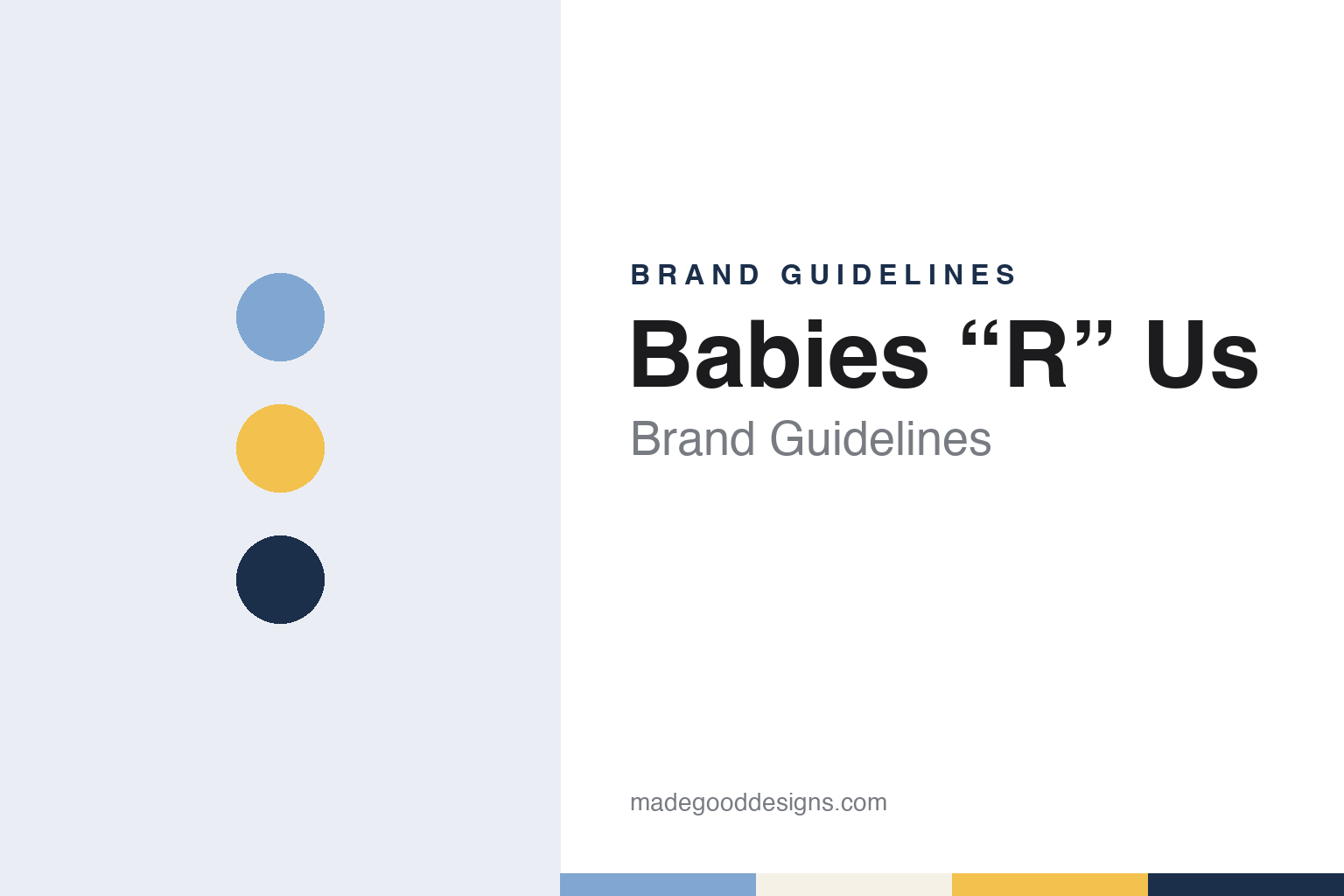
Two constants: a nursery blue, warm yellow and navy palette and a rounded sans register. Abstract homage — not a Babies “R” Us product or mark; no logo, sign or packaging is reproduced.
Westbury and Greenville
A toy giant’s baby offshoot, and the rival it bought.
Babies “R” Us began as the baby-products offshoot of Toys “R” Us, the American retailer that Charles Lazarus founded in Washington, D.C., in 1948 as a baby-furniture shop called Children’s Supermart, according to English Wikipedia. Lazarus refocused the business on toys in 1957 and designed the Toys “R” Us logo himself, with a backwards “R” meant to look as if a child had written it, the same article says. The “R” Us name pattern later carried over to sister chains: Kids “R” Us for children’s clothing from 1983, and Babies “R” Us for the nursery.
The baby chain had two starting points. According to the International Directory of Company Histories profile of Baby Superstore, republished by FundingUniverse, Toys “R” Us announced in 1994 that it would open five Babies “R” Us stores in 1995; English Wikipedia dates the first Babies “R” Us store to April 1996, in Westbury, New York.
The second starting point was a rival in South Carolina. Jack Tate opened the first Carolina Baby shop in Greenville in March 1971, the company history says, with furniture, clothing and toys for babies and children in one shop. After an experimental 20,000-square-foot superstore in Marietta, Georgia, in 1987, he renamed the company Baby Superstore and moved the chain to the larger format. In 1992 its stores borrowed an idea from the hardware chain Home Depot: interior walls came out, back-room space shrank, and stock was piled high along long, wide aisles.
In February 1997 Toys “R” Us acquired Baby Superstore, then a 78-store chain based in Duncan, South Carolina, English Wikipedia says, and converted the stores to the Babies “R” Us name. The chain grew to about 260 stores in the United States, according to the same source, selling products for newborns, infants and toddlers and running a gift registry for expectant parents. From 2011 Toys “R” Us also opened co-branded stores with Babies “R” Us departments.
Colour
Superstore aisles, a registry and a liquidation.
Babies “R” Us inherited the superstore idea it had bought. Baby Superstore’s 40,000-square-foot stores of 1994 stocked about 25,000 items from 500 suppliers, the company-history profile says, grouped into departments such as furniture and clothing for children up to the age of three. That model — one large store holding the whole nursery list — became the Babies “R” Us format, with the gift registry at its centre. Parents built a list, and friends and family bought from it; English Wikipedia describes Babiesrus.com as offering baby products and access to the registry.
The parent company’s finances decided the chain’s fate. A consortium of Bain Capital, KKR and Vornado Realty Trust took Toys “R” Us private in a leveraged buyout announced in March 2005, English Wikipedia says. On 18 September 2017 Toys “R” Us, Inc. filed for Chapter 11 bankruptcy. In January 2018 it said it would close up to 182 US stores and convert up to 12 into co-branded Toys “R” Us and Babies “R” Us stores, and on 15 March 2018 the bankruptcy court approved the liquidation of its stores.
That day the Philadelphia station 6abc reported that liquidation sales would run over the following months at more than 740 Toys “R” Us and Babies “R” Us stores across the United States, with gift cards honoured for 30 days and registries kept active. Toys “R” Us permanently closed all of its remaining US locations on 29 June 2018, according to English Wikipedia, which ended the original Babies “R” Us store chain in the country.
Typography
Nursery chains and their signs.
Baby and nursery store chains in the UK, France, Germany, Italy, the United States and Australia sell to families at the same moment in life, but each presents itself in its own way. The shop sign and logo are the first point of contact, and the same name is carried onto catalogues and websites; Mothercare’s history page, for example, shows its catalogues from 1962 onwards beside shopfronts from Kingston in 1961 to Plymouth in 2018. Colour schemes are each company’s own choice.
Store formats run from large nursery superstores to high-street shops and shop-in-shop counters inside other retailers. Mothercare describes a range from small shop-in-shop units to mid-sized high-street stores and larger out-of-town or shopping-mall stores, while PRG Retail Group describes Prénatal’s Italian network as a mix of shops and megastores, including a two-floor store near Milan shared with the Toys Center banner.
Franchising is one route abroad. Mothercare says it began franchising in 1984 and awards one partner per territory, so the same name can appear over stores run by different companies in different countries. Own-label ranges sit beside branded nursery goods, and the companies name and describe those ranges themselves on their websites and in their catalogues.
Corporate pages tell the rest of the story: founders, owners and changes of ownership. Mothercare and Prénatal have both passed through mergers, private-equity ownership or sale, and Mothercare’s British shops closed after its UK arm entered administration in 2019. For a design reader, these pages are a direct record of how a name, a sign and a palette have travelled through those changes.
Aa
A rounded, friendly sans for a nursery name. (Specimen set in Nunito, a sans STAND-IN; NOT the Babies “R” Us logo.)
Babies “R” Us today
A brand carried into other companies’ stores.
The name outlived the stores. In October 2018 a bankruptcy filing said the company’s controlling lender planned to revive the business behind the Toys “R” Us and Babies “R” Us names rather than auction them, and on 20 January 2019 the company emerged from bankruptcy as Tru Kids, English Wikipedia says. In March 2021 the brand-management company WHP Global announced that it had acquired a controlling interest in Tru Kids, the parent of the Toys “R” Us, Babies “R” Us and Geoffrey the Giraffe brands.
Under WHP the brand returned through partners rather than a chain of its own. In April 2023 ABC7 New York reported that Babies “R” Us would open a 10,000-square-foot flagship inside the American Dream mall in New Jersey, its first physical store in six years; English Wikipedia dates the opening to July 2023. The same encyclopedia records stores in Brazil, in São Paulo state and in Rio de Janeiro, in 2023 and 2024, and a Babies “R” Us area inside a Liverpool department store in Mexico City from late 2024.
The widest return came through the department store Kohl’s. Retail Dive reported on 9 May 2024 that Kohl’s, which had announced the partnership with WHP Global-owned Babies “R” Us in March, would open shops of 750 to 2,500 square feet in states including Texas, California, Michigan and Florida, and would become the exclusive retailer for the Babies “R” Us at Kohl’s online gift registry. On 14 September 2026 the same publication reported that the partnership, launched in 2024 at about 200 Kohl’s locations, was adding shop-in-shops in 56 more stores — 25 of them in California and 20 in Texas — together with an exclusive collection of bibs, blankets and crib sheets in coordinated designs.
Babies “R” Us today is therefore a brand owned by WHP Global and sold mainly through shop-in-shops and partner stores, not the stand-alone American chain that traded from 1996 to 2018. For a design guide, Babies “R” Us shows how a retail name can be separated from its buildings and carried into other companies’ stores. Compare Toys “R” Us, its sister brand under the same owner, and Mothercare, a British nursery retailer. For this guide we use a nursery blue, a warm yellow and a deep navy with a rounded sans, an unofficial interpretation; no product or logo is reproduced.
Explore & save
Keep Babies “R” Us’s identity on hand — save it to a board in the Made Good inspiration library.
Babies “R” Us identity set
Pin the nursery blue, warm yellow and navy palette and the rounded sans register to your own board.
Source & notes
Frequently Asked Questions
What font can I use to match the Babies “R” Us look?
This guide describes Babies “R” Us’ type as “A rounded, friendly sans for a nursery name”. Its type specimen is set in Nunito from Google Fonts as a stand-in; Nunito is not Babies “R” Us’ own lettering.
What colours are in the Babies “R” Us palette?
This guide’s Babies “R” Us palette is Nursery blue #7FA7D1, Deep navy #1B2E4A, Registry blue #2C5A8C, Warm yellow #F2C14E and Cream #F6F1E7. The tones are the guide’s own unofficial interpretation, not official Babies “R” Us hex codes.
When was Babies “R” Us founded?
Babies “R” Us was founded in April 1996 (first store), in Westbury, New York, US.
Who owns Babies “R” Us?
Babies “R” Us is owned by Toys “R” Us, Inc. (until 2018).