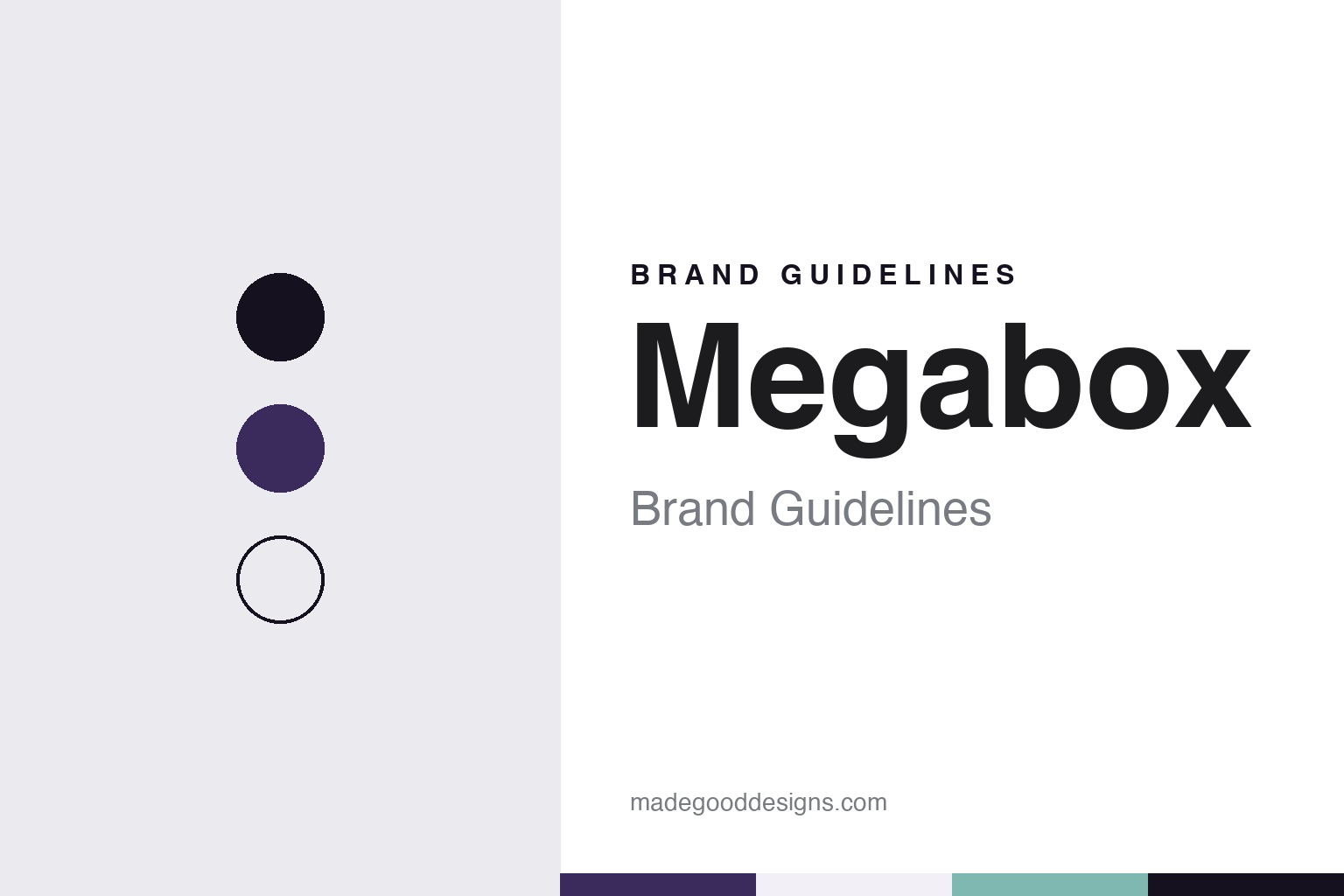
Megabox Brand Guidelines
Korea’s third cinema chain, from COEX to rehabilitation.
Aa
Two constants: a deep violet, lobby white and soft teal palette and a clean Korean gothic sans register. Abstract homage — not a Megabox asset or mark; no logo, sign or poster is reproduced.
COEX, 2000
A joint venture and a mall in Gangnam.
Megabox began as a joint venture. English Wikipedia says it was established in 2000 by the Korean confectionery group Orion and the North American exhibitor Loews Cineplex Entertainment; Korean Wikipedia gives the venture’s first name as Megabox Cineplex, and says it then took over a cinema business that the Daewoo group had been preparing before adopting the Megabox name.
The first site opened in the COEX Mall in Samseong-dong, in Seoul’s Gangnam district, on 13 May 2000, according to Korean Wikipedia, which describes it as the chain’s first multiplex. English Wikipedia says a second site followed two years later in Busan, for the city’s international film festival, and that the chain grew to 14 branches in its early years.
Ownership changed within the decade. Korean Wikipedia says the chain was bought in 2007 by a fund linked to Australia’s Macquarie. The Asian private equity title AVCJ reported in September 2014 that a consortium including Macquarie and Korea’s National Pension Service had bought its stake in 2007, holding it through a vehicle called Korea Multiplex Investment, and that the stake was being offered for sale. The same report said the three largest Korean multiplex operators — CJ CGV, Lotte Cinema and Megabox — together controlled 95 percent of the market in 2013.
Megabox’s name has also been used by unrelated businesses: English Wikipedia lists a shopping mall in Kowloon Bay, Hong Kong, and a former music service under the same name. English Wikipedia says the cinema chain styles its name as MEGABOX; in Korean it is 메가박스.
Colour
Cinus, JoongAng and a hundred sites.
The chain’s long-term owner came through another cinema company. Cinus, a Korean chain built from smaller theatres such as Gangnam Central 6 and Bundang Cine Plaza, was acquired in September 2008 by ISPlus, an affiliate of the newspaper group JoongAng Ilbo, English Wikipedia says; ISPlus later renamed itself Jcontentree. Cinus acquired Megabox in 2010, and the two companies merged on 20 May 2011, trading for a time as Megabox Cinus. On 1 November 2011 the Cinus brand was folded into Megabox and the two websites were combined, according to both language editions.
The merged chain mixes directly run cinemas with sites operated under consignment. Korean Wikipedia says consignment cinemas once traded under a separate brand, Megaline, before being brought under the Megabox name, and that the company runs a membership scheme in which customers collect MegaPoint points.
Korean Wikipedia records several milestones. In 2017 the company declared a new brand identity. In 2018 it opened its 100th site, at the Seoul World Cup Stadium in Sangam, and changed its corporate name to Megabox JoongAng. In 2019 it moved its head office from Gangnam to Wangsimni-ro in Seongdong district, into a building called Megabox Square that also houses the Megabox Seongsu cinema.
Its special auditoriums carry their own names. Korean Wikipedia lists Dolby Cinema halls at sites including COEX, a Dolby Atmos format it describes as an upgrade of its M2 halls, The Boutique, which it calls a premium hall with the character of a boutique hotel, a Balcony hall at Bundang, and Megabox Kids, children’s auditoriums with bright, high-definition screens. Comfort halls, with tables and two-armrest seats, are spread across dozens of sites.
By the mid-2020s Megabox was the third-largest chain in the country. Citing the Korean Film Council, the Yonhap report published by The Korea Times in May 2025 gave Megabox 767 screens in 2024, behind CGV with 1,346 and Lotte Cinema with 915.
Typography
How cinema chains present themselves.
This group of guides looks at cinema chains in France, Central and Eastern Europe, Germany, Finland, South Korea, Singapore, Malaysia, the United Kingdom and Australia, and at how each presents itself: the name over the entrance, the signs, logos and colour schemes the companies publish, and the way that name carries over to tickets, websites and apps. The palettes shown here are our own interpretations, not official colour values.
Formats are part of that presentation. Some operators label their auditoriums with the premium and large-format systems they install, such as IMAX, 4DX, ScreenX or Dolby Atmos sound, and with their own names for reclining seats or VIP rooms, as Cinema City’s national websites do. City-centre multiplexes carry house labels too: UGC has grouped its large multiplexes under the Ciné Cité name since 1995.
Ownership varies. Some chains belong to larger cinema groups, as Cinema City has belonged to Cineworld since 2014; others sit inside film and media companies, as with UGC, which also produces and distributes films and series and in which Canal+ says it took a 34% stake in November 2025. Restructurings and sales are part of the record, and corporate pages on founders and owners are where each company tells its own version.
Loyalty cards and subscription passes have become part of the brand as well. UGC launched its UGC Illimité card in France in 2000, and other operators followed with passes and clubs under their own names. This guide sets out what can be checked about each chain: who founded it, who owns it now and how it names its cinemas and cards, and it marks clearly what rests only on the company’s own word.
Aa
A clean Korean gothic sans for Hangul and Latin listings. (Specimen set in Gothic A1, a sans STAND-IN; NOT the Megabox logo.)
Megabox
A merger called off, then the courts.
In May 2025 the JoongAng Group and the Lotte Group signed a memorandum of understanding to merge Megabox JoongAng with Lotte Cultureworks, the operator of Lotte Cinema, The Korea Times reported on 8 May 2025. The report said Contentree JoongAng held 95.98 percent of Megabox JoongAng, which also oversaw the film investor and distributor PlusM Entertainment and the Playtime JoongAng indoor playgrounds for children, and that the merger would need review by the Fair Trade Commission. The deal was never completed. The business daily Edaily reported on 1 July 2026 that both companies had disclosed that the memorandum, extended once in March, had expired on 30 June 2026, ending all merger procedures.
By then the owner was in court. According to Edaily and The Financial News, Megabox JoongAng, its parent ContentreeJoongAng, the holding company JoongAng Holdings and JoongAng P&I filed for corporate rehabilitation with the Seoul Bankruptcy Court on 14 June 2026, and the court ordered rehabilitation proceedings to begin for the four companies on 30 June 2026. The Asia Business Daily reported on 12 October 2026 that Megabox JoongAng’s rehabilitation plan was due by 1 December 2026, described the chain as a potential sale candidate among the group’s affiliates, and noted delays in settlements with film distributors and with cinemas run under consignment since the proceedings began.
For a design guide, Megabox shows how a cinema brand can absorb another chain’s sites, rename its company and keep a single short name across hundreds of screens. Compare CGV, the largest Korean chain, and Golden Village, a multiplex chain in Singapore. For this guide we use a deep violet, a lobby white and a soft teal with a sans, an unofficial interpretation; no product or logo is reproduced.
Explore & save
Keep Megabox’s identity on hand — save it to a board in the Made Good inspiration library.
Megabox identity set
Pin the Megabox deep violet, lobby white and soft teal palette and the clean Korean gothic sans register to your own board.
Source & notes
Frequently Asked Questions
What font can I use to match the Megabox look?
This guide describes Megabox’s type as “A clean Korean gothic sans for Hangul and Latin listings”. Its type specimen is set in Gothic A1 from Google Fonts as a stand-in; Gothic A1 is not Megabox’s own lettering.
What colours are in the Megabox palette?
This guide’s Megabox palette is Deep violet #3B2A5C, Projection black #15111F, Lobby white #F2EFF6, Soft teal #7FB8B0 and Paper #F8F7F5. The tones are the guide’s own unofficial interpretation, not official Megabox hex codes.
When did Megabox open?
Megabox opened in May 2000, in COEX Mall, Seoul. Megabox is known for Dolby Cinema, The Boutique, Megabox Kids.
Who founded Megabox?
Megabox was founded by Orion and Loews Cineplex (joint venture) in May 2000.