Excess Catamarans Brand Guidelines
Groupe Beneteau’s aft-helm catamaran line, sister to Lagoon.
Aa
Two constants: a navy, coral and sand palette and a bold grotesque sans register. Abstract homage — not an Excess product or mark; no boat, logo or hull graphic is reproduced.
A second catamaran line
Groupe Beneteau’s answer beside Lagoon.
Excess Catamarans is a brand of Groupe Beneteau, the French boat-building group that also owns Lagoon and Jeanneau. It is not a separate yard with its own founding story: it is a second catamaran line, set up by the group beside Lagoon. The German magazine YACHT reported in March 2020 that the first concrete details and images of the new line became public at the boot Düsseldorf boat show in January 2019, and that the announcement of a second catamaran range from Beneteau and CNB “caused a stir” among multihull sailors. In 2023 Yachting World described the brand as one that Groupe Beneteau had launched “four years ago.”
The idea, as the trade press set it out, was to sit next to Lagoon rather than inside it. YACHT wrote that the new models were meant to set themselves apart from the Lagoon line with a different concept, aimed at a younger and active sailing clientele. The British racing magazine Seahorse, writing in November 2019, quoted Bruno Belmont, then Groupe Beneteau’s in-house multihull designer, on the thinking behind the range: the boats were laid out for private owners rather than charter fleets, with a simpler interior fit-out and a cockpit meant to be shared by several people working the boat together.
The two opening models were the Excess 12 and the Excess 15, about 38 and 48 feet long. Seahorse reported that both were already in the water in autumn 2019 and were due to make their debut at that season’s boat shows. They were not clean-sheet designs. YACHT called them variants of similarly sized Lagoon catamarans “with significant modifications,” and SAIL magazine wrote in December 2020 that the 12 and 15 were built from repurposed Lagoon sections. The brand’s own website now groups the pair as its “first-generation” catamarans.
Colour
Aft helms, VPLP and a new hull.
The visible signature of Excess is where the helmsman stands. On Lagoon catamarans the steering position is raised to one side or on a flybridge; on the Excess boats, YACHT wrote, the twin helm stations sit aft, at the level of the outer cockpit. Seahorse quoted Belmont describing the layout as the standard cockpit of a modern monohull, with twin wheels aft, and a platform in the middle. The early boats also had a retractable sunroof over the cockpit, clear untinted plexiglass for the windows, and a choice of three distinct interior schemes with different fabrics, surfaces and furniture, rather than a single fit-out in different colours.
The naval architects named across the range are VPLP, the French design office. SAIL called VPLP “the naval architect behind the Excess line,” and the brand’s own site says its catamarans are designed by the VPLP team together with the French shipyards of the Beneteau group. The Australian magazine Trade a Boat credited the Excess 11 to VPLP with interiors by Nauta Design and design input from Patrick le Quément, the former car designer, and Yachting World in 2023 wrote that VPLP’s Vannes office carried out a structural analysis of the whole boat for the Excess 14.
The Excess 11 was the third model and the turning point. Trade a Boat dated its launch to January 2020, and Multihulls World, testing it off La Rochelle in March 2020, noted that it was not built in a mould borrowed from Lagoon and that it targeted the under-40-foot cruising catamaran, a size the big builders had largely left. SAIL described its hull as all new, with twin chines running aft. The Excess 14 followed: the dealer and trade site Katamarans wrote in February 2022 that it had been developed from the ground up by Excess with VPLP and Nauta Design, and Yachting World reviewed it in February 2023, noting that the delivery crew had brought it from France’s Atlantic coast to the Cannes Yachting Festival.
Where the boats are built is stated in the trade press rather than on a single company page. SAIL gave the builder as Excess Catamarans, Bordeaux, France, in 2020, and Trade a Boat wrote that the range was produced in the Beneteau group’s Bordeaux yard and its shipyards at Les Sables-d’Olonne.
Typography
Design and documentation.
Catamaran and trimaran builders present themselves through a small set of public materials: the yard name, the model names, the hull graphics, the brochure and the boat-show stand. Model names usually carry a length in feet, sometimes with a word for the layout or character of the boat, and a builder’s range is often easier to follow through those numbers than through any logo.
Charter shapes the look of many of these boats. Some yards build the same hulls for private owners under their own brand and for charter companies under the charter company’s name and model number, so a single design can appear in two liveries and in two sets of brochures. Others have stepped away from charter fleets to concentrate on private owners, and say so in their own timelines.
Ownership varies widely and is set out here plainly with dates. The sector includes yards still run by their founders, brands that sit inside listed groups, builders owned by investment funds, and yards that have passed through insolvency, court-supervised restructuring or a change of shareholder. A brand and the yard that builds it are not always owned by the same company, and the corporate pages on founders and owners are usually where those links are set out.
Design credits follow the same rule. Naval architects and designers are named in this guide only where a dated source or the builder itself credits them, and hull decorations, colour codes and graphic charters are described only as the builders publish them. Nothing here is a claim about how any boat sails or behaves at sea; the palettes and typefaces shown are unofficial interpretations, not the builders’ own marks.
Aa
A bold grotesque sans for a numeric model system. (Specimen set in Archivo, a sans STAND-IN; NOT the Excess Catamarans logo.)
Excess Catamarans
A brand that changed designers.
The newest model brought in a different design office. In December 2024 Yachting World reported that Excess had engaged Marc Lombard Yacht Design of La Rochelle, the studio behind the modern Nautitech range, for the Excess 13, a 43-footer. The magazine wrote that Lombard was building on the first generation of models drawn by VPLP and Patrick Le Quément, with a focus on hull shapes and weight, and that the interior was by Jean-Marc Piaton, who had designed interiors for the modern CNB range; it noted a touch of Lombard’s reverse sheer in the profile. The brand’s own page for the Excess 13 names Eric Levet of the Lombard office as its naval architect and says the boat keeps the asymmetric hulls of earlier models, with versions offering three or four cabins.
In 2026 the brand’s website lists the Excess 11, 13 and 14 as its current catamarans, plus a “Riders’ Edition,” with the 12 and 15 shown on a separate page for earlier boats. The site itself uses short, punchy headlines, photography of people on deck and in the water, and a configurator, and it sells through a network of exclusive dealers rather than direct.
For a brand that has existed only since 2019, Excess has a clear set of visual habits. Its boats share a family profile: the aft twin helms, a low coachroof that Trade a Boat said marks the 11 as a Lagoon cousin, and, on the later models, chined hulls. The naming is plain and numeric, with each model number close to the overall length in metres given in its specifications: 11, 12, 13, 14, 15. That gives the brand a short, consistent system for hull graphics, brochures and boat-show stands.
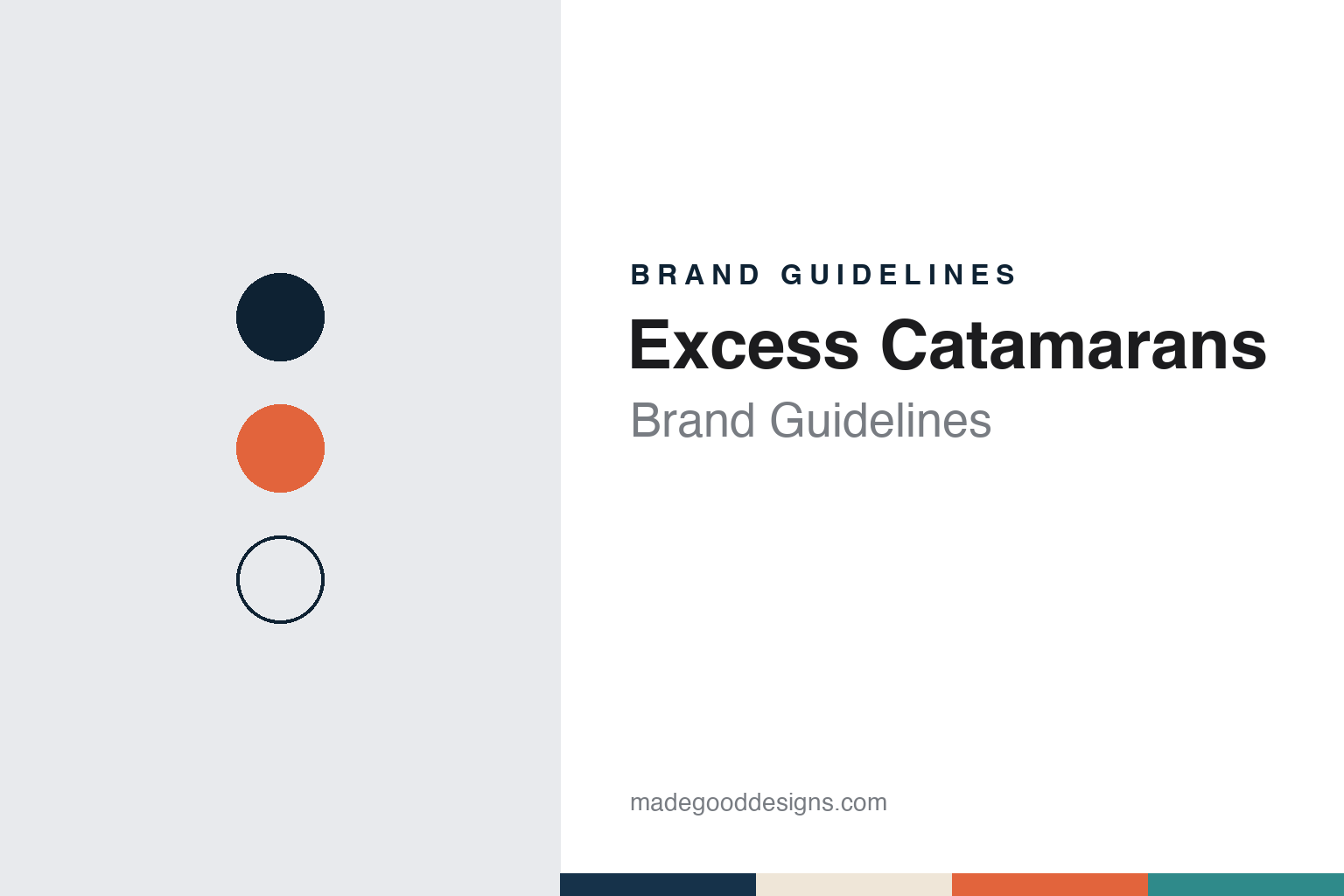
For a design guide, Excess Catamarans shows how a large group can give a second line its own identity through layout, naming and tone rather than through a new yard; compare it with Lagoon, its sister brand inside Groupe Beneteau, and with Nautitech, another aft-helm catamaran line drawn by Marc Lombard. For this guide we use a harbour navy, a sunset coral, a lagoon teal and a deck sand with a bold grotesque sans, an unofficial interpretation; no product or logo is reproduced.
Explore & save
Keep Excess Catamarans’s identity on hand — save it to a board in the Made Good inspiration library.
Excess Catamarans identity set
Pin the Excess navy, coral and sand palette and the bold grotesque sans register to your own board.
Source & notes
Frequently Asked Questions
What font can I use to match the Excess Catamarans look?
This guide describes Excess Catamarans’ type as “A bold grotesque sans for a numeric model system”. Its type specimen is set in Archivo from Google Fonts as a stand-in; Archivo is not Excess Catamarans’ own lettering.
What colours are in the Excess Catamarans palette?
This guide’s Excess Catamarans palette is Harbour navy #16324A, Deep ink #0E2233, Sunset coral #E2643C, Lagoon teal #2F8A8A and Deck sand #EFE6D8. The tones are the guide’s own unofficial interpretation, not official Excess Catamarans hex codes.
When was Excess Catamarans launched?
Excess Catamarans was launched in 2019. Excess Catamarans is known for Excess 11, Excess 14, Excess 13.
Who owns Excess Catamarans?
Excess Catamarans is owned by Groupe Beneteau. Excess Catamarans is known for Excess 11, Excess 14, Excess 13.