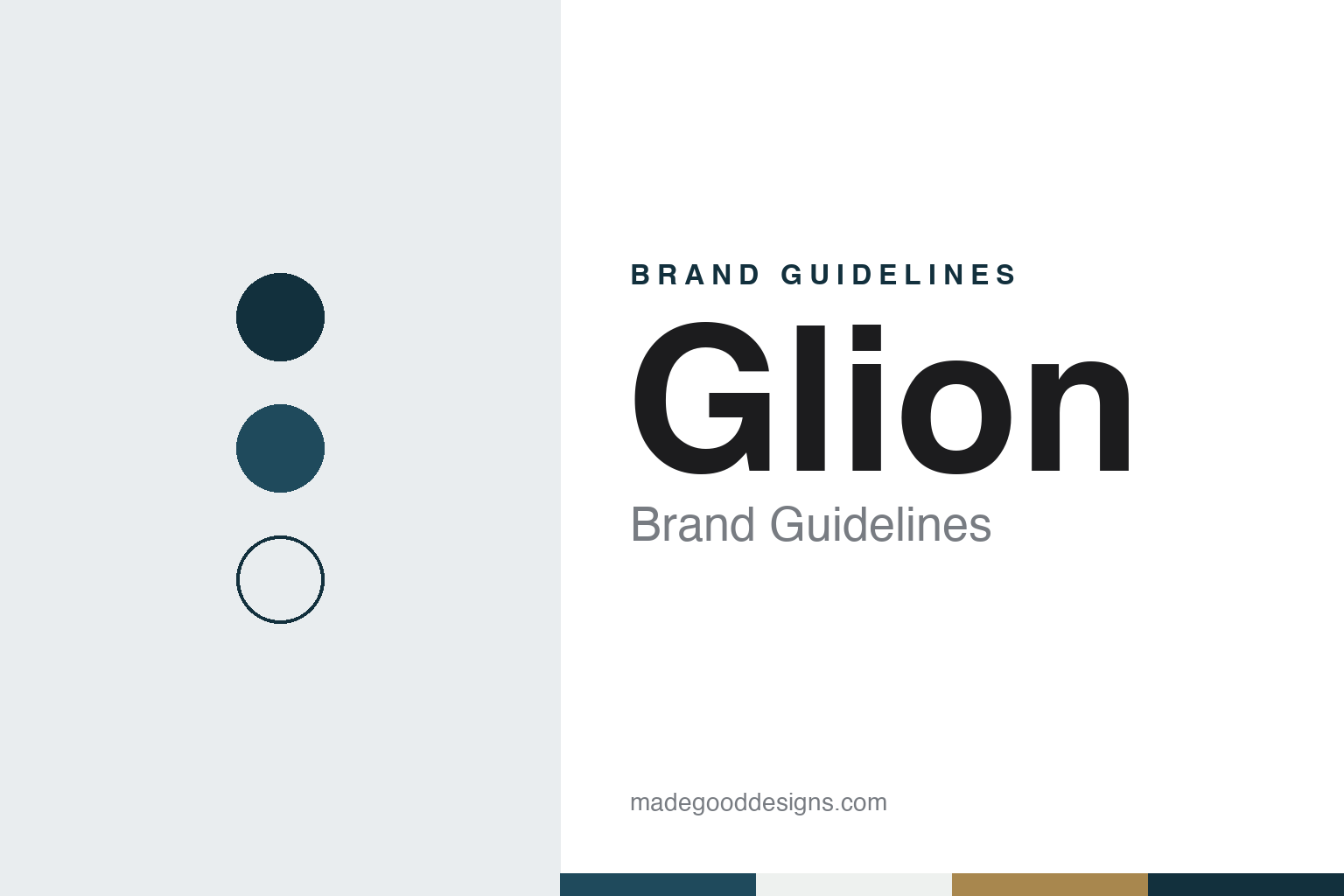
Glion Brand Guidelines
The 1962 hotel school above Montreux, now with campuses in Bulle and London.
Aa
Two constants: a lake slate, mist and brass palette and a Belle Époque serif register. Abstract homage — not a Glion asset or mark; no crest, logo or building is reproduced.
Institut International de Glion
Two professors and a former hotel above the lake.
Glion began in September 1962 as the Institut International de Glion. English and French Wikipedia both give its founders as the Swiss professors Walter Hunziker and Frédéric Tissot, and say they chose the site of the former Grand Hôtel Bellevue at Glion, the hillside village above Montreux on Lake Geneva; French Wikipedia cites a 1968 report in the Valais newspaper Le Nouvelliste for that account. The first intake, the encyclopaedias say, was fifteen students from five countries, taught in French.
The school has changed its name several times. In 1977 it became the Centre International de Glion, or CIG, and later the Glion Hotel School. In 2002 it took its current name, Glion Institute of Higher Education, in French Institut de hautes études de Glion, and the short form GIHE. Today all of its programmes are taught in English, French Wikipedia says, with extra English classes for students who need them.
A second Swiss site followed in 1989, when Glion opened a campus in Bulle, in the Gruyère district of the canton of Fribourg. French Wikipedia’s timeline adds that Glion was a founding member of the Swiss Hotel Schools Association in 1985 and launched its first master’s programme in 2000. Over the next decade it added online study: the same timeline dates an online MBA in international hospitality and service-industry management to 2010, and fully online graduate programmes and professional-development certificates to 2011.
The school marked its fiftieth anniversary in 2012, and the year after that it went abroad. In 2013 Glion opened a campus in London, on the grounds of the University of Roehampton, both Wikipedia editions say. French Wikipedia adds that from 2014 students could split their studies between Switzerland and London, and that in March 2016 the London campus moved into Downshire House, a building on the Roehampton site.
Colour
Laureate, Eurazeo and Sommet Education.
Glion has had two owners since the turn of the century. In 2002, English Wikipedia says, it became part of Laureate Education, the American education company; French Wikipedia places it in Laureate Hospitality Education, a branch of the group. On 17 March 2016 Laureate and the Paris investment company Eurazeo announced an agreement under which Eurazeo would buy Glion and its sister school Les Roches, according to the companies’ announcement as published by eHotelier. That announcement dated the two schools to 1962 and 1954, said Glion had more than 2,000 students across its campuses, and said completion depended on regulatory approvals, including that of the American accreditor then called NEASC. French Wikipedia dates the completed acquisition to June 2016.
Glion now sits within Sommet Education, the hospitality education group whose own website lists Les Roches, Glion and École Ducasse as its schools. Glion and Les Roches are separate schools with their own campuses and names, and the group’s website gives each its own leadership. Sommet Education names Philippe Vignon as the managing director who oversees Glion’s campuses in Switzerland and the United Kingdom. English Wikipedia gave the school 2,557 students in 2022.
Its American accreditation is the clearest dated record of the school’s status. The roster of the New England Commission of Higher Education, or NECHE, lists Glion with its main campus in Bulle and a branch campus at Downshire House in London, run by Glion Institute of Higher Education – UK, Limited. NECHE records a candidacy period from 2001 to 2005, initial accreditation in 2005, and degrees awarded at associate’s, bachelor’s and master’s level. Its roster also records two actions: in March 2020 Glion was continued in accreditation after a comprehensive evaluation, and in April 2026 it was placed on a programme of special monitoring.
Typography
Schools, kitchens and the names on the gate.
Hospitality schools and cookery schools present themselves through a small set of public materials: the school’s name, its crest or logo, the colours used on its website and printed material, and the history pages in which it tells its own story. This guide sets out what can be checked about each school in this group — who founded it, where it teaches and who owns it today — and marks plainly what rests on the school’s own word.
Names matter more than marks in this field. Many schools carry the name of a town, a village or a founder, and several have changed names as their teaching changed: the École hôtelière de Lausanne became EHL Hospitality Business School in 2022, and the École des Roches in Bluche, opened as a boarding school in 1954, became a hotel and tourism school in 1979. Where a school has been renamed, this guide gives the earlier names with their dates.
The places where students learn are also part of how these schools describe themselves. Their websites name campuses, training restaurants open to the public and teaching kitchens, and list programmes and diplomas by their own titles, from vocational certificates to bachelor’s and master’s degrees. This guide uses those names as the schools publish them, and gives accreditation only where an official body names it.
Ownership varies across the group. Some schools are run by founders and their families, some by foundations, and some belong to education groups that hold several schools under one company; EHL is owned by the non-profit EHL Foundation, while Les Roches has belonged to Sommet Education since 2016. Owners, founders and dates are given here as dated facts, and the palettes and typefaces shown are an unofficial interpretation, not any school’s own identity.
Aa
A Belle Époque serif for a school that began in a former lakeside hotel. (Specimen set in Cormorant Garamond, a serif STAND-IN; NOT the Glion logo.)
Glion
A former hotel, a business campus and a London branch.
Each campus has its own character, as Glion describes them. The original site at Glion sits in the hills above Montreux, looking over Lake Geneva towards the Alps, and the school says the building was once a luxury hotel. It now houses the school’s gastronomic restaurant, Restaurant Stéphane Décotterd, named after its chef, as well as the Maison Décotterd lounge bar and a club restaurant with a terrace, which the school presents as part of its hospitality training.
The Bulle campus is different in tone. Glion calls it a modern, university-style campus with the feel of a business college, set between mountains, a medieval town and a growing city, and says it holds the school’s main academic centre and the Glion Research & Innovation Center, which runs its applied research. It also has student residences, one of them named Raymond Jaussi. That split matches NECHE’s listing, which gives Bulle, not Glion, as the main campus address.
London, the third site, works inside another university’s grounds. The school offers bachelor’s and master’s programmes in hospitality, luxury and business, and its programme names on its website range from hotel operations to a master’s in real estate, finance and hotel development.
The name itself is a place name. Glion is the village above Montreux where the school began, so the brand has always carried the address of its first building rather than the name of a founder or owner. The school’s own pages give the founding date as 1962, and that date has stayed with it through four names and two changes of owner. Its sister school Les Roches, which the 2016 announcement dated to 1954, is a separate school in the same group and keeps its own name.
For a design guide, Glion shows how a school can build its identity on a single place and a former hotel while its teaching spreads across three campuses and two countries. Compare Les Roches, its sister school in Sommet Education, and EHL, the Lausanne hospitality school. For this guide we use a lake slate, a pale mist and an old brass with a serif, an unofficial interpretation; no product or logo is reproduced.
Explore & save
Keep Glion’s identity on hand — save it to a board in the Made Good inspiration library.
Glion identity set
Pin the Glion lake slate, mist and brass palette and the Belle Époque serif register to your own board.
Source & notes
Frequently Asked Questions
What font can I use to match the Glion look?
This guide describes Glion’s type as “A Belle Époque serif for a school that began in a former lakeside hotel”. Its type specimen is set in Cormorant Garamond from Google Fonts as a stand-in; Cormorant Garamond is not Glion’s own lettering.
What colours are in the Glion palette?
This guide’s Glion palette is Lake slate #1F4A5C, Deep water #12303D, Alpine mist #EEF1EF, Old brass #A8874E and Paper #F8F7F4. The tones are the guide’s own unofficial interpretation, not official Glion hex codes.
When was Glion founded?
Glion was founded in September 1962, in Glion, above Montreux, Switzerland.
Who founded Glion?
Glion was founded by Walter Hunziker and Frédéric Tissot in September 1962.