schlaich bergermann partner Brand Guidelines
Stuttgart bridge and roof engineers since 1980.
Aa
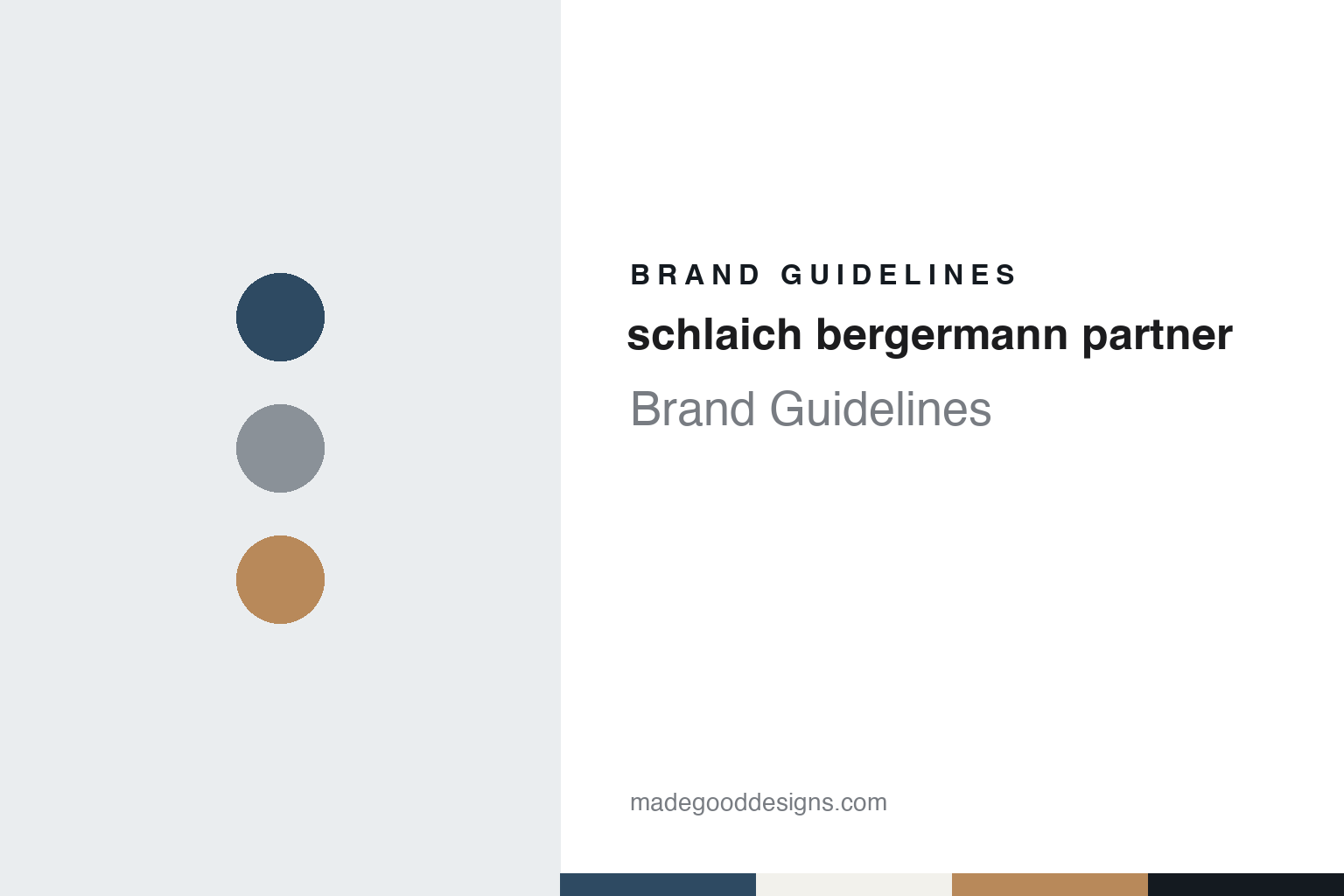
Two constants: a slate blue, cable grey and membrane white palette and a lower-case sans register. Abstract homage — not an sbp drawing or mark; no structure, logo or document is reproduced.
Schlaich + Partner
Two Stuttgart engineers and a new office in 1980.
schlaich bergermann partner, written in lower case and shortened to sbp, is a firm of consulting structural engineers headquartered in Stuttgart. It was founded in 1980 by the engineers Jörg Schlaich and Rudolf Bergermann, English and German Wikipedia say. In a note marking Bergermann’s 80th birthday in September 2021, the firm gave the name of the original office as Schlaich + Partner.
Both founders came from the same Stuttgart engineering background. In the 1960s and 1970s they had worked as engineers for Leonhardt und Andrä, the Stuttgart consultancy that engineered the tent-like roof structure for the Munich Olympic grounds of 1972, according to both Wikipedia articles. Bergermann studied civil engineering at the University of Stuttgart, the firm says, and in 2021 he was still working with sbp as a consulting engineer. The same note credits him with bridges, stadium roofs and movable roofs, and with long-running research alongside Jörg Schlaich on the solar updraft tower and on generating electricity from solar energy.
The founders handed over the running of the firm in stages. Since 2002 it has been led by a group of four partners, among them Mike Schlaich, and in 2015 Knut Stockhusen joined them as partner and managing director, German Wikipedia says. The firm links the opening of its Berlin office to Mike Schlaich’s appointment as a professor of concrete structures at the Technical University of Berlin and his recognition as a checking engineer.
Colour
Bridges, roofs, glass and the sun.
sbp describes its work as long-span lightweight roofs, bridges, slender towers, high-rise buildings and solar power plants. German Wikipedia lists membrane, glass, roof and façade structures, bridges and cable structures, towers, tall buildings and halls, together with checking work on structural stability, and a separate solar division, sbp sonne. That division has worked since the early 1980s on solar updraft towers and dish-Stirling units, and since 2000 on parabolic-trough power plants, English Wikipedia says. The firm itself says it has been developing and building solar thermal systems for some 40 years and has followed photovoltaics from its early days, working with a range of technologies around the world.
A long project stands early in the record. The Second Hooghly Bridge in Kolkata, also called Vidyasagar Setu, was built between 1979 and 1992. Local requirements called for Indian steel that could not be welded and a great deal of manual work, so large cross-sections, including the tops of the pylons, were assembled from thick plates with millions of rivets, English Wikipedia says.
Two recurring structural ideas are described in detail in the same article. The gridshell takes its cue from a kitchen sieve: a square mesh that can be distorted into rhombuses to follow a curved surface, braced with diagonal cables and covered with glass panes laid directly on the grid beams, so that the load-bearing structure and the glass become one layer without the usual secondary frame, an approach the firm has applied over museum courtyards and station halls. The cable-net façade, compared there to a tennis racket, stretches parallel horizontal and vertical cables between the sides of a building and between roof girders and floor to carry the glass.
Stadium roofs recur too. In September 2017 ArchDaily reported the completion of the roof of Madrid’s Wanda Metropolitano, the rebuilt Peineta athletics stadium that became the home ground of Atlético Madrid, describing the roof as designed and constructed by engineers Schlaich Bergermann Partner and noting the 96 radial PTFE panels installed over four months; the builder, FCC Construcción, filmed the installation as a time-lapse.
The work also reaches into existing buildings. In May 2024 ArchDaily reported a design by FAKT and Gustav Düsing to convert a 1970s modular concrete printing works in Siegen into a hub of about 7,000 square metres for the University of Siegen’s architecture faculty, using a lightweight strategy developed with schlaich bergermann partner: mass-timber interiors, a steel and timber hybrid structure and a hanging timber roof on the top floor.
Typography
How engineering consultancies present themselves.
Structural and façade engineering consultancies rarely sell a product, so their identity rests on a name and a record. Many carry the surnames of founders or partners, sometimes joined by a plus sign or an ampersand, sometimes run together in lower case, and many shorten to initials in everyday use. The wordmark is usually typographic rather than pictorial: a plain sans or a restrained serif, set on a quiet background, with one accent colour at most.
The work itself does most of the talking. Websites, brochures and monographs lead with project photography of bridges, stadium roofs, glass façades, towers and temporary pavilions, often shot at dusk or from below to show cables, members and joints. Alongside the photographs come drawings, sections, physical and digital models and construction sequences, and the projects are credited together with the architects and builders who worked on them, since an engineer’s name rarely appears on a building alone.
Writing about these firms tends to follow the same pattern. Founders and partners are described in their professional roles, with dates for when they joined or took over; ownership is set out plainly, whether a partnership, a firm owned by its employees or a practice absorbed into a larger group; and renamings and mergers are dated. History pages trace a practice back through earlier names, and office pages list the cities where teams are based, often with the year each office opened.
This guide follows that approach. It sets out what dated sources say about each firm: who founded it, how its name and ownership changed, where it works and which projects independent publications credit to it. It describes what was engineered rather than what it achieves, and it treats the palette and typefaces shown here as an unofficial interpretation, not the firms’ own identity.
aa
A lower-case sans for a name the firm writes without capitals. (Specimen set in Work Sans, a sans STAND-IN; NOT the schlaich bergermann partner logo.)
schlaich bergermann partner
A lower-case name and ten offices.
The office network has spread out from Stuttgart. sbp’s website names offices in Stuttgart, Berlin, Hamburg, New York, São Paulo, Shanghai, Paris, Madrid, Los Angeles and Riyadh, and says the team numbers more than 300 people from well over 20 countries. It dates its New York office to 2005, when it took a small space on West 21st Street in the Flatiron District, its earliest location outside Europe, the firm says; its Hamburg office opened in June 2026. It says its work in Saudi Arabia goes back to 1985, that its São Paulo engineers have worked there for more than ten years, and that it has taken part in construction projects in Asia for over 20 years, with the Shanghai office concentrating on bridges, exhibition halls, sports facilities and high-rise buildings. In Hamburg, the firm says, it had worked for many years on existing structures and new infrastructure before opening a local office.
The name itself is written the way the firm writes it: three lower-case words, two surnames and the word partner, with sbp as the short form. ArchDaily printed it with capitals in 2017 and in lower case in 2024.
For a design guide, schlaich bergermann partner shows how an engineering practice can let a lower-case name, two founders’ surnames and a record of bridges and roofs carry its identity. Compare Werner Sobek and Knippers Helbig, two more engineering practices based in Stuttgart. For this guide we use slate blue, cable grey and a membrane white with a sans, an unofficial interpretation; no product or logo is reproduced.
Explore & save
Keep schlaich bergermann partner’s identity on hand — save it to a board in the Made Good inspiration library.
schlaich bergermann partner identity set
Pin the schlaich bergermann partner slate blue, cable grey and membrane white palette and the lower-case sans register to your own board.
Source & notes
Frequently Asked Questions
What font can I use to match the schlaich bergermann partner look?
This guide describes schlaich bergermann partner’s type as “A lower-case sans for a name the firm writes without capitals”. Its type specimen is set in Work Sans from Google Fonts as a stand-in; Work Sans is not schlaich bergermann partner’s own lettering.
What colours are in the schlaich bergermann partner palette?
This guide’s schlaich bergermann partner palette is Slate blue #2E4A62, Cable grey #8A9198, Membrane white #F2F1EC, Larch #B8895A and Night #141A20. The tones are the guide’s own unofficial interpretation, not official schlaich bergermann partner hex codes.
When was schlaich bergermann partner founded?
schlaich bergermann partner was founded in 1980 (as Schlaich + Partner), in Stuttgart, Germany.
Who founded schlaich bergermann partner?
schlaich bergermann partner was founded by Jörg Schlaich and Rudolf Bergermann in 1980 (as Schlaich + Partner).