Met Gala Brand Guidelines
A museum benefit whose theme, exhibition and dress code change every May while the name stays.
Aa
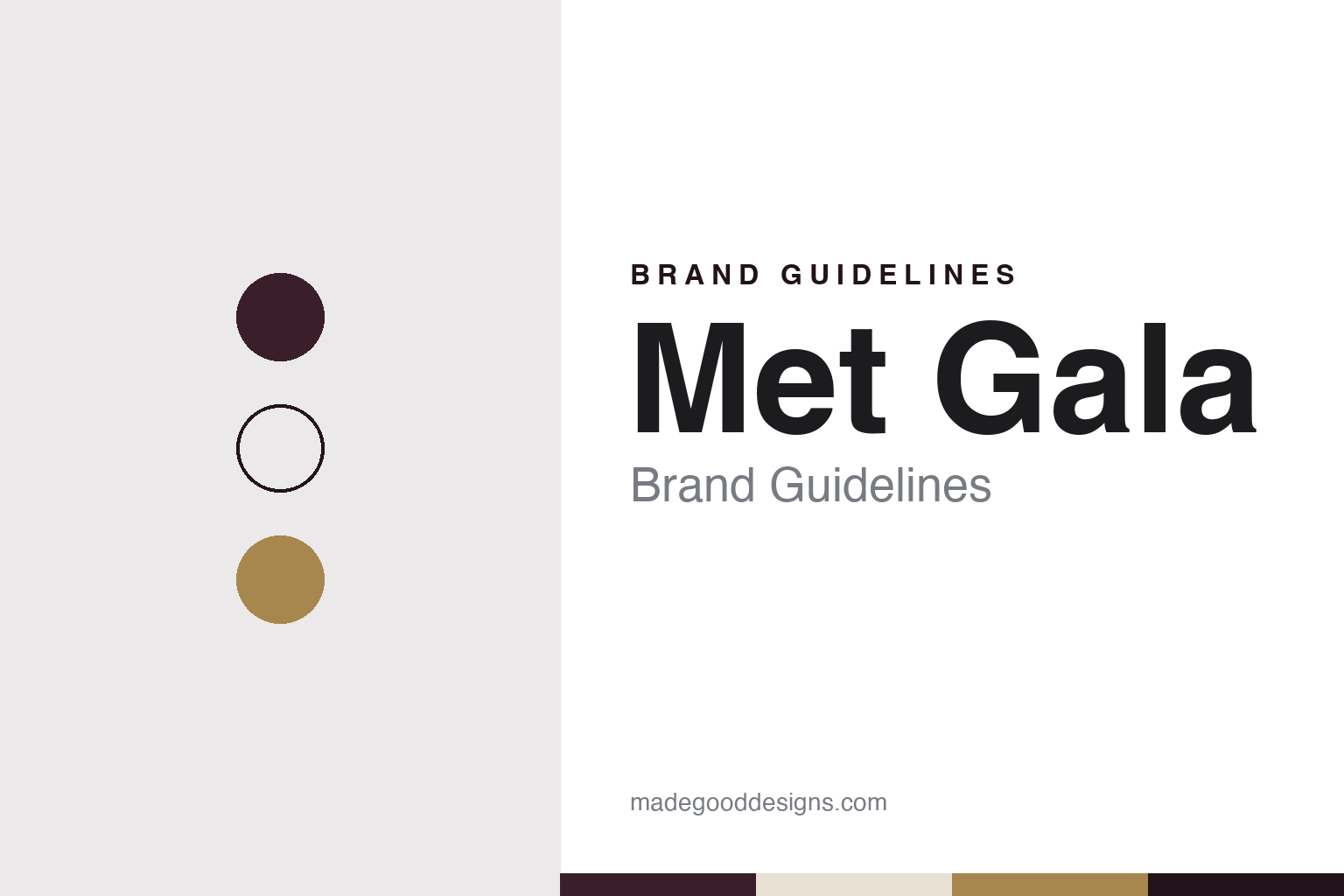
Two constants: a plum, limestone and gilt palette and a benefit serif register. Abstract homage — not a Met Gala or museum mark; no logo, invitation or photograph is reproduced.
Costume Institute Benefit
A supper for a new institute, 1948.
The Met Gala is the informal name of the Costume Institute Benefit, the annual fundraising evening for the Costume Institute of the Metropolitan Museum of Art in New York. Its roots lie in a collection rather than a party. Writing for RTÉ’s Brainstorm in April 2026, a fashion historian at the University of Southern California explained that the Museum of Costume Art was launched in 1937 to preserve and study historical clothing, and that in 1946 the publicist Eleanor Lambert helped bring its collection under the Met, on condition that it ran outside the museum’s budget. It was then renamed the Costume Institute.
Lambert organised the first benefit in 1948 to raise money for the institute. National Geographic reported in May 2024 that it began as a dinner and that Lambert led the event for the next two decades. The same RTÉ article adds that from 1949 a Lord & Taylor executive gave the institute and its gala a formal management structure, and that the evenings of the 1950s already had many of today’s ingredients: a theme, a formal dinner, live entertainment, a fashion parade and a row of photographers.
The venue moved over time. English Wikipedia says the benefit was held at Manhattan venues including the Waldorf Astoria, Central Park and the Rainbow Room between 1948 and 1971, and National Geographic likewise describes the first twenty years at outside venues. The RTÉ article dates the move into the museum itself to 1961, as a way to cut costs and revive interest, while Wikipedia places the first gala at the Met in the 1970s; the sources differ. Wikipedia also notes that there was no gala in 1963 or 1969.
Colour
Themes from 1973.
The shape of the modern evening dates from the arrival of Diana Vreeland, the former editor of Vogue, who became a consultant to the Costume Institute in 1972, English Wikipedia says. The RTÉ article says Vreeland took charge of the gala in 1973 and chose themes and exhibitions that would interest the press as well as the guests. Her first, in 1973, was The World of Balenciaga, an exhibition devoted to a single designer; later themes included Romantic and Glamorous Hollywood Design and American Women of Style.
Vreeland also opened the evening to reporters and photographers, according to the RTÉ article, and coverage spread from the society pages and Women’s Wear Daily to newspapers and magazines in Europe and Asia. She also brought in corporate sponsors to pay for the exhibitions and the parties, the article says.
After Vreeland, museum curators ran the event for some years; in the late 1990s, the RTÉ article says, they handed control back to the fashion industry, with fashion houses as sponsors and magazine editors as chairs. Anna Wintour of Vogue has chaired or co-chaired the gala since 1995, with the exception of 1996, English Wikipedia says, and Vogue organises the evening for the museum.
The theme now ties the gala to the Costume Institute’s spring exhibition and sets a dress code for guests. In 2024 the exhibition was Sleeping Beauties: Reawakening Fashion, with the dress code “The Garden of Time”, National Geographic reported. English Wikipedia gives the 2025 theme as Superfine: Tailoring Black Style. On 4 May 2026 the gala opened Costume Art, with the dress code “Fashion is Art”; Wallpaper* reported in April 2026 that the exhibition would draw on works from across the Met’s collection and run from 10 May 2026 to 10 January 2027.
Typography
Cities, councils and calendars.
A fashion week usually takes its name from a city, and that name is the one part of its identity that rarely changes. The rest follows a calendar. In New York the shows run in February and September, and Wallpaper* described the September 2026 week as the start of a month of shows that moved on to London, Milan and Paris. Each round carries a season label, spring/summer or autumn/winter, set roughly six months ahead of the clothes reaching shops.
Behind most weeks sits an organising council or trade body that keeps the official schedule. In New York that is the Council of Fashion Designers of America, which took over the official schedule in 2014; other cities have their own councils and chambers, each with a formal name that is often longer and less familiar than the week it runs. Production companies, venues and sponsors work alongside them, and the division of roles differs from city to city.
Sponsors have often put their names in front of the city. From 2007 to 2015 the New York shows produced by IMG were billed as Mercedes-Benz Fashion Week New York, and FashionUnited reported in January 2015 that the car maker also backed weeks in Sydney, Istanbul and Berlin. When a title sponsor leaves, the week usually returns to its plain city name, so the same event can appear under several names in its own history.
Venues and visual material change even faster. A week may move from tents in a park to a performing-arts campus to a studio building within a few years, while individual houses stage shows in rooms of their own choosing. Invitations, schedules and season campaign images are made new for each round, and a gala such as the Met Gala sets a fresh theme and dress code every May. The guides in this collection trace those changing parts around a name that stays the same.
Aa
A high-contrast serif for an evening built around an exhibition. (Specimen set in Cormorant Garamond, a serif STAND-IN; NOT a Met Gala or museum logo.)
Met Gala
A new theme every May.
The gala is held each year on the first Monday in May, which marks the opening of the Costume Institute’s spring exhibition, English Wikipedia says, and the museum closes to visitors that day. The evening begins with a cocktail hour, when guests arrive along the red carpet and steps, tour the new exhibition and then sit down to dinner with entertainment. Wallpaper* noted in April 2026 that the press sees the exhibition on the morning of the gala, that phones are not allowed inside, and that the red carpet is livestreamed on Vogue’s website and YouTube channel. Wikipedia dates the ban on selfies and social media inside the event to 2015.
The 2026 edition also opened a new home for the department. Wallpaper* reported that the Costume Institute, whose collection it put at about 33,000 garments, accessories and pieces of ephemera, would move into a gallery of about 12,000 square feet beside the museum’s Great Hall, designed by the Brooklyn architecture firm Paterson Rich Office and named the Condé M. Nast Galleries after the founder of the publishing house. The magazine described the new space as a far more prominent position within the museum than the department had before.
The gala’s identity changes every year with its theme. Each spring brings a new exhibition title, a new dress code and a new set of co-chairs, while the formal name, the date in May and the museum on Fifth Avenue stay the same. The exhibition that follows runs for several months, so the evening serves as the opening of a longer public show rather than a stand-alone party.
For a design guide, the Met Gala shows how a fixed name and date can carry an identity that is rewritten every year by a theme, an exhibition and a dress code. Compare the Metropolitan Museum of Art, its host, and Vogue, the magazine that organises it. For this guide we use a deep plum, a pale limestone and an antique gilt with a serif, an unofficial interpretation; no product or logo is reproduced.
Explore & save
Keep Met Gala’s identity on hand — save it to a board in the Made Good inspiration library.
Met Gala identity set
Pin the Met Gala plum, limestone and gilt palette and the benefit serif register to your own board.
Source & notes
Frequently Asked Questions
What font can I use to match the Met Gala look?
This guide describes Met Gala’s type as “A high-contrast serif for an evening built around an exhibition”. Its type specimen is set in Cormorant Garamond from Google Fonts as a stand-in; Cormorant Garamond is not Met Gala’s own lettering.
What colours are in the Met Gala palette?
This guide’s Met Gala palette is Gala plum #3A1F2B, Night #22121A, Limestone #E9E1D3, Antique gilt #A8874E and Paper #F8F5F0. The tones are the guide’s own unofficial interpretation, not official Met Gala hex codes.
When was Met Gala founded?
Met Gala was founded in 1948 (as the Costume Institute Benefit), in New York, United States.
Who founded Met Gala?
Met Gala was founded by Eleanor Lambert in 1948 (as the Costume Institute Benefit).