Pitti Uomo Brand Guidelines
The Florence menswear fair named after a palace and held in a fortress.
Aa
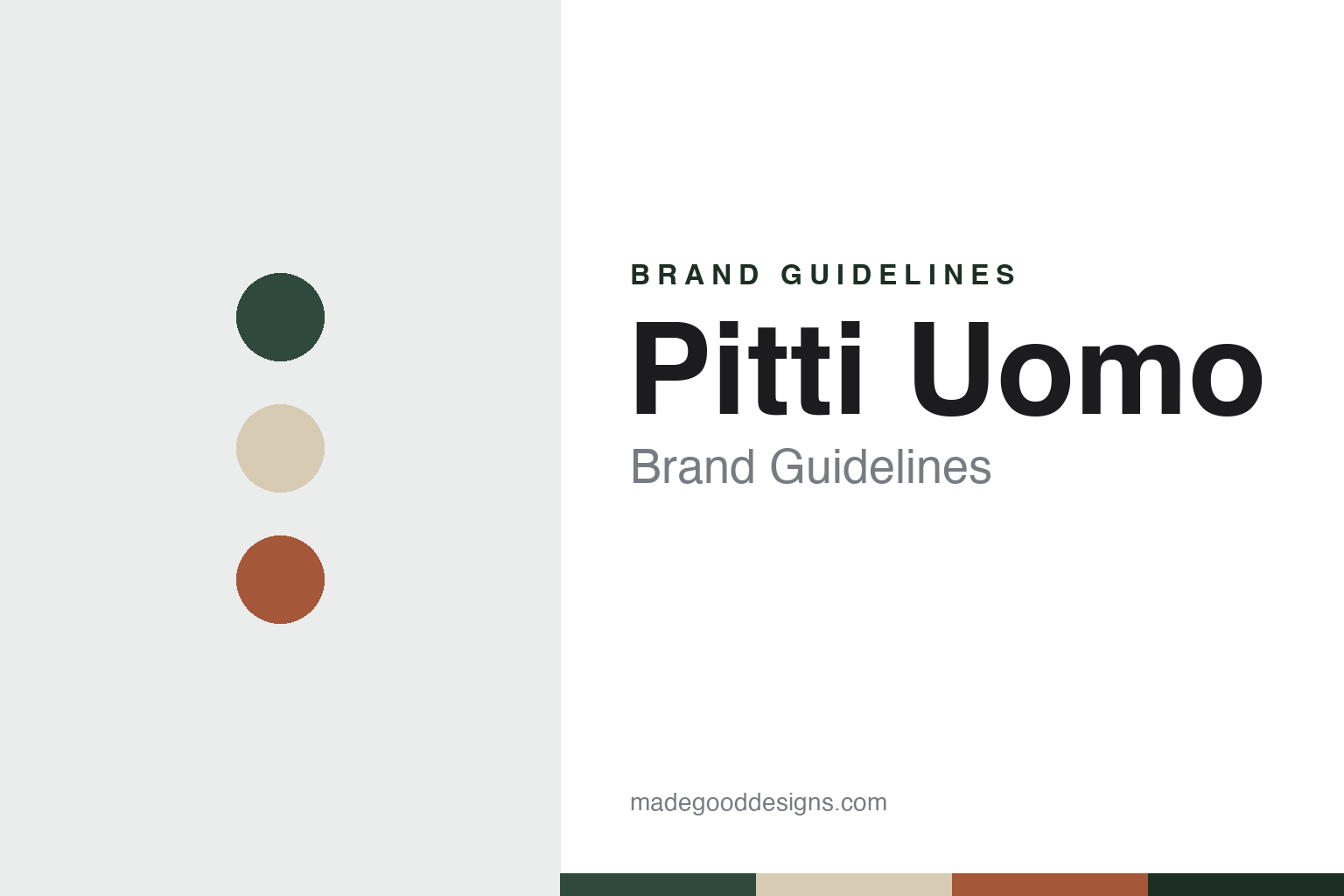
Two constants: a bottle green, fortress stone and terracotta palette and a Florentine serif register. Abstract homage — not a Pitti Uomo mark; no logo, poster or venue image is reproduced.
Florence and the Sala Bianca
From Palazzo Pitti to a menswear fair.
Pitti Uomo takes its name from Palazzo Pitti in Florence, whose Sala Bianca, or White Hall, hosted the first shows by Italian brands, FashionUnited wrote in June 2016. The story begins with the buyer and organiser Giovanni Battista Giorgini, who on 12 February 1951 presented the collections of a group of Italian houses to American buyers and journalists at his home, Villa Torrigiani, according to the history published by Pitti Immagine. Il Post wrote in September 2025 that the show was timed for just after the Paris collections, so that international guests and press already in Europe could attend. From 1952 to 1982 the Sala Bianca was the stage for the Florentine shows, and in 1954 the Centro di Firenze per la Moda Italiana (CFMI) was set up to promote the events, the company says.
The 1960s redrew the Italian map. Giorgini left CFMI in 1965, Pitti Immagine says, and in 1967 the centre’s new president signed an agreement with the Camera Nazionale della Moda under which high fashion shows moved to the ateliers of Rome, while boutique and knitwear collections stayed in Florence. In the 1970s CFMI turned towards the growing clothing industry and towards large retailers from Europe, the United States and Japan as its main contacts, while Milan was becoming the centre for women’s ready-to-wear.
The first Pitti Uomo, a fair for men’s clothing and accessories, followed in 1972. Pitti Immagine dates it to September 1972. FashionUnited reported in 2016 that the first edition took place in February 1972 at the Hotel Villa Medici in Florence, with 43 exhibiting brands and 526 buyers, 98 of them from abroad, and cited a report on the fair in the newspaper Il Giorno on 19 September 1972. Both sources say the fair was set up to promote Italian menswear makers in foreign markets. More fairs followed under the same organisation: Pitti Bimbo for childrenswear in 1975, Pitti Filati for knitting yarns in 1977 and Pitti Casa for household linens in 1978.
Colour
The Fortezza da Basso, from the 1980s.
The 1980s began with the closure of the Sala Bianca and the opening of new fairs in the pavilions of the Fortezza da Basso, Pitti Immagine says. FashionUnited dates Pitti Uomo’s move to the Fortezza to 1982, about a decade after the first edition, and a 2019 FashionUnited timeline describes the fortress as the hub for the organiser’s fairs, including Pitti Uomo, Pitti Filati and Pitti Bimbo. Italian Wikipedia says Pitti Uomo began as the central pavilion of the fair at the Fortezza, devoted to classic Italian menswear.
The organiser’s present name dates from 1988. In 1983 CFMI moved its operations into a company called Centro Moda; in 1987 Marco Rivetti, of the clothing group GFT, became its president and managing director; and in 1988 Centro Moda was renamed Pitti Immagine, according to the company’s history. In 1989 Raffaello Napoleone took over the running of Pitti Immagine, and FashionUnited still named him as managing director in 2016. Italian Wikipedia says CFMI has been the holding company of Pitti Immagine since 1988.
Under the new name the fair spread across the city. Italian Wikipedia says a programme of exhibitions began in 1990, and that invited designers staged projects made for Pitti Uomo, the earliest a show at Villa Gamberaia in June 1990. The fair used the Stazione Leopolda for the first time in 1993, and in 1994 it added a streetstyle project on denim and men’s lifestyle, housed on the ground floor of the Fortezza in the space called the Arsenale. FashionUnited’s 2016 list of moments from the fair’s history includes shows in the Boboli Gardens, on Piazzale Michelangelo and at the Forte Belvedere. In 2011 the organiser launched E.Pitti, a digital platform for virtual showrooms and online fairs, FashionUnited reported in 2019.
The fair still runs twice a year at the Fortezza da Basso, in January and June, with editions numbered in sequence. The 90th edition ran from 14 to 17 June 2016. Pitti Immagine reported that the 110th edition, held from 16 to 19 June 2026, showed 740 collections and drew around 11,000 buyers and more than 14,000 visitors. FashionUnited, writing from that edition on 19 June 2026, described spring/summer 2027 collections that were more minimal and cleaner, with linen suits, wide silhouettes, large weekender bags and accents of red, on stands where several brands played music at the same time.
Typography
Seasons, chambers and venues.
A fashion week usually takes its name from a city, and that name is the one part of its identity that rarely changes. The rest follows a calendar. In New York the shows run in February and September, and Wallpaper* described the September 2026 week as the start of a month of shows that moved on to London, Milan and Paris. Each round carries a season label, spring/summer or autumn/winter, set roughly six months ahead of the clothes reaching shops.
Behind most weeks sits an organising council or trade body that keeps the official schedule. In New York that is the Council of Fashion Designers of America, which took over the official schedule in 2014; other cities have their own councils and chambers, each with a formal name that is often longer and less familiar than the week it runs. Production companies, venues and sponsors work alongside them, and the division of roles differs from city to city.
Sponsors have often put their names in front of the city. From 2007 to 2015 the New York shows produced by IMG were billed as Mercedes-Benz Fashion Week New York, and FashionUnited reported in January 2015 that the car maker also backed weeks in Sydney, Istanbul and Berlin. When a title sponsor leaves, the week usually returns to its plain city name, so the same event can appear under several names in its own history.
Venues and visual material change even faster. A week may move from tents in a park to a performing-arts campus to a studio building within a few years, while individual houses stage shows in rooms of their own choosing. Invitations, schedules and season campaign images are made new for each round, and a gala such as the Met Gala sets a fresh theme and dress code every May. The guides in this collection trace those changing parts around a name that stays the same.
Aa
A Florentine serif for a fair that kept a palace in its name. (Specimen set in Cormorant Garamond, a serif STAND-IN; NOT the Pitti Uomo logo.)
Pitti Uomo
A palace name, a fortress venue.
Pitti Uomo is one of a family of fairs that share the Pitti name. English Wikipedia lists Pitti Bimbo for childrenswear and Pitti Filati for knitting yarns, both at the Fortezza da Basso twice a year, together with Taste, a fair for food culture, and Fragranze, for artistic perfumes, both held once a year at the Stazione Leopolda. Pitti Immagine’s own list of venues also includes the Dogana on Via Valfonda, Villa Vittoria and the Palazzo degli Affari. Exhibitions and cultural projects run through the Fondazione Pitti Discovery, set up in 2002, Italian Wikipedia says.
Its full name, Pitti Immagine Uomo, joins the organiser’s name to the Italian word for man. The fair’s history has also been told as an exhibition: FashionUnited reported in 2019 that an exhibition titled “A short novel on men’s fashion”, tracing the history and evolution of menswear, was staged at Palazzo Pitti. A book on thirty years of the fair, published by Marsilio in 2019, appears in the bibliography of Italian Wikipedia’s article.
The edition numbers work as a running record. FashionUnited counted the 90th edition in June 2016; Pitti Immagine counted the 110th in June 2026. In between, the categories on show widened. The organiser’s June 2026 report, quoting the president of the industry body Confindustria Moda, listed sportswear, streetwear, outdoor wear, workwear and technical pieces alongside classic menswear, a range that grew from the classic tailoring pavilion of the early Fortezza years and the streetstyle project added in 1994.
For a design guide, Pitti Uomo shows how an event can keep a building’s name long after leaving it: the palace stays in the title, a fortress serves as the venue, and a number counts every edition. Compare Milan Fashion Week, where the women’s ready-to-wear shows moved in the 1970s, and Brunello Cucinelli, an Italian menswear house. For this guide we use a bottle green, a warm fortress stone and a terracotta with a serif, an unofficial interpretation; no product or logo is reproduced.
Explore & save
Keep Pitti Uomo’s identity on hand — save it to a board in the Made Good inspiration library.
Pitti Uomo identity set
Pin the Pitti Uomo bottle green, fortress stone and terracotta palette and the Florentine serif register to your own board.
Source & notes
Frequently Asked Questions
What font can I use to match the Pitti Uomo look?
This guide describes Pitti Uomo’s type as “A Florentine serif for a fair that kept a palace in its name”. Its type specimen is set in Cormorant Garamond from Google Fonts as a stand-in; Cormorant Garamond is not Pitti Uomo’s own lettering.
What colours are in the Pitti Uomo palette?
This guide’s Pitti Uomo palette is Bottle green #2F4A3C, Deep cypress #1D2E25, Fortress stone #D8CBB4, Terracotta #A5573A and Paper #F6F2EA. The tones are the guide’s own unofficial interpretation, not official Pitti Uomo hex codes.