Art Cologne Brand Guidelines
The Cologne fair founded in 1967 as Kunstmarkt Köln.
Aa
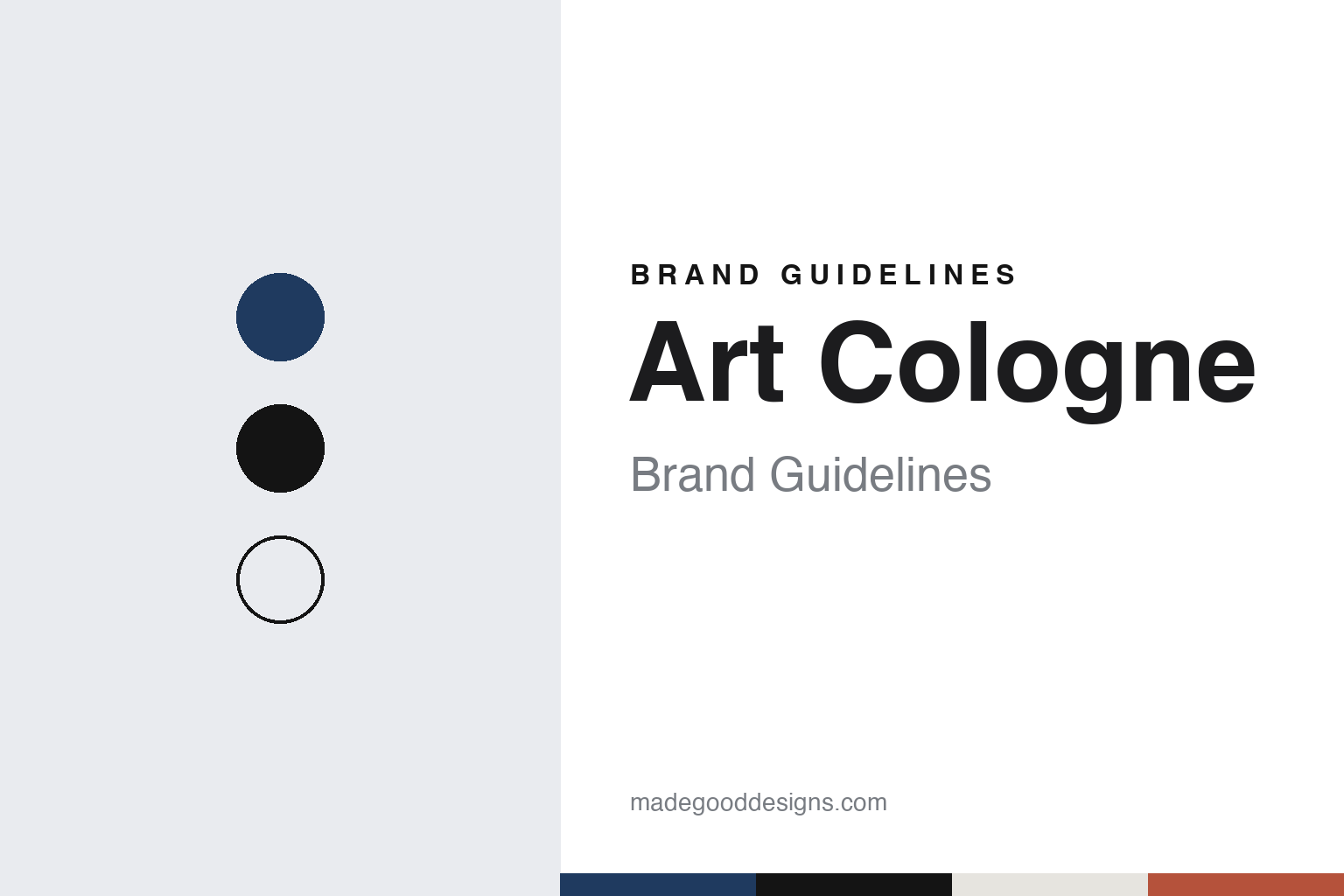
Two constants: a deep blue, black and grey palette and an upright capital sans register. Abstract homage — not an Art Cologne or Koelnmesse asset; no logo, poster or artwork is reproduced.
Kunstmarkt Köln ’67
Two Cologne gallerists and a festival hall.
Art Cologne is a fair for modern and contemporary art held each year at the exhibition centre in Cologne-Deutz. It began as the Kunstmarkt Köln ’67, staged from 13 to 17 September 1967 in the entrance area and banqueting hall of the Gürzenich, a historic building in Cologne’s old town, according to the history published on the fair’s website. Its founders were the Cologne gallerists Hein Stünke and Rudolf Zwirner; English and German Wikipedia give the same founders and the same year.
To obtain municipal funding, the founders needed an organisation, so they and a group of fellow dealers set up the Verein progressiver deutscher Kunsthändler, the association of progressive German art dealers, the fair’s history says. German Wikipedia names Stünke’s gallery as Galerie Der Spiegel and counts five further colleagues among the association’s founders, while the fair’s own account gives sixteen other dealers. Under an agreement with the city, the association was allowed to use the Gürzenich for its event.
The fair then moved and changed its name several times. In 1968 it moved to the Cologne Kunsthalle, and in 1970 it was renamed Kölner Kunstmarkt, the history says. In 1974 a newly founded European art dealers’ association organised a revamped Internationaler Kunstmarkt Köln in halls 1 and 2 of the exhibition centre run by the Cologne trade-fair organisation, with 80 international exhibitors; the following year the event filled the whole ground floor of the Rheinhallen. From 1976 to 1983 the Internationaler Kunstmarkt alternated between Cologne and Düsseldorf.
The present name dates from 1984. That year the Bundesverband Deutscher Galerien, the federal association of German galleries, took the fair over and renamed it ART COLOGNE; the 18th edition was held in November with 160 exhibitors from ten countries, according to the fair’s history. Since then the main fair has been held only in Cologne, German Wikipedia says. The two Wikipedia articles differ slightly on the intermediate name, English Wikipedia dating it to 1974 and German Wikipedia to 1975.
Colour
From a dealers’ association to Koelnmesse.
Accounts of when the trade-fair company took charge differ. The fair’s own history says the galleries’ association signed an agreement in 1997 transferring the organisation of the fair to Koelnmesse, after which the association acted in a sponsoring role only. German Wikipedia says the organisation passed to the Cologne trade-fair company in 1974, when the fair moved to the Rheinhallen, and English Wikipedia says Koelnmesse bought the fair in 1994. Today the fair’s press releases are issued by Koelnmesse GmbH.
The halls have changed with the fair. For three decades it used the Rheinhallen at Deutz; in 1990 it added Hall 5 to halls 1 to 3, and in 2004 it held its last edition in the Rheinhallen before moving to halls 9 and 10 in 2005 and to halls 4 and 5 in 2006, the fair’s history says. In 2009 the fair opened with a new south entrance, with an outside staircase and entrance hall, and used the new Hall 11.
Named programmes for younger participants run through the fair’s history. It dates a sponsorship programme for young artists to 1980 — the programme now called New Positions — a special programme for young galleries to 1989 and a Young Galleries scheme to 1998; in 2004 the fair adopted the slogan NEW ART, with sections called NEW TALENTS and NEW CONTEMPORARIES. In 2026 the fair had four sections: GALLERIES, for art of the 20th and 21st centuries; NEUMARKT, for young galleries, with 35 participants; COLLABORATIONS, for projects curated jointly by pairs of galleries; and ART + OBJECT, which places design and applied arts beside the visual arts. The galleries are chosen by an advisory board of eight members, the fair says. English Wikipedia says the NEUMARKT name recalls an alternative Cologne fair of the 1960s.
The calendar has moved too. After 40 years in November, the fair was rescheduled to April in 2007, its history says. It has since returned to the autumn: the 58th edition ran from 6 to 9 November 2025, according to an interview published by the art site Arterritory on 28 October 2025, and the 59th from 5 to 8 November 2026, with 164 galleries and dealers from 22 countries, the fair says.
Typography
How art fairs present themselves.
Contemporary art fairs usually present themselves through a short name that does most of the work. Some take the city outright, as Art Cologne does; others join a coined word to the city, as ARCOmadrid does with ARCO and, for its Portuguese sibling, ARCOlisboa. The name stays fixed while much around it changes from one edition to the next, and editions are counted: ARCOmadrid held its 45th in March 2026 and Art Cologne its 59th in November 2026.
Behind many fairs stand trade-fair companies and galleries. ARCOmadrid is organised by IFEMA MADRID, and Art Cologne’s press releases come from Koelnmesse, while both fairs trace their beginnings to gallerists: Juana de Aizpuru in Madrid in 1982, and a Cologne dealers’ association in 1967. At both fairs the exhibitors are chosen by a committee or advisory board, and both are held in the exhibition halls of their organisers, IFEMA in Madrid and the fairgrounds at Cologne-Deutz, so the venue becomes part of the fair’s picture.
Inside the halls, fairs divide themselves into named sections. A main programme for established galleries sits beside sections for younger galleries, such as ARCOmadrid’s Opening, for galleries under eight years old, or Art Cologne’s NEUMARKT, and beside curated programmes with their own themes and curators. At these two fairs the section names are written in capitals or set off with punctuation — GALLERIES, ART + OBJECT, Profiles | Latin American Art — so that they read as titles in their own right.
The material the fairs publish follows a steady pattern: exhibitor lists by city and country, hall plans, programmes of talks and special exhibitions, and headline figures for each edition. Themed projects change from edition to edition — ARCOmadrid named its 2026 project ARCO2045 — while the name, the organiser and the city stay constant, which keeps a fair recognisable across decades.
Aa
An upright capital sans for a name the fair writes in capitals. (Specimen set in Libre Franklin, a sans STAND-IN; NOT the Art Cologne logo.)
Art Cologne
A director since 2008 and a return to Mallorca.
The fair has had one director since 2008. Daniel Hug, who had run a gallery under his own name in Los Angeles, was presented as the new artistic director at the opening of the 2008 fair, the fair’s history says; German Wikipedia names him director since 2008, and the fair called him its Art Director in 2026. English Wikipedia adds that from 2017 to 2019 Art Cologne was involved in Art Berlin, a fair held for three editions at the former Tempelhof Airport.
Spain has been part of the story twice. A satellite fair, ART COLOGNE Palma de Mallorca, was held in September 2007 and did not continue, according to the fair’s history. In 2026 the fair went back. The Art Newspaper reported on 8 April 2026 that Art Cologne Palma Mallorca would run from 9 to 12 April at the Palau de Congressos de Palma, a convention centre, after an approach from Art Palma Contemporani, the island’s association of contemporary galleries. Of its 88 galleries, 32 came from Spain and 26 from Germany, the paper reported, and the fair was laid out in two sections: Gran Saló, a classic fair layout, and Parkour, a format that encouraged galleries to move beyond the standard stand.
On its website and in its releases the fair writes its name in capitals, ART COLOGNE, and gives its section names the same treatment. Its 2026 programme added special exhibitions with long-standing partners, among them a show on the art market between West and East Germany from 1949 to 1990 by ZADIK, the central archive for art-market research at the University of Cologne, and a talks programme organised by the magazine Texte zur Kunst, the fair said. The fair’s history also notes that Art Basel was founded in 1970, three years after the Cologne fair began.
For a design guide, Art Cologne shows how a fair can keep one city name through decades of new venues, halls and section titles, with each change recorded as part of its own story. Compare Koelnmesse, the Cologne trade-fair company that organises it, and Art Basel, which its history dates to 1970. For this guide we use a deep blue, black and a warm grey with a sans, an unofficial interpretation; no product or logo is reproduced.
Explore & save
Keep Art Cologne’s identity on hand — save it to a board in the Made Good inspiration library.
Art Cologne identity set
Pin the Art Cologne deep blue, black and grey palette and the upright capital sans register to your own board.
Source & notes
Frequently Asked Questions
What font can I use to match the Art Cologne look?
This guide describes Art Cologne’s type as “An upright capital sans for a name the fair writes in capitals”. Its type specimen is set in Libre Franklin from Google Fonts as a stand-in; Libre Franklin is not Art Cologne’s own lettering.
What colours are in the Art Cologne palette?
This guide’s Art Cologne palette is Rhine blue #1F3A5F, Black #141414, Hall grey #E6E4DF, Brick #B5523B and Paper #F7F6F3. The tones are the guide’s own unofficial interpretation, not official Art Cologne hex codes.
When was Art Cologne founded?
Art Cologne was founded in 1967 (as Kunstmarkt Köln), in Cologne, Germany.
Who founded Art Cologne?
Art Cologne was founded by Hein Stünke and Rudolf Zwirner in 1967 (as Kunstmarkt Köln).