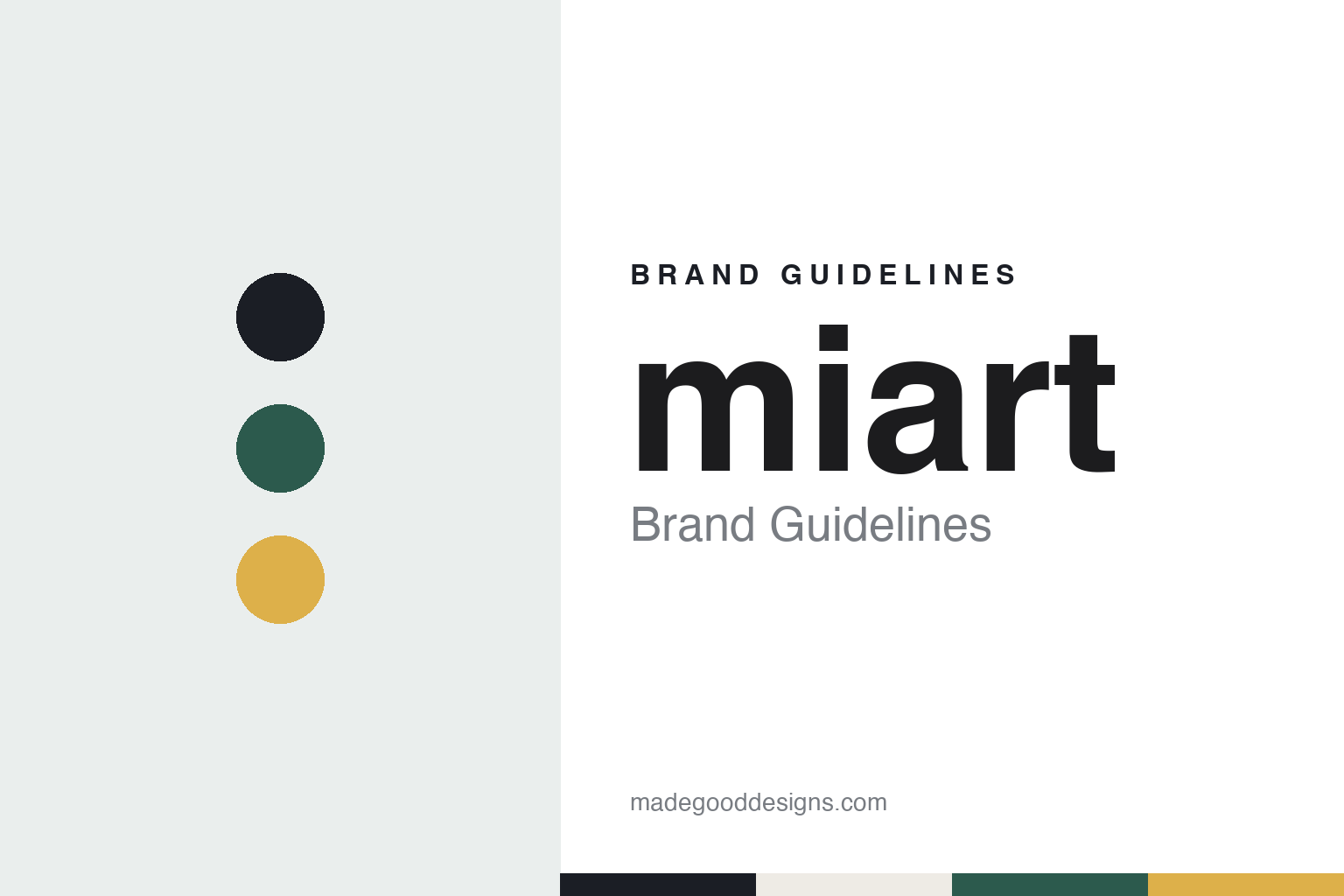
miart Brand Guidelines
Milan’s modern and contemporary art fair, run by Fiera Milano.
Aa
Two constants: an ink, green and yellow palette and a geometric grotesque register. Abstract homage — not a miart asset; no logo, poster or artwork is reproduced.
Relaunch
A Milan fair remade in 2013.
miart is the international fair of modern and contemporary art held each spring in Milan by the trade-fair company Fiera Milano, which presents it in its own press materials and writes its name in lower case. Its origins go back to the mid-1990s: in a feature on the 2013 edition, Wallpaper* quoted the fair’s new director describing it as an 18-year-old fair, and in April 2026 the Italian art magazine Artribune reported that miart was opening its 30th edition and marking 30 years.
For much of its early history the fair was a gathering of Italian galleries specialising in the secondary market for modern art, Wallpaper* wrote. The 2013 edition marked a change of course. Fiera Milano signed Vincenzo de Bellis, co-founder and co-director of the Milan art centre Peep-Hole, to run the fair for three years, and the restructured edition, held from 5 to 7 April 2013, brought together 140 selected galleries, 61 of them from abroad, according to the magazine. It also extended the fair to design and drew in the city’s public and private art institutions over the three days.
The 2013 relaunch set out a structure in four sectors, Wallpaper* reported: Established, for contemporary and modern art galleries; Emergent, for young artists; THENnow, pairing artists from different generations; and Object, for modern and contemporary design. A board of gallery advisers and an honorary committee of collectors supported the contemporary sector. The magazine quoted de Bellis on keeping the fair’s modern-art roots while adding a contemporary edge, in a city with a long modernist past.
Colour
Three directors, one organiser.
Since the relaunch the fair has had three directors, all working for the same organiser. The Art Newspaper reported in May 2024 that de Bellis ran miart from 2013 to 2016 and Alessandro Rabottini from 2017 to 2020. In September 2020 Fiera Milano asked Nicola Ricciardi, then artistic director of the OGR arts centre in Turin, to take over from Rabottini, the paper reported in September 2021.
Ricciardi’s first edition was held from 17 to 19 September 2021. The Art Newspaper reported that 145 galleries from 21 countries took part, most of them Italian, and that the dividing line between the modern and contemporary sections had been loosened, so that modern galleries were mixed in with contemporary ones and a few design galleries were placed around the fair. Ricciardi, a literature graduate, gave that edition a theme of poetry, with a series of online conversations.
The 2024 edition ran from 10 to 14 April, overlapping with Milan Design Week, and had 178 galleries, The Art Newspaper reported. The paper noted that the emerging section had been moved to the entrance of the fair the year before, so that visitors met new galleries first, and that a six-gallery micro-section, Timescape, showed art connected to the early 20th century. Four galleries from the 2023 emerging section had moved up to the main section in 2024, the paper added. It also noted that Milan’s private art foundations, among them those of Prada, Trussardi and Pirelli, time major exhibitions to Milan Art Week.
Typography
Fairs, halls and names.
Contemporary art fairs usually present themselves through a short name that does most of the work. Some take the city outright, as Art Cologne does; others join a coined word to the city, as ARCOmadrid does with ARCO and, for its Portuguese sibling, ARCOlisboa. The name stays fixed while much around it changes from one edition to the next, and editions are counted: ARCOmadrid held its 45th in March 2026 and Art Cologne its 59th in November 2026.
Behind many fairs stand trade-fair companies and galleries. ARCOmadrid is organised by IFEMA MADRID, and Art Cologne’s press releases come from Koelnmesse, while both fairs trace their beginnings to gallerists: Juana de Aizpuru in Madrid in 1982, and a Cologne dealers’ association in 1967. At both fairs the exhibitors are chosen by a committee or advisory board, and both are held in the exhibition halls of their organisers, IFEMA in Madrid and the fairgrounds at Cologne-Deutz, so the venue becomes part of the fair’s picture.
Inside the halls, fairs divide themselves into named sections. A main programme for established galleries sits beside sections for younger galleries, such as ARCOmadrid’s Opening, for galleries under eight years old, or Art Cologne’s NEUMARKT, and beside curated programmes with their own themes and curators. At these two fairs the section names are written in capitals or set off with punctuation — GALLERIES, ART + OBJECT, Profiles | Latin American Art — so that they read as titles in their own right.
The material the fairs publish follows a steady pattern: exhibitor lists by city and country, hall plans, programmes of talks and special exhibitions, and headline figures for each edition. Themed projects change from edition to edition — ARCOmadrid named its 2026 project ARCO2045 — while the name, the organiser and the city stay constant, which keeps a fair recognisable across decades.
Aa
A lower-case name set in a plain grotesque. (Specimen set in Space Grotesk, a sans STAND-IN; NOT the miart logo.)
miart
A lower-case name and a new hall.
The 30th edition, in April 2026, moved miart to a new venue. Fiera Milano announced on 24 March 2026 that the fair would run from 17 to 19 April, with a VIP preview on 16 April, in the South Wing of Allianz MiCo, a building facing the CityLife district. Il Giorno, reporting in January 2026, and Artribune, reporting from the opening on 16 April, both described 160 galleries from 24 countries spread over three levels rather than a single floor. The edition was titled “New Directions,” after John Coltrane’s 1963 album, and used jazz as its theme throughout.
The 2026 layout set out three sections, according to Artribune and the organiser: Emergent, with 29 galleries on the entrance level; Established, with 111 galleries spanning modern and contemporary art; and a new upper-floor section, Established Anthology, with 20 galleries, which Il Giorno said included Lia Rumma and Cardi. A special project, Movements, presented artists’ films with the St. Moritz Art Film Festival; Fiera Milano said it brought together 20 films by artists represented by 15 galleries, under the theme “If Music,” on the relationship between music and film. Fiera Milano named the banking group Intesa Sanpaolo as main partner and placed the fair within Milano Art Week, held from 13 to 19 April and coordinated by the city’s culture department. Artribune reported that 2026 was Ricciardi’s final year as director.
The identity has been rebuilt more than once. For the 2013 relaunch the Milan art magazine Mousse created a new brand identity for the fair, Wallpaper* reported, while a new architect designed the space. Since then the name has been written “miart,” in lower case, in Fiera Milano’s press releases, while The Art Newspaper writes it with a capital M. Each edition carries its own title, from a poetry theme in 2021 to “New Directions” in 2026, while the section names Emergent and Established appear both in 2013 and in 2026.
For a design guide, miart shows how a lower-case name and a stable set of section titles can carry a fair through new directors and a new hall. Compare Fiera Milano, the fair’s organiser, and Artissima, the contemporary art fair in Turin. For this guide we use ink, a tram green and a signal yellow with a sans, an unofficial interpretation; no product or logo is reproduced.
Explore & save
Keep miart’s identity on hand — save it to a board in the Made Good inspiration library.
miart identity set
Pin the miart ink, green and yellow palette and the geometric grotesque register to your own board.
Source & notes
Frequently Asked Questions
What font can I use to match the miart look?
This guide describes miart’s type as “A lower-case name set in a plain grotesque”. Its type specimen is set in Space Grotesk from Google Fonts as a stand-in; Space Grotesk is not miart’s own lettering.
What colours are in the miart palette?
This guide’s miart palette is Milan ink #1B1E25, Tram green #2C5A4D, Marble white #EEEBE5, Signal yellow #DDB04A and Paper #FAF8F4. The tones are the guide’s own unofficial interpretation, not official miart hex codes.
When was miart founded?
miart was founded in mid-1990s, in Milan, Italy.