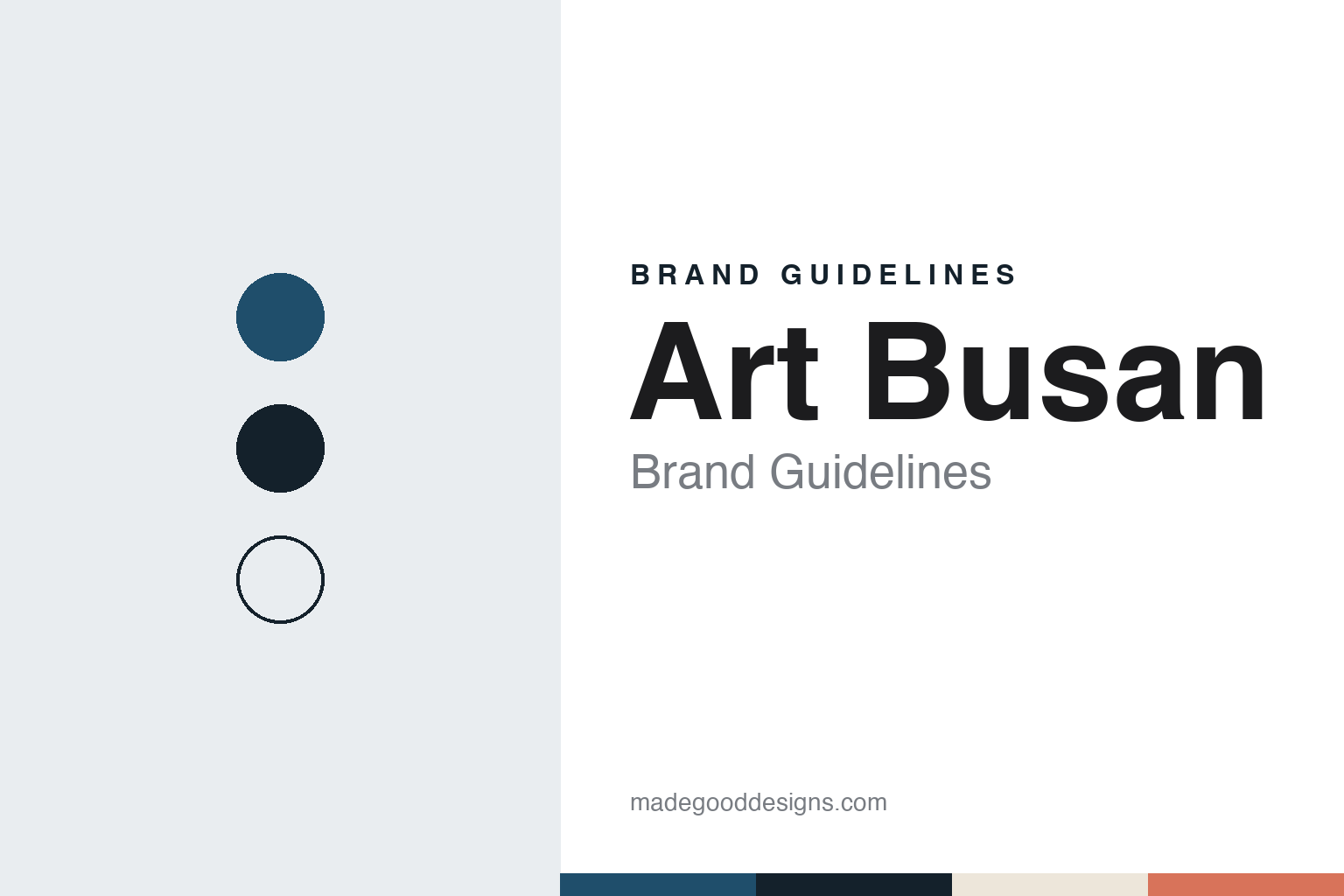
Art Busan Brand Guidelines
The spring fair at BEXCO that began as Art Show Busan in 2012.
Aa
Two constants: a harbour blue, sand and coral palette and a geometric sans register. Abstract homage — not an Art Busan asset; no logo, poster or artwork is reproduced.
Art Show Busan
A private fair in a port city, from 2012.
Art Busan is a contemporary art fair held each spring in Busan, the port city on the south-east coast of Korea, at the exhibition and convention centre BEXCO. It began in June 2012 under the name Art Show Busan, the Korean news agency Newsis reported in May 2019, and took the name Art Busan in 2015, when the organisers declared what the agency called a second start.
The venue was growing at the same moment. In January 2012 the newspaper Seoul Shinmun reported that BEXCO, then in its eleventh year, was completing a second exhibition hall and an auditorium, due by May, and that it had listed “Art Show Busan 2012,” from 7 to 11 June, among the exhibitions it had attracted for the new space. The fair has stayed at BEXCO since.
Art Busan is privately run. Newsis described it in 2019 as a private art fair run by Sohn Young-hee, the head of the incorporated association Art Busan, and the Korea JoongAng Daily named her in April 2026 as the fair’s founder and chair. At a press conference that month, reported by Newsis, she described a structure in which a nonprofit incorporated association handles the public-interest side while a company runs the business operations, with an executive team responsible for planning, overseas networks and partnerships.
Counted from 2012, the editions have followed one another year by year. The 2019 fair was the eighth: it opened with a VIP preview on 30 May and ran to 2 June, with 164 galleries from 17 countries, 58 of them from abroad, according to Newsis. The agency reported that the fair had arranged partnerships with hotels, restaurants, bars and cafés in the city for its VIP guests, tying the fair to the city around it.
Colour
Halls, sections and editions at BEXCO.
The hall itself has framed the fair’s scale. The Korea Times reported in May 2023 that 145 galleries from 22 countries set up their booths across a hall of about 26,500 square metres at BEXCO, with dealers including Kukje Gallery and Tang Contemporary Art among those taking part; the four-day fair opened that year on a Thursday with its VIP day, on the first weekend of May. Two years later the Asia Business Daily reported that the 2025 edition brought together 109 galleries from 17 countries, compared with 127 galleries from 20 countries in 2024, after the fair strengthened its screening criteria for participating galleries; the paper named exhibitors from Korea, Italy, Japan and Singapore.
The 2026 edition marked fifteen years. According to the Korea JoongAng Daily of 28 April 2026, it ran from 22 to 24 May, after a VIP preview on 21 May, with around 110 galleries from 18 countries, roughly a quarter of them based outside Korea; the international participants it named included Gladstone Gallery and Galerie Philia. Newsis placed the fair in Exhibition Hall 1 at BEXCO, and the Asia Business Daily, reporting from the preview, said that 26 of the galleries came from abroad, that about 30 percent were taking part for the first time, and that 1,500 guests attended the VIP preview in its first three hours. Newsis reported that gallery applications for the edition had opened in August 2025, nine months ahead of the fair.
The same edition reorganised the floor. LIGHTHAUS, a new section, used a “booth-in-booth” format that treated participating stands as curated exhibition units, the Korea JoongAng Daily reported. DEFINE, launched in connection with Busan’s selection as the 2028 World Design Capital, placed design beside art, with Karimoku, Fritz Hansen and a project by the architect Kengo Kuma among the participants. Newsis listed further sections — CONNECT, FUTURE and CONVERSATIONS — that extended the fair into sculpture, installation and media work, the discovery of younger artists, and talks. The Asia Business Daily described a layout that drew attention to booths conceived as stand-alone exhibitions, including solo presentations.
Typography
How city fairs present themselves.
A mid-sized or city art fair is usually organised in one of two ways. Some are set up by galleries themselves, or by a foundation or association that grew out of them: Melbourne Art Fair says it was founded by a group of galleries in 1988 and is now run by the nonprofit Melbourne Art Foundation. Others are run by an exhibition company or a private organiser: Newsis has described Art Busan, held at BEXCO, as a privately run fair. Either way, the organiser selects the galleries; Art Busan, for example, tightened its screening criteria for its 2025 edition, the Asia Business Daily reported.
The venue becomes part of how a fair is pictured. Convention halls offer open floors that can be divided into booths and rebuilt every year; some fairs instead use a tent, a former industrial site or a historic exhibition building, and several have moved between them. Melbourne Art Fair moved from the Royal Exhibition Building in the Carlton Gardens to a riverside convention centre, while Art Busan has stayed in the same exhibition centre since its first edition.
Each fair also holds a fixed place in the art calendar, usually the same month every year, and counts its editions rather than renaming them. Inside, the floor is divided into named sections: a main gallery section, a section for younger galleries or artists, curated areas for video, installation or design, and a programme of talks. These names are short, often set in capitals, and repeated on floor plans, in printed guides and on the website.
The visual identity follows the same split between what stays and what changes. The name, usually the word “Art” and a city, stays put, sometimes with a shortened form or a version in the local script. The campaign image, the colours of the season and the designed spaces inside the hall change from edition to edition, which lets a fair look new each year and still be recognised.
Aa
A geometric sans — ART BUSAN in capitals. (Specimen set in Manrope, a sans STAND-IN; NOT the Art Busan logo.)
Art Busan
ART BUSAN, 아트부산.
Art Busan has also built links with other fairs in the region. Newsis reported in April 2026 that it had worked with Tokyo Gendai, Art Central in Hong Kong and Art Jakarta, and that the collaboration was moving from exchange towards joint planning and curation. The fair’s website extends the event across the city through Busan Art Week, which it presents as a way of carrying the fair’s programme beyond the exhibition hall to a wider circle of collectors.
Visually, the fair works with a short, bilingual name. Its website sets the name in capitals, ART BUSAN, beside the Korean 아트부산, and writes its section names the same way, so that LIGHTHAUS, DEFINE, CONNECT and CONVERSATIONS read as titles in their own right. The edition year is attached to the name, as in ART BUSAN 2026. The name has changed once, in 2015, and the venue not at all, while the sections and the floor plan are rebuilt from one edition to the next.
For a design guide, Art Busan shows how a fair outside a capital can keep one venue and a capitalised bilingual name while reworking its sections edition by edition. Compare Kiaf Seoul, the fair held in Korea’s capital, and Tokyo Gendai, one of the fairs Art Busan has worked with. For this guide we use a harbour blue, a sand and a coral with a geometric sans, an unofficial interpretation; no product or logo is reproduced.
Explore & save
Keep Art Busan’s identity on hand — save it to a board in the Made Good inspiration library.
Art Busan identity set
Pin the Art Busan harbour blue, sand and coral palette and the geometric sans register to your own board.
Source & notes
Frequently Asked Questions
What font can I use to match the Art Busan look?
This guide describes Art Busan’s type as “A geometric sans — ART BUSAN in capitals”. Its type specimen is set in Manrope from Google Fonts as a stand-in; Manrope is not Art Busan’s own lettering.
What colours are in the Art Busan palette?
This guide’s Art Busan palette is Harbour blue #1F4E6B, Night quay #14212B, Sand #EDE6DA, Coral #D8735A and Paper #F8F6F2. The tones are the guide’s own unofficial interpretation, not official Art Busan hex codes.
When was Art Busan founded?
Art Busan was founded in June 2012 (as Art Show Busan), in Busan, South Korea.