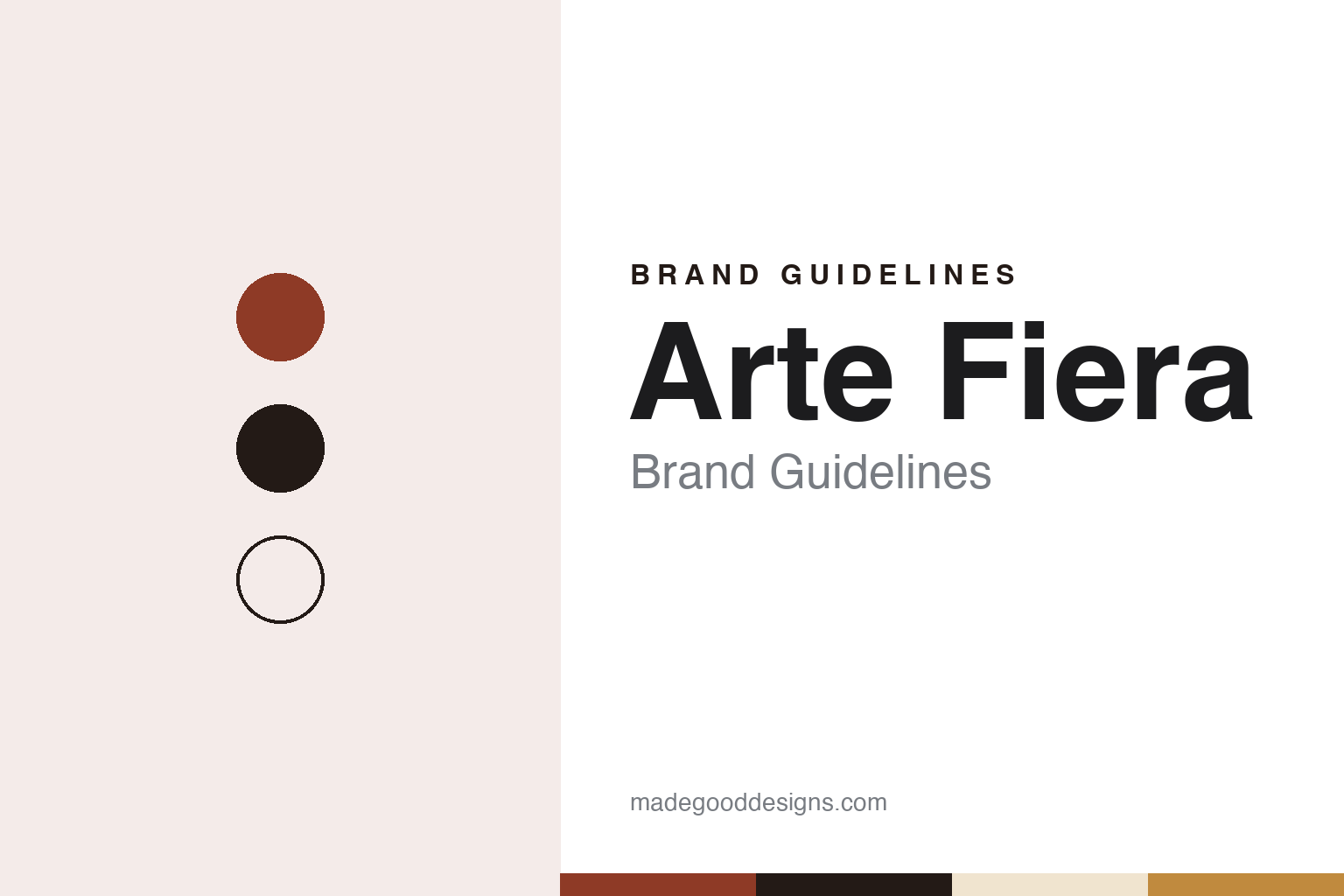
Arte Fiera Brand Guidelines
The art fair of Bologna, held at the city’s trade fair since 1974.
Aa
Two constants: a brick red, umber and cream palette and a warm display serif register. Abstract homage — not an Arte Fiera asset; no logo, poster or artwork is reproduced.
Fiera Campionaria
A pilot edition of ten galleries in 1974.
Arte Fiera is the fair for modern and contemporary art held each winter in Bologna, at the city’s trade fair, BolognaFiere. It began in 1974. Il Resto del Carlino, writing on 2 February 2024, said the fair was born that year within the Fiera Campionaria, the city’s general trade fair, from an idea of the trade-fair manager Maurizio Mazzotti. Italian Wikipedia says that among art fairs it is preceded in age only by Art Basel and Art Cologne, and that it is held every year in Bologna.
The beginning was small. In an interview with Artribune published on 31 January 2024, the fair’s then director, Simone Menegoi, described the first year as a pilot edition of just ten galleries, at a time when, he said, art fairs in Europe could be counted on the fingers of one hand. He added that performance had been part of the fair from the outset, with works by artists such as Luigi Ontani already present in 1974, and that editioned works, or multiples, played an important part in its first editions.
Performance remained a thread through the 1970s. Italian and English Wikipedia both describe the “Settimane internazionali della performance,” international weeks of performance held alongside the fair in 1977 and 1978, and Menegoi told Artribune that in 1976 a series of performances, organised on the initiative of several galleries, had already taken place during the fair; an exhibition at the fair in 2024, produced with the MAMbo museum in Bologna, returned to that episode. Menegoi also pointed to conferences held at the fair, from one on the critical autonomy of the artist in 1979 to another on the space between exhibition and fair in 2018.
Colour
Directors, sections and fifty years.
Over five decades the fair has been run by a sequence of directors and curators appointed by its organiser. Italian Wikipedia says that a long-serving director was succeeded by two curators for the editions of 2013 to 2016, that another curator led the editions of 2017 and 2018, and that Menegoi directed the fair from 2019. Under him the fair added new sections: Pittura XXI, for contemporary painting, began in 2020, and Multipli, for works in editions, began in 2023, he told Artribune in January 2024. Il Resto del Carlino recorded that the 2022 edition was held in May rather than in the winter.
The fair’s links with the city grew in the same period. Italian Wikipedia says that the programme of events in the city centre was first called Art First and, from 2013, Art City Bologna, an initiative of the city’s culture department and BolognaFiere held at the time of the fair. Finestre sull’Arte reported in February 2026 that the fourteenth edition of ART CITY Bologna, promoted by the city with the support of BolognaFiere, coincided with the fair and included a White Night on 7 February.
In 2024 the fair marked its fiftieth anniversary with its 47th edition, which opened in early February; Il Resto del Carlino quoted the president of BolognaFiere as saying that nearly 200 galleries were taking part. Menegoi told Artribune that this would be the last edition of his term. The 49th edition, from 6 to 8 February 2026 with a preview on 5 February, was the first under the artistic direction of Davide Ferri, who worked alongside an operational director serving his fourth year, according to Artribune on 25 November 2025. That preview put the total at 200 exhibitors; Finestre sull’Arte, on 3 February 2026, gave 174 galleries, 12 publishing exhibitors and 15 institutions, 201 in all. Galleries named by Artribune for the edition included Alfonso Artiaco, Galleria Continua, Franco Noero and Kaufmann Repetto. Beside the Main Section, the curated sections that year were Ventesimo+, for twentieth-century art, Fotografia e dintorni, Multipli, Pittura XXI and Prospettiva, a section of solo presentations by younger galleries in its second year.
Typography
Names, halls, sections.
A mid-sized or city art fair is usually organised in one of two ways. Some are set up by galleries themselves, or by a foundation or association that grew out of them: Melbourne Art Fair says it was founded by a group of galleries in 1988 and is now run by the nonprofit Melbourne Art Foundation. Others are run by an exhibition company or a private organiser: Newsis has described Art Busan, held at BEXCO, as a privately run fair. Either way, the organiser selects the galleries; Art Busan, for example, tightened its screening criteria for its 2025 edition, the Asia Business Daily reported.
The venue becomes part of how a fair is pictured. Convention halls offer open floors that can be divided into booths and rebuilt every year; some fairs instead use a tent, a former industrial site or a historic exhibition building, and several have moved between them. Melbourne Art Fair moved from the Royal Exhibition Building in the Carlton Gardens to a riverside convention centre, while Art Busan has stayed in the same exhibition centre since its first edition.
Each fair also holds a fixed place in the art calendar, usually the same month every year, and counts its editions rather than renaming them. Inside, the floor is divided into named sections: a main gallery section, a section for younger galleries or artists, curated areas for video, installation or design, and a programme of talks. These names are short, often set in capitals, and repeated on floor plans, in printed guides and on the website.
The visual identity follows the same split between what stays and what changes. The name, usually the word “Art” and a city, stays put, sometimes with a shortened form or a version in the local script. The campaign image, the colours of the season and the designed spaces inside the hall change from edition to edition, which lets a fair look new each year and still be recognised.
Aa
A warm display serif for a fair whose name means art fair. (Specimen set in Fraunces, a serif STAND-IN; NOT the Arte Fiera logo.)
Arte Fiera
A plain Italian name, two halls and a title for each edition.
The name could hardly be plainer: Arte Fiera is Italian for “art fair,” and the fair is often written as a single word, ArteFiera, as well as in two. Italian Wikipedia gives a longer form, Arte Fiera – Fiera internazionale d’arte contemporanea. What changes from year to year is the edition title and the way the halls are arranged. The 2026 edition took the title Cosa sarà, “what will be,” which Finestre sull’Arte read as an opening towards the future.
The venue is the trade-fair district of Bologna. In 2026 the fair occupied halls 25 and 26, which Finestre sull’Arte described as lit by daylight from opening to closing, with the modern section in hall 26 and contemporary work in hall 25. The district has its own landmark: Artribune noted that the towers designed by Kenzo Tange have marked the BolognaFiere district since 1983, and the fair’s 2026 video series LET’S WALK, in which people connected with Bologna walk through places in the city, began with an episode on those towers. At the entrance in 2026 stood a temporary installation, KOLOSSAL, in which a crane lifted a Bologna road sign between earth and sky, with posters made for the project spread between the fair and the city, according to Finestre sull’Arte, which also named the bank BPER as the fair’s main partner.
For a design guide, Arte Fiera shows how a fair can hold on to a plain generic name and a fixed place in the early-year calendar of one trade-fair district, and let curated sections and a new title for each edition carry the change. Compare miart, the fair of Milan, and Artissima, the fair of Turin. For this guide we use a brick red, dark umber, plaster cream and ochre with a serif, an unofficial interpretation; no product or logo is reproduced.
Explore & save
Keep Arte Fiera’s identity on hand — save it to a board in the Made Good inspiration library.
Arte Fiera identity set
Pin the Arte Fiera brick red, umber and cream palette and the warm display serif register to your own board.
Source & notes
Frequently Asked Questions
What font can I use to match the Arte Fiera look?
This guide describes Arte Fiera’s type as “A warm display serif for a fair whose name means art fair”. Its type specimen is set in Fraunces from Google Fonts as a stand-in; Fraunces is not Arte Fiera’s own lettering.
What colours are in the Arte Fiera palette?
This guide’s Arte Fiera palette is Portico brick #8E3A26, Dark umber #231A16, Plaster cream #F0E4CF, Ochre #C08A3E and Paper #FAF6EE. The tones are the guide’s own unofficial interpretation, not official Arte Fiera hex codes.
When was Arte Fiera founded?
Arte Fiera was founded in 1974, in Bologna, Italy.