Art Toronto Brand Guidelines
The convention-centre fair that began in 2000.
Aa
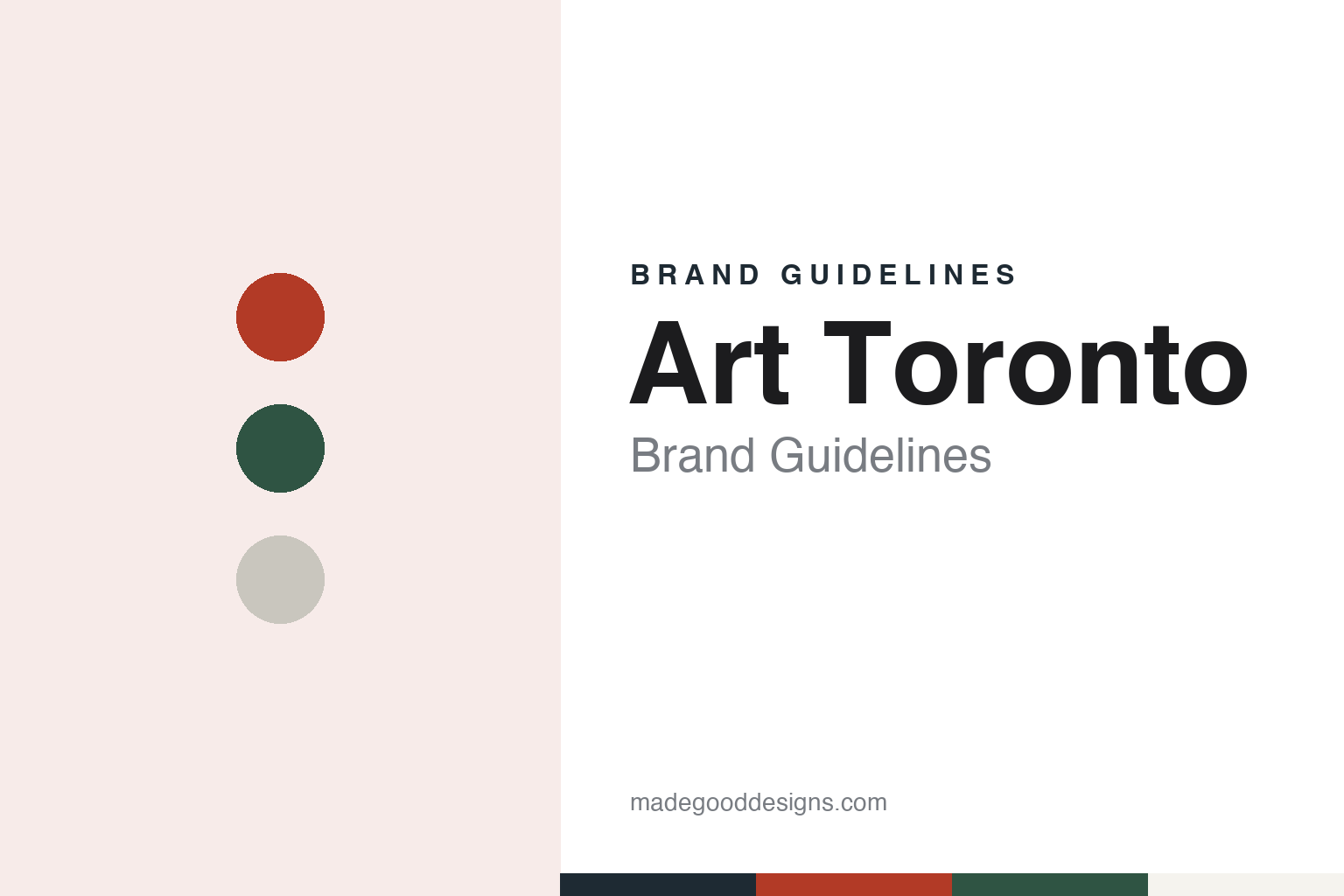
Two constants: a lake slate, vermilion and pine palette of our own and an open civic sans register. Abstract homage — not an Art Toronto asset; no logo, campaign image or artwork is reproduced.
Toronto International Art Fair
From Vancouver to a convention hall in Toronto.
Art Toronto began life under a longer name. The fair opened in 2000 as the Toronto International Art Fair at the Metro Toronto Convention Centre, The Globe and Mail reported in October 2016, and English Wikipedia says it has been held there every year since. The same newspaper, in October 2019, said the fair had been founded by Linel and Ella Rebenchuk in Vancouver and moved to Toronto in 2000, and that it drew established Canadian dealers from its first edition.
Some of those first exhibitors stayed for decades. The Globe and Mail reported in 2019 that six of the original exhibitors, most of them Toronto galleries and one from London, Ontario, were returning for that year’s edition, the fair’s twentieth in the city.
Ownership changed within the first decade. In January 2008 ArtsJournal reported that the Chicago-based Merchandise Mart had bought the Toronto International Art Fair, adding it to a group of fairs that already included Art Chicago, The Armory Show in New York and the Volta show. By late 2014 the fair’s parent company was Informa Exhibitions, which named a new director that year, The Globe and Mail reported in 2016. Today the fair’s website carries the name of Informa Connect, a trading division of Informa PLC.
The fair now uses the shorter name Art Toronto, and its website describes it as “Canada’s Art Fair.” English Wikipedia still records the earlier title, Toronto International Art Fair, in its opening line.
Colour
A national gathering in a convention hall.
By its 17th edition, in October 2016, Art Toronto had 124 exhibitors, about 10 per cent more than in 2015, The Globe and Mail reported. The paper said attendance had reached a record 21,000 in 2015, and that non-Canadians made up about 45 per cent of the 111 commercial galleries. That year the fair continued a geographical focus programme on contemporary art from Latin America, with 16 galleries from seven countries, and added Edition Toronto, a free companion fair on the convention centre’s main floor for multiples, artists’ books, exhibition catalogues and small-run zines.
The 2019 edition marked twenty years in Toronto. The Globe and Mail reported that October that a new director, previously curator of exhibitions and director of events at the Drake Hotel, had taken over; that participating galleries were selected by a jury committee; and that the fair drew about 20,000 visitors. Most of the roughly 100 galleries came from Canada, the paper said, from Vancouver and Calgary to Regina, Montreal, Halifax and St. John’s. The curated Focus section that year was dedicated to Portugal, and for the first time five public installations greeted visitors at the entrance before the ticket desk, with ten more on the show floor. The fair opened with a fundraiser for the Art Gallery of Ontario.
English Wikipedia says that after two years of hybrid and virtual programming the fair returned to the Metro Toronto Convention Centre in 2022, and that in 2023 it added Discover, a section for exhibitions by emerging artists, alongside Focus.
The 27th edition ran from 29 October to 1 November 2026 in the convention centre’s North Building, according to the fair’s website. The Art Newspaper reported on 30 October 2026 that the fair’s new director, Emily Jean Alexander, counted 105 exhibitors, 80 per cent of them based in Canada. Among the stands the paper described were those of Mónica Reyes Gallery, the Toronto-based Nicholas Metivier Gallery and Montreal’s Galerie Nicolas Robert, as well as a stand by the McMichael Canadian Art Collection. It also noted a series of talks titled “Building a Stronger Arts Ecosystem” and a ground-floor installation presented with Artist Project, which it called Art Toronto’s sister fair.
Typography
How mid-sized and city art fairs present themselves.
A mid-sized or city art fair is usually organised in one of two ways. Some are set up by galleries themselves, or by a foundation or association that grew out of them: Melbourne Art Fair says it was founded by a group of galleries in 1988 and is now run by the nonprofit Melbourne Art Foundation. Others are run by an exhibition company or a private organiser: Newsis has described Art Busan, held at BEXCO, as a privately run fair. Either way, the organiser selects the galleries; Art Busan, for example, tightened its screening criteria for its 2025 edition, the Asia Business Daily reported.
The venue becomes part of how a fair is pictured. Convention halls offer open floors that can be divided into booths and rebuilt every year; some fairs instead use a tent, a former industrial site or a historic exhibition building, and several have moved between them. Melbourne Art Fair moved from the Royal Exhibition Building in the Carlton Gardens to a riverside convention centre, while Art Busan has stayed in the same exhibition centre since its first edition.
Each fair also holds a fixed place in the art calendar, usually the same month every year, and counts its editions rather than renaming them. Inside, the floor is divided into named sections: a main gallery section, a section for younger galleries or artists, curated areas for video, installation or design, and a programme of talks. These names are short, often set in capitals, and repeated on floor plans, in printed guides and on the website.
The visual identity follows the same split between what stays and what changes. The name, usually the word “Art” and a city, stays put, sometimes with a shortened form or a version in the local script. The campaign image, the colours of the season and the designed spaces inside the hall change from edition to edition, which lets a fair look new each year and still be recognised.
Aa
An open civic sans for a two-word city name. (Specimen set in Work Sans, a sans STAND-IN; NOT the Art Toronto logo.)
Art Toronto
A short city name for a national fair.
The identity rests on a plain place name. The move from Toronto International Art Fair to Art Toronto turned a descriptive title into two words, and the website pairs it with the line “Canada’s Art Fair,” along with the venue and season of the next edition. Its menus list the parts of the event a visitor meets: an opening night, daily programming, the Arte Sur programme, installations, alongside a show guide for visitors. The fair’s about page says that since 2000 it has connected audiences with local, national and international galleries.
The structure is that of a fair run by an events company rather than by its galleries. The newspaper coverage of 2016 and 2019 describes the same pattern each year: a juried gallery list, a curated Focus section, public installations and a programme of tours, talks and panels around the stands. Under Informa the fair sits alongside other events: The Art Newspaper called Artist Project its sister fair in 2026, and in October 2026 Hyperallergic reported that Informa had acquired the New York fair Independent in 2025.
The venue is part of the picture too. For more than two decades the fair has used the same downtown convention centre, and in 2019 it began placing public installations in the entrance areas before the ticket desk, The Globe and Mail reported, as part of a stronger commitment to public art and to giving younger artists room for large works.
For a design guide, Art Toronto shows how a fair can trade a long formal title for a short city name while keeping one venue for more than two decades. Compare The Armory Show, which shared the Merchandise Mart’s group of fairs in 2008, and Independent, another Informa fair. For this guide we use a lake slate, a vermilion and a pine green on paper with a sans, an unofficial interpretation; no product or logo is reproduced.
Explore & save
Keep Art Toronto’s identity on hand — save it to a board in the Made Good inspiration library.
Art Toronto identity set
Pin the Art Toronto lake slate, vermilion and pine palette and the open civic sans register to your own board.
Source & notes
Frequently Asked Questions
What font can I use to match the Art Toronto look?
This guide describes Art Toronto’s type as “An open civic sans for a two-word city name”. Its type specimen is set in Work Sans from Google Fonts as a stand-in; Work Sans is not Art Toronto’s own lettering.
What colours are in the Art Toronto palette?
This guide’s Art Toronto palette is Lake slate #1E2A33, Signal vermilion #B23A26, Ontario pine #2F5443, Concourse grey #C9C6BE and Paper #F5F3EE. The tones are the guide’s own unofficial interpretation, not official Art Toronto hex codes.
When was Art Toronto founded?
Art Toronto was founded in 2000 (as Toronto International Art Fair), in Toronto, Canada.
Who owns Art Toronto?
Art Toronto is owned by Informa (Informa Connect) (parent by 2014).