viennacontemporary Brand Guidelines
The Vienna art fair that ran from 2015 to 2025.
Aa
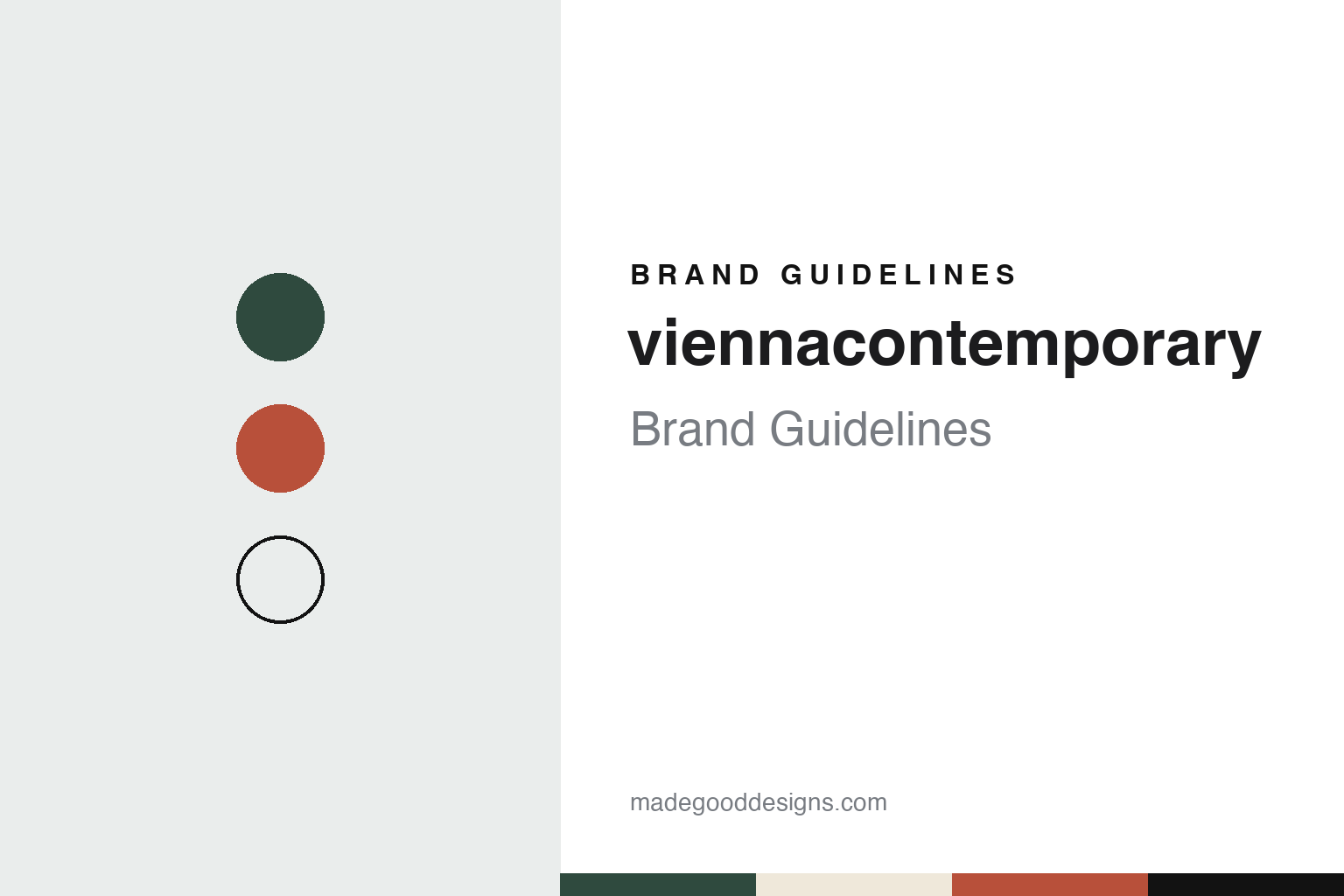
Two constants: an iron green, cream and coral palette and a lower-case geometric sans register. Abstract homage — not a viennacontemporary asset or mark; no logo, artwork or campaign image is reproduced.
From Viennafair
A renamed fair and a new hall.
viennacontemporary grew out of an older Vienna fair. English Wikipedia says Viennafair was founded in 2005 by Reed Messe Wien, with a focus on galleries from Central, Eastern and South-Eastern Europe. It says that from 2012 a new team ran the fair, with Christina Steinbrecher-Pfandt among its artistic directors, and that in 2015 the same team renamed it viennacontemporary and moved it to the Marx Halle in St. Marx, in Vienna’s third district.
The Art Newspaper reported the change on 5 October 2015. It wrote that viennacontemporary, previously known as Viennafair, had taken place from 22 to 25 September 2015 in a new location, the Marx Halle, which it described as a lofty glass and cast-iron industrial building. The number of galleries had been reduced from 130 in 2014 to 99 from 25 countries, and Steinbrecher-Pfandt, the fair’s artistic director, described the aim as one third Austrian galleries, one third from Eastern Europe and one third from the rest of the world. The paper said a board of experts, mainly Austrian gallerists, selected the exhibitors, and that a section called Zone 1 gave twelve galleries space for small presentations of young artists.
The old name did not last. The Art Newspaper reported on 20 September 2016 that the inaugural viennacontemporary and the decade-old Viennafair had both been held in the city in autumn 2015, after Reed Exhibitions licensed the Viennafair brand to new management, and that only viennacontemporary would take place in 2016 because Viennafair had been cancelled. The second edition had 105 galleries, compared with 99 in 2015, and kept its focus on Eastern European and younger art.
Colour
Four venues in eleven editions.
Venues shaped the fair’s image. In September 2018, after three editions, The Art Newspaper reported that the fair had booked dates at the Marx Halle for the following decade; that edition ran from 27 to 30 September. English Wikipedia says the fair stayed at the Marx Halle until 2020, moved to the Neue Alte Post in 2021 and from 2022 used the Kursalon in the Stadtpark in the city centre, a building The Art Newspaper later described as ornate and Italian Renaissance-style, where the 2023 edition took place from 7 to 10 September. German Wikipedia says the fair moved to Messe Wien, Hall D, from 2024.
The artistic direction changed several times. Wikipedia lists Steinbrecher-Pfandt as artistic director from 2015 to 2018, with new artistic directors appointed in 2019 and 2021. Writing on 13 September 2024, The Art Newspaper described the tenth edition at the Messe Wien exhibition centre under its recently appointed artistic director, Francesca Gavin, with 98 galleries, up from 61 the year before. One third were Austrian, one third from Eastern Europe and the rest mostly from elsewhere in Europe. The paper noted a section for emerging galleries and another, Context, which aimed to bring back once-prominent artists who had been overlooked, and said the fair was then owned by a group of Austrian investors.
The 2025 fair was the eleventh. The Art Newspaper reported on 13 September 2025 that it ran from 11 to 14 September 2025 with 97 exhibitors from 24 countries, under managing director Markus Huber. Zone1 was devoted to emerging artists who were Austrian or worked in Austria, with ten galleries, and Context presented more historical work. Galleries from Poland, Slovakia, Slovenia, Lithuania, Latvia, Hungary and Croatia exhibited alongside Austrian ones.
Typography
The category.
A younger or regional contemporary art fair usually introduces itself with very few words. Many simply put “Art” in front of a city, as Art Paris and Art Rotterdam do; others use a short coined name or a single word for “contemporary” in a local language, attached to a place. The name is the part that stays put. Editions are counted rather than renamed, so a fair can say that it is holding its 27th or 28th edition and still look like itself.
Behind the name there is usually a small company, a trade-fair organiser or a group of gallerists. Art Paris is run by a company called France Conventions, according to French Wikipedia, and Art Rotterdam grew out of a free slot in a Rotterdam port building, as its director told De Kunstbode in 2020. Venues matter as much as owners: a glass-roofed exhibition palace, a listed factory or the halls of a large events complex become part of how a fair is pictured, and Art Paris and Art Rotterdam have both changed venue more than once.
Inside, the fairs are built from named sections. A main section for established galleries sits beside sections for younger galleries and emerging artists — Promises at Art Paris, the New Art Section at Art Rotterdam — and beside curated programmes for video, sculpture, design or photography, often with their own invited curators. These section names are short and are usually written as titles, and they recur on floor plans and in catalogues.
Around the fair itself sits a steady set of printed and online material: an exhibitor list, a catalogue, a floor plan or map, a programme of talks and, at some fairs, an online magazine. The campaign image and the themed programme usually change with every edition, while the name, the season and the city stay the same, and that combination is what lets a fair remain recognisable from one year to the next.
aa
A lower-case geometric sans for a name written as one lower-case word. (Specimen set in Jost, a sans STAND-IN; NOT the viennacontemporary logo.)
viennacontemporary
One word, written small.
In January 2026 the fair’s operator said it would stop in its existing form. On 17 January 2026 wien.ORF.at, citing the newspaper Kurier, reported that the operating company, VC Artfairs GmbH, had confirmed that viennacontemporary would not continue in its previous form as an international art fair, because the format could no longer be financed under current economic conditions. ORF quoted Huber, via Die Presse, as saying the fair would no longer be held at Messe Wien. ORF also reported that the fair had first been owned through a company called VC Venture and had passed to VC Artfairs GmbH in 2022.
The name itself did not change. Where its predecessor used a city name with a separate word, viennacontemporary ran the two words together and styles the result as one lower-case word; The Art Newspaper has printed it both as Viennacontemporary and as Vienna Contemporary. The name stayed the same while the venue changed four times in eleven editions, from the Marx Halle to the Neue Alte Post, the Kursalon in the Stadtpark and the Messe Wien exhibition centre.
The fair’s sections followed the same logic of short names. Zone1 for young artists working in Austria and Context for overlooked historical positions sat beside the main gallery section, and each could be signposted with one word on a floor plan. The regional idea was also simple enough to state in a sentence: a third Austrian, a third Eastern European and a third from elsewhere, as The Art Newspaper described the exhibitor mix in 2015 and 2024.
For a design guide, viennacontemporary shows how a compact lower-case name can hold a fair together through changes of venue, owner and director. Compare Art Cologne, another fair in the German-speaking art market, and Liste, a fair built around younger galleries. For this guide we use iron green, Kursalon cream and coral with a sans, an unofficial interpretation; no product or logo is reproduced.
Explore & save
Keep viennacontemporary’s identity on hand — save it to a board in the Made Good inspiration library.
viennacontemporary identity set
Pin the viennacontemporary iron green, cream and coral palette and the lower-case geometric sans register to your own board.
Source & notes
Frequently Asked Questions
What font can I use to match the viennacontemporary look?
This guide describes viennacontemporary’s type as “A lower-case geometric sans for a name written as one lower-case word”. Its type specimen is set in Jost from Google Fonts as a stand-in; Jost is not viennacontemporary’s own lettering.
What colours are in the viennacontemporary palette?
This guide’s viennacontemporary palette is Iron green #2F4A3E, Ink #121212, Kursalon cream #EFE8DA, Coral #B8503A and Paper #FAF9F6. The tones are the guide’s own unofficial interpretation, not official viennacontemporary hex codes.
When was viennacontemporary founded?
viennacontemporary was founded in 2015 (successor to Viennafair), in Vienna, Austria.