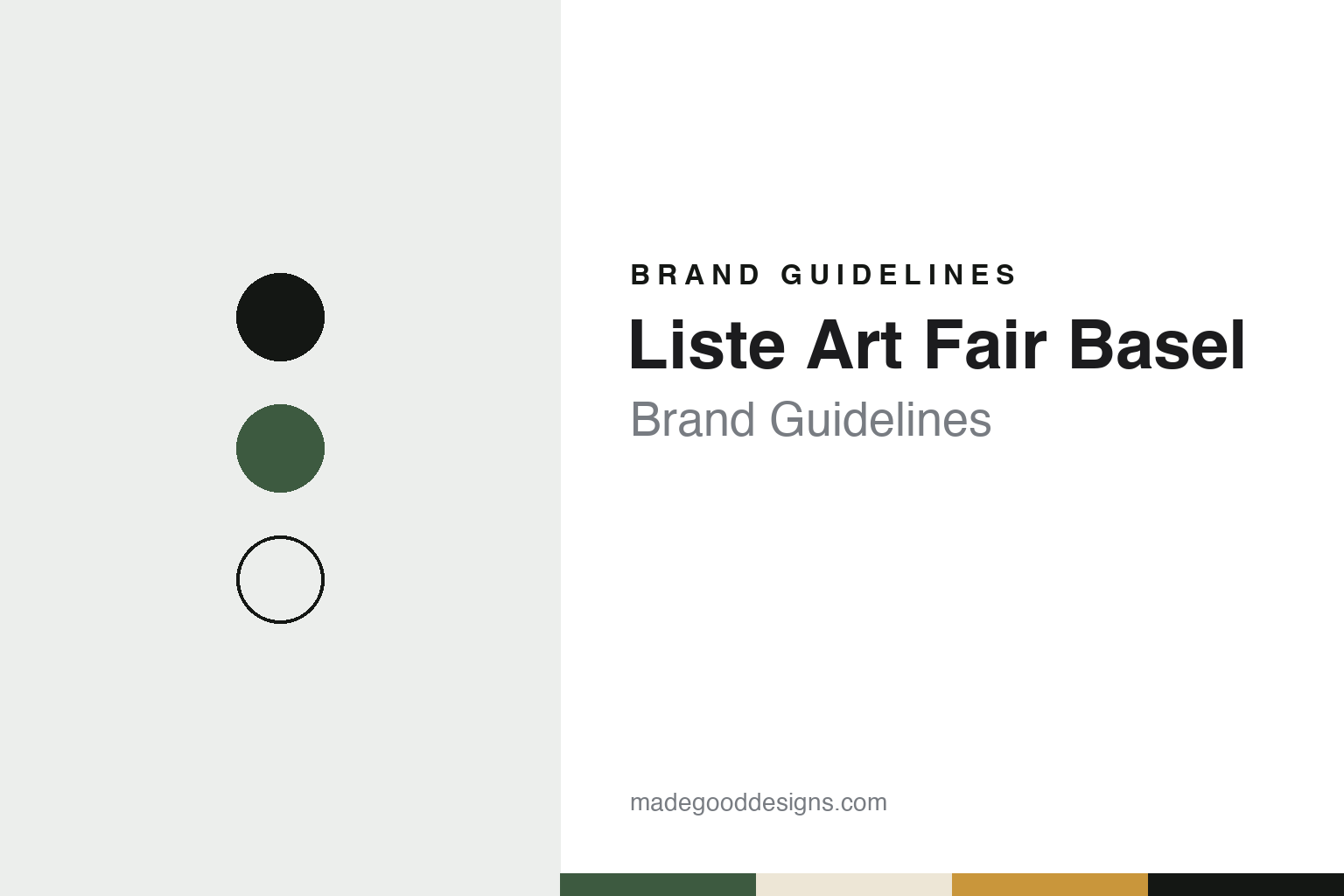
Liste Art Fair Basel Brand Guidelines
Young galleries, from a brewery to Messe Basel.
Aa
Two constants: a malt green, plaster and amber palette and a grotesque sans register. Abstract homage — not a Liste asset; no logo, poster or artwork is reproduced.
The Young Art Fair
A fair for a new generation, in a former brewery.
Liste Art Fair Basel was founded in 1996. German Wikipedia and the fair’s own history give the same origin: in 1995 two gallerists from Zurich approached the Basel exhibition-maker and curator Peter Bläuer with the idea of a new fair for young international galleries, to run in Basel during the same week as Art Basel. Bläuer took on its organisation and direction and, the fair says, led it as co-founder and director for more than twenty years.
The early name stated the idea plainly. Photographs on the fair’s own site from 1996 and 1997 are captioned LISTE The Young Art Fair, and in 2025 The Art Newspaper reported that, when it began, the fair was strictly for young artists: participating galleries were not allowed to show artists over the age of 40. Those age rules have since been loosened, the paper said.
The first edition was small. The fair gives it as 36 galleries from 12 countries; German Wikipedia gives 37. Among the first exhibitors, both name Air de Paris, Maureen Paley, neugerriemschneider and David Zwirner. Between 1996 and 2005, the fair says, around 190 galleries from 28 countries took part.
Its home for 25 years was the Werkraum Warteck pp, a former brewery in Basel that had become a base for art, craft, design and performance in the 1990s. During the fair week, the fair says, the tenants cleared their studios, workshops and offices so that galleries could move in, producing stands in old production halls, stairwells and corridors. The fair’s history quotes a London collector recalling factory spaces with yellow and brown glazed ceramic walls.
Since 1997 the Basel private bank E. Gutzwiller & Cie, Banquiers has supported Liste as its main partner, according to both German Wikipedia and the fair.
Colour
From Warteck to Hall 1.1.
The fair grew beyond the stands. Its own history says performances began in the late 1990s, a standalone performance project followed in 2005, and curated projects, publications and talks became part of the programme over the years. English Wikipedia describes performances, panels, readings, workshops, children’s activities and guided tours alongside the galleries.
Leadership changed after two decades. The fair says Joanna Kamm became director in 2018 and led it for six years, expanding the programme and launching digital formats. The 2020 edition did not take place in person; in the same year the fair launched Liste Showtime, an online platform on which galleries present an artist from their programme, according to German Wikipedia.
In 2021 the fair moved out of the brewery and into Messe Basel, the exhibition centre on the Messeplatz, close to Art Basel. ARTnews reported the move in June 2025; the fair says it has used Hall 1.1 since then. The new hall needed new architecture. The Brussels firm OFFICE Kersten Geers David Van Severen, working with an artist, designed an open circular plan: a ring of radially arranged walls joined at the top by diagonal beams into a crown-like structure, with stands on both sides of the ring and a central “piazza” for meeting, the fair says. That layout, conceived for reuse, served the editions from 2021 to 2024, and the fair describes it as replacing the labyrinth of the old brewery with a communal space.
In 2022 the fair was restructured and has since been operated by Stiftung Liste Basel, a non-profit foundation, alongside the Friends of Liste, a sponsor group that supports selected gallery presentations, according to the fair.
Typography
How contemporary art fairs present themselves.
Contemporary art fairs usually present themselves through a short name that does most of the work. Some take the city outright, as Art Cologne does; others join a coined word to the city, as ARCOmadrid does with ARCO and, for its Portuguese sibling, ARCOlisboa. The name stays fixed while much around it changes from one edition to the next, and editions are counted: ARCOmadrid held its 45th in March 2026 and Art Cologne its 59th in November 2026.
Behind many fairs stand trade-fair companies and galleries. ARCOmadrid is organised by IFEMA MADRID, and Art Cologne’s press releases come from Koelnmesse, while both fairs trace their beginnings to gallerists: Juana de Aizpuru in Madrid in 1982, and a Cologne dealers’ association in 1967. At both fairs the exhibitors are chosen by a committee or advisory board, and both are held in the exhibition halls of their organisers, IFEMA in Madrid and the fairgrounds at Cologne-Deutz, so the venue becomes part of the fair’s picture.
Inside the halls, fairs divide themselves into named sections. A main programme for established galleries sits beside sections for younger galleries, such as ARCOmadrid’s Opening, for galleries under eight years old, or Art Cologne’s NEUMARKT, and beside curated programmes with their own themes and curators. At these two fairs the section names are written in capitals or set off with punctuation — GALLERIES, ART + OBJECT, Profiles | Latin American Art — so that they read as titles in their own right.
The material the fairs publish follows a steady pattern: exhibitor lists by city and country, hall plans, programmes of talks and special exhibitions, and headline figures for each edition. Themed projects change from edition to edition — ARCOmadrid named its 2026 project ARCO2045 — while the name, the organiser and the city stay constant, which keeps a fair recognisable across decades.
Aa
A plain grotesque for a fair that kept its one-word name. (Specimen set in Archivo, a sans STAND-IN; NOT the Liste logo.)
Liste
A new director for the thirtieth edition.
In June 2024 the foundation appointed the art historian Nikola Dietrich as artistic director, on the recommendation of a search committee, the German art magazine Monopol reported; she took up the post on 1 September 2024. Monopol noted that she had headed contemporary art at the Kunstmuseum Basel from 2008 to 2014 and had earlier been a curator at the Portikus in Frankfurt, and the fair adds that she later directed the Kölnischer Kunstverein.
Her first edition, in June 2025, was the fair’s thirtieth. The Art Newspaper counted 99 stands from 31 countries at Messe Basel; ARTnews gave 99 exhibitors from 32 countries, around 40 of them taking part for the first time, and reported that the floor plan had been reworked for that edition. The fair says the redesign was by the Basel practice Martina Kausch Architektinnen, which reused elements of the earlier ring to create a sequence of smaller rooms and an open plaza, and that a new “Wall” format gave space to project spaces and artist-run initiatives.
Liste is not part of Art Basel. It is an independent fair held in the same city in the same June week, and since 2021 in the same exhibition complex. Its visual identity rests on a single short word, Liste, written in capitals in its early years as LISTE, and on the character of its two venues: the improvised rooms of a working brewery, then a purpose-built ring and plaza inside a trade-fair hall.
For a design guide, Liste shows how a fair can carry an atmosphere from an old building into a new one through its exhibition architecture. Compare Art Basel, held in Basel in the same week, and Art Brussels, in the home city of the architects of Liste’s first Messe Basel layout. For this guide we use a malt green, a plaster white and an amber with a sans, an unofficial interpretation; no product or logo is reproduced.
Explore & save
Keep Liste Art Fair Basel’s identity on hand — save it to a board in the Made Good inspiration library.
Liste Art Fair Basel identity set
Pin the Liste malt green, plaster and amber palette and the grotesque sans register to your own board.
Source & notes
Frequently Asked Questions
What font can I use to match the Liste Art Fair Basel look?
This guide describes Liste Art Fair Basel’s type as “A plain grotesque for a fair that kept its one-word name”. Its type specimen is set in Archivo from Google Fonts as a stand-in; Archivo is not Liste Art Fair Basel’s own lettering.
What colours are in the Liste Art Fair Basel palette?
This guide’s Liste Art Fair Basel palette is Malt green #3D5A40, Night ink #141714, Silo plaster #EDE6D6, Glaze amber #C9963B and Paper #F8F6F1. The tones are the guide’s own unofficial interpretation, not official Liste Art Fair Basel hex codes.
When was Liste Art Fair Basel founded?
Liste Art Fair Basel was founded in 1996, in Basel, Switzerland.
Who founded Liste Art Fair Basel?
Liste Art Fair Basel was founded by Peter Bläuer with two Zurich gallerists in 1996.