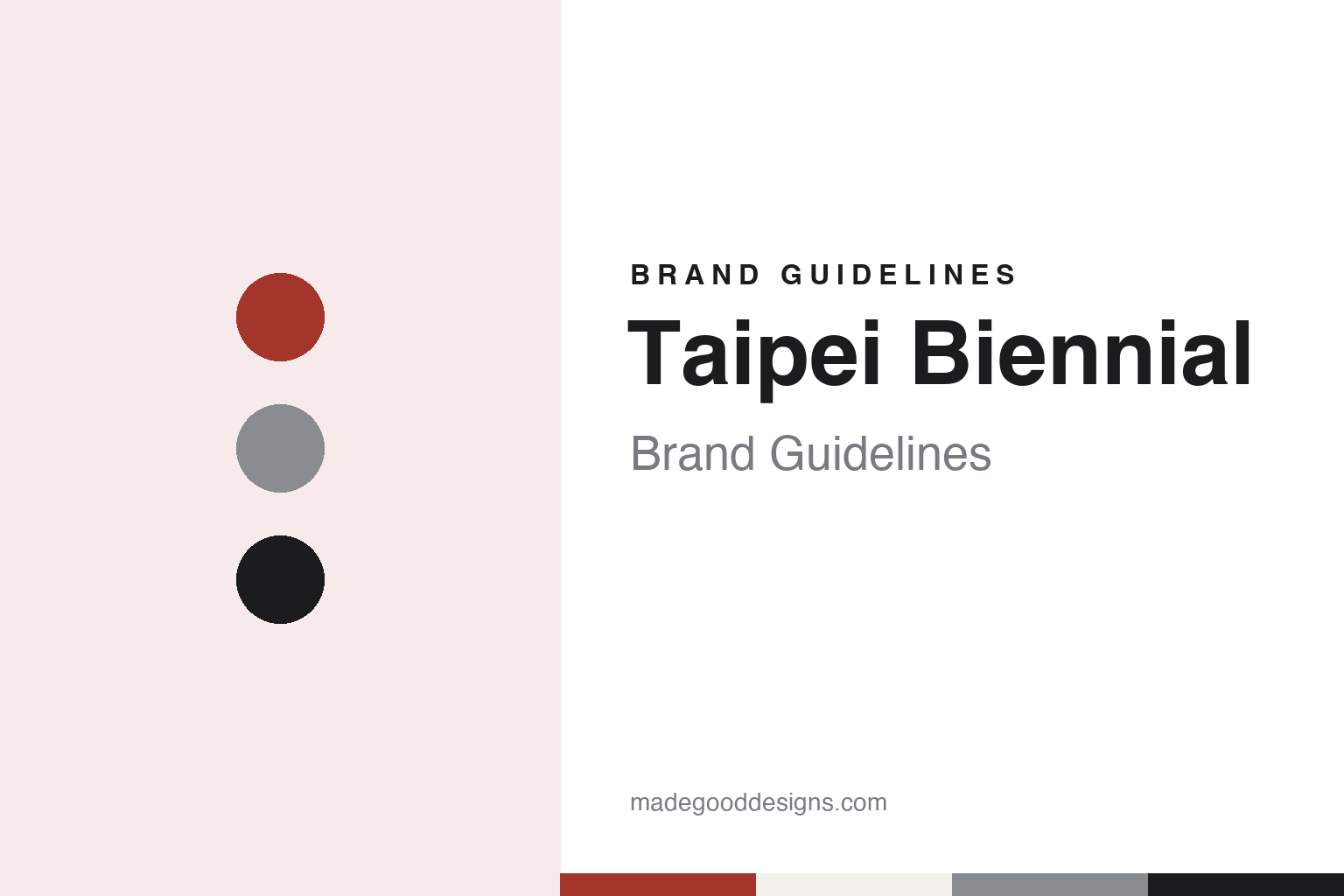
Taipei Biennial Brand Guidelines
One museum, one name and a new title every edition.
Aa
Two constants: a black, vermilion, concrete and linen palette and a grotesque sans register. Abstract homage — not a Taipei Biennial asset or mark; no logo, poster or edition graphic is reproduced.
A museum’s biennial
From a competition to an international exhibition.
The Taipei Biennial is the recurring international exhibition of the Taipei Fine Arts Museum, known as TFAM, and is held in the museum’s own building in Taipei. The biennial’s website says that in 1998 the museum began inviting curators from abroad and changed the exhibition’s name from the Taipei Art Biennial to the Taipei Biennial. English Wikipedia sets the roots further back: from 1984 to 1990 the museum ran a national, competition-style biennial, which was replaced in 1992 by the Taipei Biennial and a separate competition for younger artists. Chinese Wikipedia says the 1992 exhibition merged two earlier competitions and chose its artists by open call, and that the 1996 edition dropped the open call in favour of invited curators and a theme.
The museum is older than the international format. English Wikipedia says TFAM opened on 8 August 1983 in what is now Taipei Expo Park, in Zhongshan District, and describes its building as a local interpretation of the Japanese Metabolist movement in architecture. The biennial’s website says the museum has taken part in the Venice Biennale since 1995 and began organising the Taipei Biennial in its international form in 1998, inviting curators and artists from abroad to work with artists from Taiwan.
The 1998 edition, titled “Site of Desire,” was curated by Fumio Nanjo and looked at cultural life in Asian cities, Chinese Wikipedia says; the biennial’s website dates it from 3 June to 6 September 1998. From 2000, Chinese Wikipedia says, each edition paired a curator from abroad with a curator from Taiwan, a system it says lasted until 2018. The Taipei Times, in a feature of 5 November 2025, described the same pairing, beginning in 2000.
Colour
A title for every edition.
Each edition carries its own title. The biennial’s website and Chinese Wikipedia list “The Sky is the Limit” in 2000, “Great Theatre of the World” in 2002, “Do You Believe in Reality?” in 2004 and “Dirty Yoga” in 2006; the 2008 and 2010 editions had no set theme. Later titles included “The Great Acceleration” in 2014, “Gestures and Archives of the Present, Genealogies of the Future” in 2016 and “Post-Nature: A Museum as an Ecosystem” in 2018.
The rhythm shifted after 2020. The twelfth edition, “You and I Don’t Live on the Same Planet,” ran from 21 November 2020 to 14 March 2021, and the thirteenth, “Small World,” followed from 18 November 2023 to 24 March 2024, three years later by the dates the museum lists. In a release of 25 March 2024, TFAM said “Small World” had drawn nearly 200,000 visitors; English Wikipedia gives the same figure.
The fourteenth edition, “Whispers on the Horizon,” opened on 1 November 2025 and ran until 29 March 2026. It was curated by Sam Bardaouil and Till Fellrath, co-directors of the Hamburger Bahnhof — National Gallery of Contemporary Art in Berlin, whom TFAM named in its March 2024 release. The museum’s release of 31 October 2025 gave about 150 works by 72 artists from 37 cities, including 34 new commissions and site-specific pieces, and the Taipei Times reported the same totals, adding that more than a third of the artists were from Taiwan and that at least twenty were historical artists shown through works from the museum’s collection.
The museum said the theme, yearning, was built on three objects that never appear in the galleries: a puppet from a 1993 film, a diary from a 1960 short story and a bicycle from a recent novel, all works from Taiwan. TFAM described them as the puppet for continuity, the diary for the inner life and the bicycle for pursuit. Earlier releases gave smaller figures — 54 artists from 35 cities when the theme was announced in March 2025, and 52 in September — so the totals grew as the edition took shape.
Typography
Recurring exhibitions and their identities.
A biennial or triennial is an exhibition that is rebuilt from scratch each time it opens. The curator changes, the artists change and the theme changes, yet the event keeps one public name. What holds it together is the part that never moves: the name and the city or region attached to it. Around that fixed core sit the parts that change, usually an edition number and an edition title, so that each show is announced as, say, the 15th edition with a title of its own.
The title is normally set by the curator or artistic director invited for that edition. Some events keep a standing artistic director and invite a different curator each time; others hand the whole edition to one person or a team. Either way, the title reads less like a slogan than like the premise of an essay, and it shapes how the posters, catalogue and press material for that edition are written and designed.
The venues add a second layer. Many of these events are spread across a city or a region rather than held in one hall: a museum at the centre, then former factories, warehouses, power plants, harbour buildings, islands or open sites that may be used for one edition only. Some leave permanent works behind in the streets or landscape; others clear out completely when they close. The graphic identity is often commissioned afresh for each edition, while the name, and sometimes a simple wordmark, carries on unchanged.
For visitors, the practical design matters as much as the art. A spread-out show depends on maps, passes that cover several sites, signs that lead from one venue to the next, shuttles or ferries, and a guide or catalogue that explains each work. Each guide in this series sets out what dated sources record about one event: who founded it, who organises it, where it takes place and how each edition has been framed.
Aa
A grotesque sans — an edition number, a year and a title. (Specimen set in Space Grotesk, a sans STAND-IN; NOT the Taipei Biennial logo.)
Taipei Biennial
Textile walls and a winding route.
The 2025 edition put much of its design thinking into the galleries. TFAM said suspended textile partitions replaced solid walls between rooms, creating permeable thresholds and open sight lines through the halls, and that short, plain wall texts were meant to let visitors read each work on their own. It set close to thirty works from the museum’s collection among the new pieces, with photographs from the 1930s to the 1980s running through the show as a thread. The Taipei Times described a winding route across three floors, beginning with large installations in the atrium, and noted that the catalogue lists artists by city rather than by country. Its feature singled out a ceiling of flickering light panels by Álvaro Urbano, “Tableau Vivant (A Stolen Sun),” hung over a gallery of modernist bronzes, and a 1934 painting on silk by Chen Chin.
The name stays fixed while everything else changes. TFAM gives each edition its own website under the biennial’s address, from 1998 onwards, and styles the editions by year — “Taipei Biennial 2025” — while counting them by number. The museum also treats the series as an archive: its edition list includes a 2016 exhibition, “Recitation / Documents: Taipei Biennial 1996–2014,” which ran from 13 August 2016 to 5 February 2017 alongside that year’s edition and looked back at the earlier ones.
Because the exhibition always takes place inside one museum, its identity rests on the building as much as on any logo. Each set of curators reshapes the same floors, atrium and galleries, and each edition arrives with its own title and graphics while the museum’s name sits beside the biennial’s.
For a design guide, the Taipei Biennial shows how a museum can hold one name steady across editions while each curatorial team rebuilds the building inside. Compare the Gwangju Biennale, another biennale in Asia that began in the 1990s, and the Venice Biennale, where the museum says it has taken part since 1995. For this guide we use black, a vermilion, a concrete grey and a linen with a sans, an unofficial interpretation; no product or logo is reproduced.
Explore & save
Keep Taipei Biennial’s identity on hand — save it to a board in the Made Good inspiration library.
Taipei Biennial identity set
Pin the black, vermilion, concrete and linen palette and the grotesque sans register to your own board.
Source & notes
Frequently Asked Questions
What font can I use to match the Taipei Biennial look?
This guide describes Taipei Biennial’s type as “A grotesque sans — an edition number, a year and a title”. Its type specimen is set in Space Grotesk from Google Fonts as a stand-in; Space Grotesk is not Taipei Biennial’s own lettering.
What colours are in the Taipei Biennial palette?
This guide’s Taipei Biennial palette is Gallery Black #1C1C1E, Vermilion #A3352A, Concrete Grey #8A8D8F, Textile Linen #DCD5C8 and Paper #F3F1EC. The tones are the guide’s own unofficial interpretation, not official Taipei Biennial hex codes.