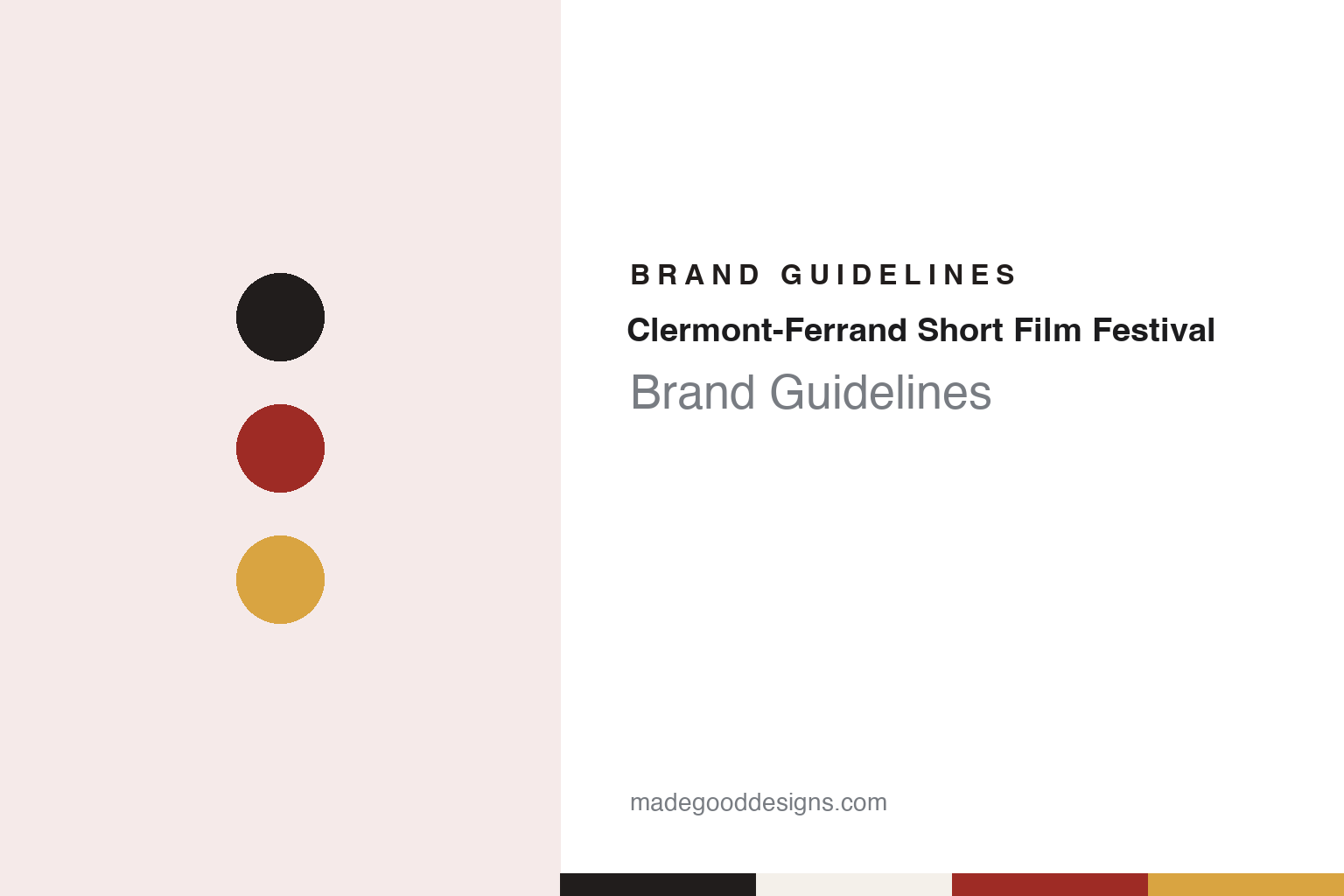
Clermont-Ferrand Short Film Festival Brand Guidelines
A student short-film week that became a festival and a market.
Aa
Two constants: a basalt, ember red and ochre palette and a short-film serif register. Abstract homage — not a Clermont-Ferrand festival asset or mark; no poster, logo or trophy is reproduced.
A student short-film week
From a university film society to an association.
The Clermont-Ferrand Short Film Festival — in French the Festival du court métrage de Clermont-Ferrand, and since 1988 the Festival international du court métrage de Clermont-Ferrand, according to French Wikipedia — is a festival devoted to short films, held each winter in Clermont-Ferrand, in the Auvergne. Its roots are in a student film society. The CNC, France’s national cinema centre, recounted in 2022 that the Cercle cinématographique universitaire de Clermont-Ferrand, a university ciné-club, organised a short-film week in February 1979, mixing recent and classic shorts and inviting directors to present them.
The week returned the following year, when more than 100 shorts were shown over five days, the CNC says, and its third edition, in 1981, was supported by the city and the CNC. In August 1981 the organisers created an association, Sauve qui peut le court métrage, and in the spring of 1982 the festival itself was officially launched. English Wikipedia names the founders as Antoine Lopez, Georges Bollon and Jean-Luc Mathion, and says that 1982 was the year the festival became competitive, with a jury judging recent French short films. Little White Lies, in a report on the 2022 edition, also dated the festival’s origin to a 1979 short-film week run by students of the university.
The festival grew in stages. French Wikipedia dates the Marché du Film Court, the Short Film Market for professionals, to 1986, and the opening to international films to 1988. It says a competition for digital work was added in 2002, later renamed Labo and given over to films with an experimental side, and that Euro Connection, a meeting platform for European co-productions of short films, was created in 2009. The 2021 edition moved online, according to French Wikipedia and Little White Lies.
The organiser has also changed how it presents itself. When the CNC described its presence at the 48th edition in 2026, it referred to the organiser as Le Court, and the festival’s older web address, clermont-filmfest.org, now redirects to lecourt-clermont.org.
Colour
Three competitions, a market and fifteen venues.
Each year the festival runs three competitions — national, international and Labo — alongside a programme for young audiences, a themed retrospective and a focus on one country, French Wikipedia says. The retrospective themes it lists range from dance, in 1991 and 2022, to cycling in 2015 and sound in 2025; in 2026 the retrospective was devoted to holidays and the country focus to South-East Asia. Its main award is the Grand Prix of the International Competition.
The 48th edition, with its Short Film Market, ran from 30 January to 7 February 2026, the CNC said; the national cinema centre ran a stand open to professionals and a series of round tables during the market. French Wikipedia records 168,000 spectators and 8,826 submitted films for 2026. Little White Lies, reporting on the edition of 28 January to 5 February 2022, said audiences could exceed 150,000 in a normal year and that the parallel market welcomed more than 3,000 distributors, buyers and festivals.
The same report described an unusual way of running a festival. It said there is no festival director, that the festival has no premiere policy, so competitions can mix films already seen elsewhere with new discoveries, and that its festival hangout, L’Univers, was busy throughout the 2022 edition.
The screenings are spread across the city. French Wikipedia lists more than fifteen venues, among them the Maison de la Culture, which hosts a large share of the festival; the theatre of the Comédie de Clermont-Ferrand; the salle Varda at the Université Clermont Auvergne; the Capitole and Rio cinemas; the salle Conchon; the art school ESACM; the Opéra; and the salle des Frères Lumière of the student services body, the CROUS, where the 1979 screenings took place. The association itself is based at La Jetée, in the city centre.
Typography
How single-form festivals build an identity.
A festival devoted to one form of cinema, or tied closely to one city, usually builds its identity from the name outward. The form or the place goes into the title — documentary, short film, fantastic film, or the name of the host city — and the title is then shortened until it works on a lanyard or a ticket. Amsterdam’s documentary festival is known by four letters, IDFA, and Copenhagen’s by a compound with a colon in the middle, CPH:DOX. Once a short name exists, it tends to spread to everything the festival runs: markets, funds, labs, online platforms and touring programmes.
The second layer changes every year. Festivals often commission a new poster, trailer or campaign for each edition, sometimes from an outside artist and sometimes from a studio that develops the look over several years. Each edition is often counted by number as well as by year, so the artwork, the edition number and the dates together mark one festival off from the next, while the name and the shortened form stay fixed.
Sections and strands give the programme a structure that visitors can learn. Competitions, non-competitive sections, thematic pathways, retrospectives and industry forums each carry a name of their own, and those names often follow a pattern — a shared prefix, a shared word, or shared punctuation — so that a schedule reads as one family rather than a list.
Then there are the places. A festival takes over cinemas, theatres, museums and halls for a week or two, and some set up a festival centre or keep a building of their own through the year. The practical design of a visit follows from that: programme books and printed schedules, online timetables, passes and accreditation, signage between venues, and a hub where audiences and professionals meet between screenings. This guide looks at how each festival handles those layers, using dated sources for each fact.
Aa
A warm display serif for a festival built on titles and credits. (Specimen set in Fraunces, a serif STAND-IN; NOT the Clermont-Ferrand festival logo.)
Clermont-Ferrand Short Film Festival
A festival named for its form and its city.
The festival’s name does two jobs: it states the form, the court métrage or short film, and it states the city. French Wikipedia gives the short name, Festival du court métrage de Clermont-Ferrand, and the longer international form used since 1988; in English it appears as the Clermont-Ferrand International Short Film Festival. The organiser’s own shorter label, Le Court, now leads its web address, while the association’s 1981 name, Sauve qui peut le court métrage, remains its formal title, according to French Wikipedia.
French Wikipedia says the main prizes in each of the three competitions come with a trophy named the Vercingétorix, made after a work by a sculptor. Beyond that, the festival’s identity is carried by its programme names — the national, international and Labo competitions, the annual retrospective and the country focus — and by its venues, from the Maison de la Culture to a university screening room.
The setting gives an interpretation its material. Little White Lies placed the festival “within sight of the dormant volcano Puy de Dôme,” and the dates fall in the depth of winter, from late January into February. For this guide we read that as dark volcanic stone, a warm ember red for screens and signage and an ochre for highlights. A short-film festival also deals in large numbers of titles, so a serif that holds up at small sizes in a programme book, with a sans for schedules, suits the material.
For a design guide, the Clermont-Ferrand Short Film Festival shows how a festival named for one form can build its identity from that form, its city and a market that runs alongside the screenings. Compare Tampere Film Festival, another festival built around short film, and Annecy Festival, a French festival devoted to animation. For this guide we use basalt, an ember red and an ochre with a serif, an unofficial interpretation; no product or logo is reproduced.
Explore & save
Keep Clermont-Ferrand Short Film Festival’s identity on hand — save it to a board in the Made Good inspiration library.
Clermont-Ferrand Short Film Festival identity set
Pin the basalt, ember red and ochre palette and the short-film serif register to your own board.
Source & notes
Frequently Asked Questions
What font can I use to match the Clermont-Ferrand Short Film Festival look?
This guide describes Clermont-Ferrand Short Film Festival’s type as “A warm display serif for a festival built on titles and credits”. Its type specimen is set in Fraunces from Google Fonts as a stand-in; Fraunces is not Clermont-Ferrand Short Film Festival’s own lettering.
What colours are in the Clermont-Ferrand Short Film Festival palette?
This guide’s Clermont-Ferrand Short Film Festival palette is Basalt #211D1C, Ember red #9E2B25, Ochre #D9A441, Ash grey #8C8681 and Screen white #F4F0EA. The tones are the guide’s own unofficial interpretation, not official Clermont-Ferrand Short Film Festival hex codes.
When was Clermont-Ferrand Short Film Festival founded?
Clermont-Ferrand Short Film Festival was founded in 1979 (short-film week); festival 1982, in Clermont-Ferrand, France.