Thessaloniki International Film Festival Brand Guidelines
A national film week that turned international and moved into the port.
Aa
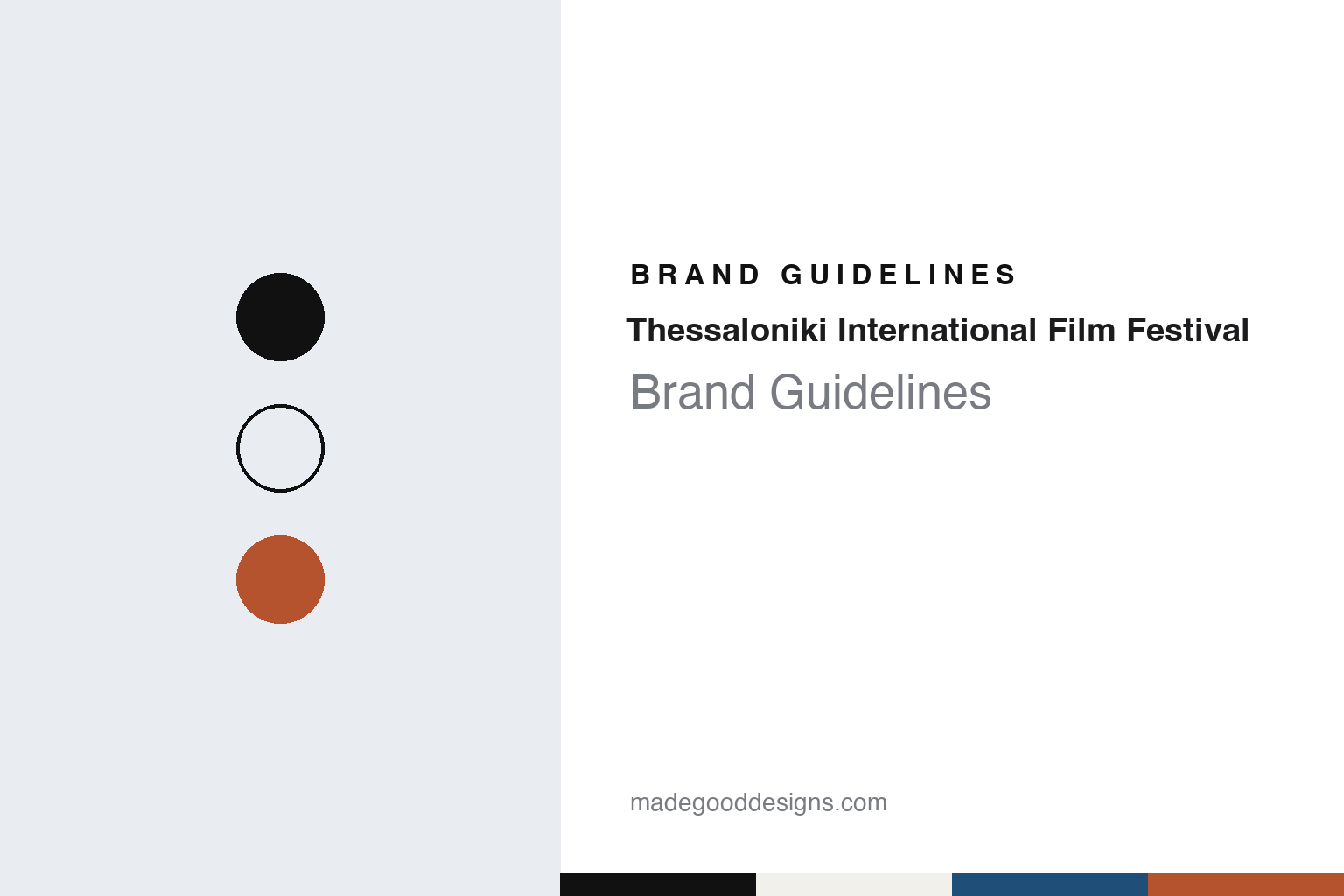
Two constants: a projection black, screen white and gulf blue palette and a technical monospace register. Abstract homage — not a Thessaloniki festival poster or mark; no festival artwork or logo is reproduced.
Greek Film Week
Sixty-seven editions in a northern port city.
The Thessaloniki International Film Festival — known in Greek as Festival Kinimatografou Thessalonikis, and by the initials TIFF — began in 1960 as a national event called the Greek Film Week, according to English and Greek Wikipedia, with the help of the Macedonian art society Techni. In 1966 it was renamed the Thessaloniki Greek Film Festival, and it stayed a national festival until 1991. Greek Wikipedia says that in 1981 it moved under the Ministry of Culture.
The international festival dates from 1992, when the 33rd edition opened to world cinema under the artistic direction of a film critic, both Wikipedias say. The Australian film journal Senses of Cinema, reporting on the 2014 edition, counted that year as the festival’s 55th as a national film competition and its 22nd as an international festival with a competition for emerging directors.
That focus on new directors has stayed. English Wikipedia describes the international competition as open to first or second features, alongside a competition called Meet the Neighbors for films from South-East Europe to the Near East. Greek City Times reported in October 2026 that the 67th edition, from 5 to 15 November 2026, would show 258 films in cinemas across Thessaloniki and online, with six competitive sections. Its main award is the Golden Alexander.
The festival is run by the Thessaloniki Film Festival, a cultural institution under the supervision of the Ministry of Culture, Greek Wikipedia says. Greek Wikipedia names Orestis Andreadakis as its director from 2016, and Greek City Times quoted him as the festival’s artistic director in 2026.
Thessaloniki’s initials match those of Toronto’s festival, but the two are separate organisations in different countries.
Colour
A square, a port and a museum.
The festival is anchored in two places. The first is the Olympion, the historic cinema on Aristotelous Square in the city centre, where the festival has its head office, according to English Wikipedia. The second is the port: since 1999, both Wikipedias say, the festival has also screened in four theatres made from restored warehouses of the Thessaloniki port authority, with Warehouse C as its hub. Travel.gr, previewing the 2026 edition in October, listed two halls in the Olympion building and two in Warehouse 1 at the port, both pairs named after filmmakers, and described historic theatres and former port warehouses as the festival’s meeting points.
The same organisation runs a year-round programme. Its website lists a cinematheque, screenings for schools and the Thessaloniki Cinema Museum, which Greek Wikipedia says belongs to the festival organisation and hosts events during the festival.
The festival also has a sister event in spring. English Wikipedia dates the documentary festival to 1999; the organisation’s website calls it the Thessaloniki International Documentary Festival and listed its 28th edition for 5 to 15 March 2026. A third event, the Evia Film Project, ran for the fifth time in June 2026, the website says, and Travel.gr described it as dedicated to cinema and environmental awareness.
For professionals there is Agora, which English Wikipedia describes as the festival’s development section for international film professionals. The website lists a TIFF Agora for the November festival and a separate Agora and Doc Together programme for the documentary festival.
Each edition also carries tributes. Greek City Times reported that the 2026 edition’s main tribute, Welcome to the Desert, was a 17-film selection chosen by a guest curator, the Galician filmmaker behind Sirāt, with an audiovisual installation at the MOMus Experimental Center for the Arts at the port; Travel.gr placed that exhibition in Warehouse B1. To Vima described the 2026 festival as eleven days of screenings across the city, with tributes to Greek cinema alongside the international competition.
Typography
City festivals and their identities.
A city film festival usually puts the city in its name and then shortens it. PÖFF in Tallinn, NYFF in New York and VIFF in Vancouver are all short forms that end up on posters, tickets and passes, and in everyday speech more often than the full title. Some short forms are shared by festivals in different countries, so the city has to stay close to the initials when the name travels.
Many of these festivals are more than one week of screenings. The organiser behind them, whether a non-profit society, a foundation, a cultural institution or an arts centre, often runs a cinema, a cinematheque or a film centre through the rest of the year, and the festival becomes the busiest moment of a longer programme. Some add sister events in other seasons or other towns, and some run an industry strand for producers, sales agents and projects in development alongside the public screenings.
Inside the main festival there are often smaller festivals for one form: animation, genre film, documentary, short film or films for children and young audiences. Each has its own section of the programme guide and sometimes its own name and mark, so the identity has to hold a family together rather than a single event.
The visible design changes every year. A new poster, trailer or campaign, sometimes made by an invited artist or a design studio, sits on top of steadier elements: a name, a short form, a mascot or a typeface, and the practical layer that audiences actually use, from schedules and programme guides to ticketing, pass systems and venue signage that leads people between cinemas across the city.
Aa
A technical monospace for a festival identity built on film frames. (Specimen set in IBM Plex Mono, a monospace STAND-IN; NOT the Thessaloniki festival logo or any festival typeface.)
Frames and seats
A monochrome identity drawn from the cinema itself.
The festival changes its visual identity from edition to edition, and one of them was documented closely by the design press. Creative Boom reported in January 2017 that the identity of the 57th Thessaloniki International Film Festival, held in 2016, was designed by the New York-based designer Axel Peemoeller with the Greek designer Dimitris Papazoglou.
According to Peemoeller, quoted by Creative Boom, the identity drew on features of cinema itself: the projection screen, the repetition of film frames, the sense of movement and time, and the rows of seats in a theatre. The magazine described a stark monochrome palette and bold typography, applied across posters and invitations, signage and wayfinding, tickets, catalogues and merchandise, with the idea of repetition carried through each of them. Peemoeller said a technical monospaced typeface linked classic cinema with the technology around it, and the magazine saw a nod to the countdown leaders of early black-and-white film in the type.
In that system, Creative Boom reported, the signage and wayfinding belonged to the same family as the poster, the tickets and the catalogue, so that the look of the festival followed visitors from the Olympion on Aristotelous Square to the warehouses at the port. The documentary festival in March uses the same two places: English Wikipedia says it is held at the Olympion, in the port warehouses and at cinemas across the city.
For a design guide, Thessaloniki International Film Festival shows how a festival can borrow its graphic language from the cinema itself and carry it from the poster to the ticket and the signs. Compare TIFF, the Toronto festival that shares the same initials but is a different festival, and Tallinn Black Nights Film Festival, which made Greek cinema its focus in 2012. For this guide we use projection black, screen white and a gulf blue with a monospace, an unofficial interpretation; no product or logo is reproduced.
Explore & save
Keep Thessaloniki International Film Festival’s identity on hand — save it to a board in the Made Good inspiration library.
Thessaloniki festival identity set
Pin the projection black, screen white and gulf blue palette and the technical monospace register to your own board.
Source & notes
Frequently Asked Questions
What font can I use to match the Thessaloniki International Film Festival look?
This guide describes Thessaloniki International Film Festival’s type as “A technical monospace for a festival identity built on film frames”. Its type specimen is set in IBM Plex Mono from Google Fonts as a stand-in; IBM Plex Mono is not Thessaloniki International Film Festival’s own lettering.
What colours are in the Thessaloniki International Film Festival palette?
This guide’s Thessaloniki International Film Festival palette is Projection black #111111, Screen white #F2F0EA, Gulf blue #1F4E79, Warehouse rust #B5532F and Harbour sand #E4DCCB. The tones are the guide’s own unofficial interpretation, not official Thessaloniki International Film Festival hex codes.
When was Thessaloniki International Film Festival founded?
Thessaloniki International Film Festival was founded in 1960 (as Greek Film Week), in Thessaloniki, Greece.