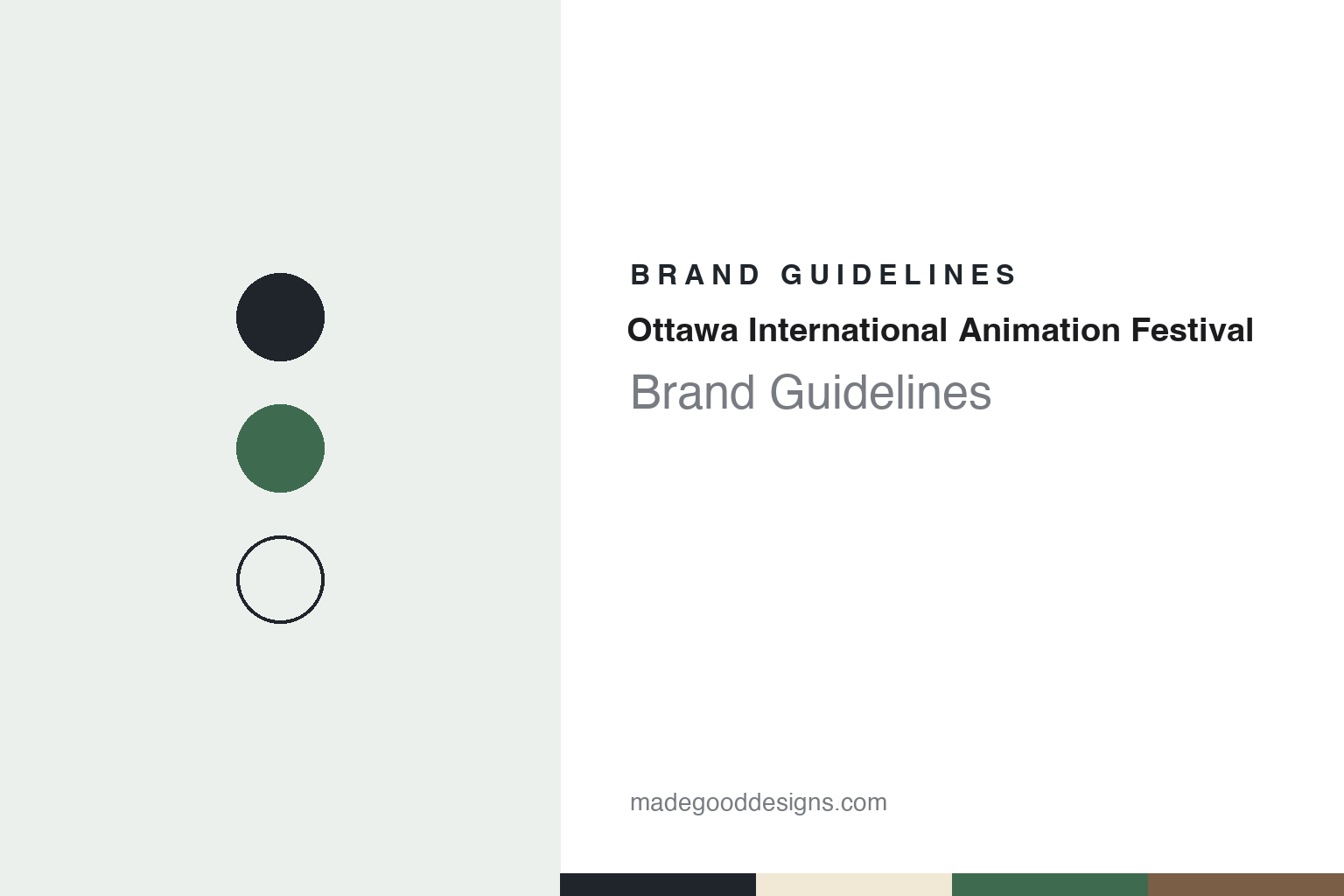
Ottawa International Animation Festival Brand Guidelines
A film institute, a five-day September gathering and an owl among the books.
Aa
Two constants: a night owl, projector green and book cream palette and a Storybook serif register. Abstract homage — not an OIAF asset or mark; no logo, poster, character, photograph or wordmark is reproduced.
A film institute’s animation festival
Founded in 1975, first held in 1976, away from Ottawa in the 1980s and annual from 2005.
The Ottawa International Animation Festival, known as OIAF and in French as the Festival international d’animation d’Ottawa, was founded in 1975 by the Canadian Film Institute, the festival’s own history says, and the first edition took place in Ottawa in 1976. English Wikipedia gives the dates of that first festival as 10 to 15 August 1976 and says it was organised on a biennial basis with the co-operation of the International Animated Film Association. In a September 2022 interview with CBC Arts, the festival was again dated to 1976.
English Wikipedia says that a group of figures from Canadian animation founded the festival and that institutions including the National Film Board of Canada, Radio-Canada, CBC Television and the Cinémathèque québécoise helped build it. The animator Norman McLaren, then living in Ottawa, became the festival’s first honorary president, Wikipedia says. Explaining the choice of city to CBC Arts in 2022, the festival’s artistic director pointed to Ottawa’s position between Montreal and Toronto and to the city’s animation history: the National Film Board was based in Ottawa until it moved to Montreal in 1955.
The festival did not always stay in the capital. English Wikipedia says it moved to Toronto in 1984 and to Hamilton, Ontario, in 1986, returning to Ottawa in 1990; the festival’s own history gives 1988 as the year it came home. In 1997 a separate Ottawa International Student Animation Festival was founded and held in the years between the main editions, Wikipedia says, and in 2005 the OIAF moved from a biennial to an annual festival, with the student categories joining the main event.
Later dates come from the festival’s own history. It marked 40 years in 2016 with a Saturday-night party called NightOwl, with dancing, drawing, virtual reality and screenings. In 2017 it added InGenius Jr Day for children and families and Animation Exposé, a public strand of behind-the-scenes talks with a careers fair. The 2020 edition moved online. In 2026 the festival marked its 50th anniversary, Apartment613 reported that September.
Colour
A division of a film institute, a programming team and a week of downtown venues.
The festival is not a free-standing company. Its website describes the OIAF as a division of the Canadian Film Institute, a registered charity, and says the institute itself was founded in 1935. The institute’s board is listed on the festival’s site. CBC Arts identified Chris Robinson as the festival’s artistic director in 2022; he told the interviewer that he started around 1991 or 1992 in the institute’s box office and that his early job was processing the submissions, which then arrived as 35mm and 16mm film prints.
The programme mixes kinds of animation that are usually kept apart. Robinson told CBC Arts that the competition places industry, independent and student work side by side, so that a commercial can screen next to an abstract short and a National Film Board narrative film, and that the festival received about 2,500 submissions a year. For 2026, Apartment613 reported 3,036 entries from 107 countries, from which a four-person programming team chose seven features and 74 short films and series for competition, with 15 films in the Canadian Student Competition. Out of competition, the Canadian Panorama and a new programme called Detours sat beside a “50 in 50” selection of Canadian shorts from the festival’s first five decades.
Young audiences have their own strand. Apartment613 described free school days for elementary pupils and teenagers, free drop-in workshops and competitions for films aimed at children aged 7 and over and at teenagers, with the children’s competition judged by a jury of their peers.
The festival runs for five days in September across downtown venues. Its website listed the ByTowne Cinema, Arts Court, Club SAW, Strathcona Park, the National Arts Centre and the Ottawa Art Gallery for the 2026 edition, held from 23 to 27 September 2026; Apartment613 said screenings centred on the Ottawa Art Gallery and the ByTowne. The social calendar is part of the event: Robinson described an animators’ picnic and a pumpkin-carving contest in 2022.
Typography
How city film festivals build an identity.
A city film festival usually puts the city in its name and then shortens it. PÖFF in Tallinn, NYFF in New York and VIFF in Vancouver are all short forms that end up on posters, tickets and passes, and in everyday speech more often than the full title. Some short forms are shared by festivals in different countries, so the city has to stay close to the initials when the name travels.
Many of these festivals are more than one week of screenings. The organiser behind them, whether a non-profit society, a foundation, a cultural institution or an arts centre, often runs a cinema, a cinematheque or a film centre through the rest of the year, and the festival becomes the busiest moment of a longer programme. Some add sister events in other seasons or other towns, and some run an industry strand for producers, sales agents and projects in development alongside the public screenings.
Inside the main festival there are often smaller festivals for one form: animation, genre film, documentary, short film or films for children and young audiences. Each has its own section of the programme guide and sometimes its own name and mark, so the identity has to hold a family together rather than a single event.
The visible design changes every year. A new poster, trailer or campaign, sometimes made by an invited artist or a design studio, sits on top of steadier elements: a name, a short form, a mascot or a typeface, and the practical layer that audiences actually use, from schedules and programme guides to ticketing, pass systems and venue signage that leads people between cinemas across the city.
Aa
Storybook serif — a warm serif for programme titles, jury names and picture-book captions. (Specimen set in Fraunces, a serif STAND-IN; NOT the OIAF logo or any festival lettering.)
Ottawa International Animation Festival
An owl on the poster, a party called NightOwl and an industry conference.
For its 50th anniversary edition the festival invited an artist to draw the poster. On the festival’s own website the cartoonist Seth, who drew the 2026 poster, wrote that the only requirement he was given was that it must have an owl in it. He drew a tweedy, bookish owl he named Owlbert, surrounded by books rather than film canisters, with a frog he called Frogworth running the film projector. His statement is printed in English and in French, as is much of the festival’s site.
The owl sits beside one of the festival’s own names: the Saturday-night party introduced for the 40th anniversary in 2016 is called NightOwl, and the festival’s history says it remains a highlight of every edition. In his 2022 CBC Arts interview Robinson described the festival’s tone in his own words: a fun event, taken seriously but not too seriously, built around parties, social events and community as much as screenings.
The industry side has its own name. The Animation Conference, known as TAC and originally called the Television Animation Conference, runs alongside the festival for animation professionals. The festival’s own pages date its creation to 2004, while English Wikipedia gives 2002. The festival describes TAC as a forum of panels, keynotes and networking, with a pitching competition that includes mentoring for new creators and a speed-pitching session that pairs creators and producers with development and acquisitions executives.
The identity therefore works in several registers at once: a bilingual festival name, the short forms OIAF and TAC, an illustrated poster and an owl. For a design guide, the Ottawa International Animation Festival shows how a festival run by a film institute can pair a hand-drawn poster and an owl with a bilingual name, two short forms and fixed September dates. Compare the Annecy Festival, the animation festival in France that Robinson named when he described where such festivals tend to be held, and TIFF, another Ontario festival. For this guide we use night owl, projector green and book cream with a serif, an unofficial interpretation; no product or logo is reproduced.
Explore & save
Keep Ottawa International Animation Festival’s identity on hand — save it to a board in the Made Good inspiration library.
Ottawa International Animation Festival identity set
Pin the OIAF night owl, projector green and book cream palette and the Storybook serif register to your own board.
Source & notes
Frequently Asked Questions
What font can I use to match the Ottawa International Animation Festival look?
This guide describes Ottawa International Animation Festival’s type as “Storybook serif — a warm serif for programme titles, jury names and picture-book captions”. Its type specimen is set in Fraunces from Google Fonts as a stand-in; Fraunces is not Ottawa International Animation Festival’s own lettering.
What colours are in the Ottawa International Animation Festival palette?
This guide’s Ottawa International Animation Festival palette is Night Owl #20242B, Projector Green #3E6B4F, Tweed Brown #7A5E45, Book Cream #F1E8D6 and Paper #FAF8F4. The tones are the guide’s own unofficial interpretation, not official Ottawa International Animation Festival hex codes.
When was Ottawa International Animation Festival founded?
Ottawa International Animation Festival was founded in 1975 (Ottawa, by the Canadian Film Institute).