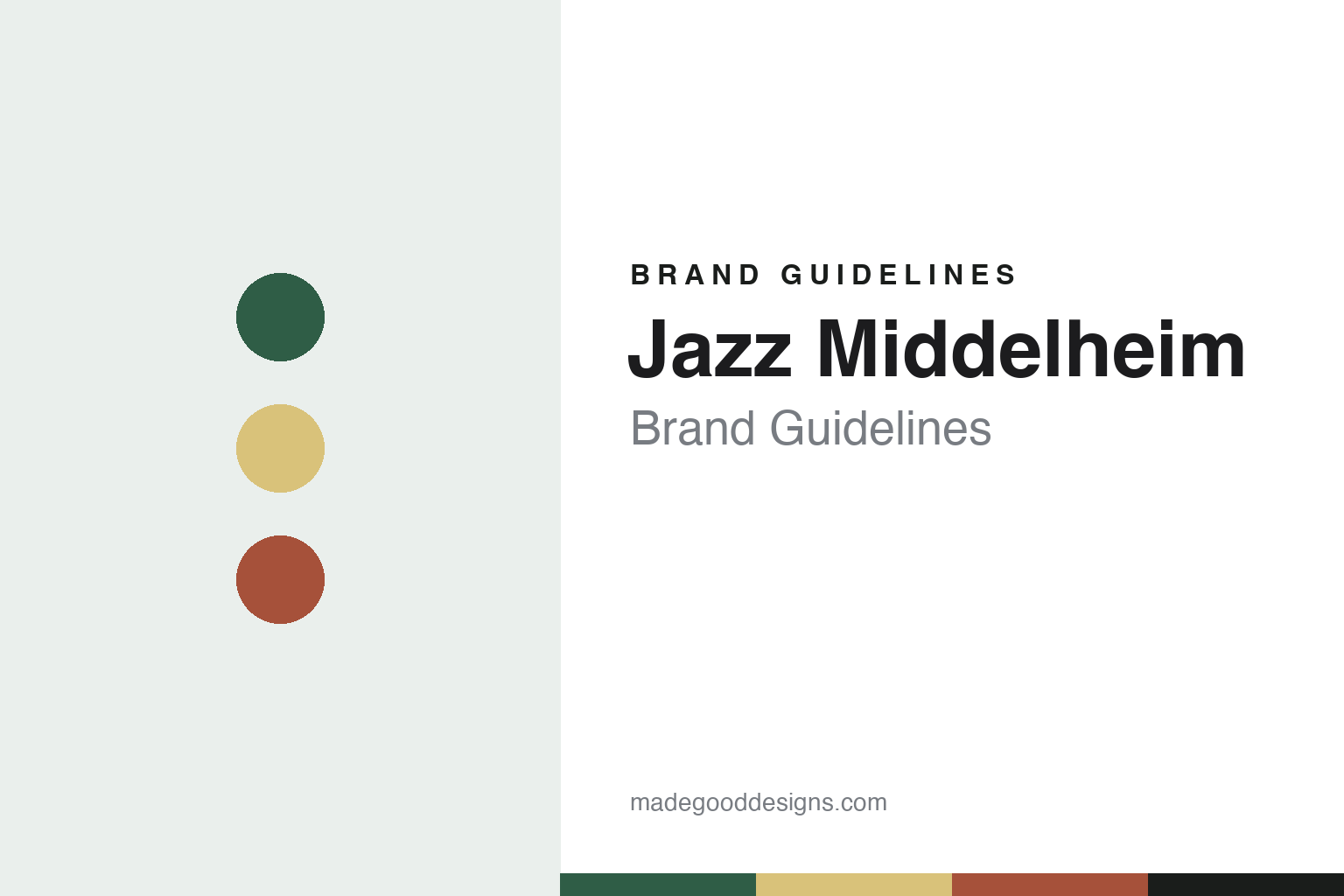
Jazz Middelheim Brand Guidelines
A broadcaster’s jazz promenade of 1969, still played under the trees of an Antwerp park.
Aa
Two constants: a park green, lawn gold and brick red palette and an open grotesque register. Abstract homage — not a Jazz Middelheim poster or mark; no logo, artwork or wristband is reproduced.
A broadcaster’s festival
From a jazz promenade in 1969 to a fixture of the Antwerp summer.
Jazz Middelheim began in 1969. The Flemish public broadcaster VRT, in a statement on the festival’s future published in 2023, says its predecessor, the Belgische Radio- en Televisieomroep (BRT), organised the first edition that year, originally in the Middelheim park in Antwerp and later in Park Den Brandt; the same statement says the city of Antwerp lent its cooperation, with logistical or other support, at every edition. English Wikipedia, citing a DK Eyewitness travel guide of 2013, describes that first event as a jazz promenade in the park. The festival kept the name of its first site after it moved.
Dutch Wikipedia names Elias Gistelinck among the founders: a producer who led the jazz section of BRT radio and had already been organising concerts around the country under the title Jazzpanorama. It also sketches the festival’s rhythm over the following decades. In 1981 the festival was shortened to five days, and in 1982 it was not held. From 1983 Jazz Middelheim became a biennial event, with two stages and a programme that, in Dutch Wikipedia’s words, ran from country blues to free jazz. It became an annual festival again in 2008, with its 27th edition, and in 2011 it marked its 30th edition.
For much of that time the practical organisation sat close to its Ghent counterpart. Dutch Wikipedia says that from 2008 the festival was run by the non-profit association Jazz & Muziek in cooperation with VRT, and that the same association organised Gent Jazz. The 50th edition ran from 13 to 16 August 2021, and the 2022 edition, from 12 to 15 August, drew about 15,000 visitors, according to the same article.
Colour
A new team and a new weekend.
There was no edition in 2023. VRT said that year that it and the city of Antwerp would work together on the festival’s continuation and would select a partner for its programming and organisation. In February 2024 VRT NWS reported that the city had chosen a new organiser from eight candidates: a partnership between the teams behind two other festivals, Brosella, a Brussels festival of folk, jazz and music in between, and Paradise City, an electronic-music festival held on a castle estate. The same report said the event would stay in Park Den Brandt, and that the brand name Jazz Middelheim is owned by VRT.
Two figures from that partnership appear in the reporting. Bert Schreurs, director of Brosella, is named by VRT NWS as the festival’s programmer and organiser; Gilles De Decker is named as the organiser of Paradise City. In June 2025 Schreurs told VRT NWS that, before teaming up with Paradise City, he had first approached the team behind Tomorrowland, and that it was through them that he met De Decker.
The calendar changed as well. In July 2024 VRT NWS reported that the festival, which for more than fifty years had been held in August, would from then on take place over the weekend around Whitsun, keeping four days by including Whit Monday and staying at the same site. The first edition under the new team took place in June 2025: VRT NWS described four days on three stages, a new layout in Park Den Brandt and, for the first time, a separate stage for DJ sets alongside the jazz programme. Afterwards it reported about 11,000 visitors.
The 2026 edition took place over the long Whitsun weekend in May, again in Park Den Brandt. VRT NWS reported more than 11,000 visitors over three days, with a programme that included the saxophonist Isaiah Collier and a closing set by the Buena Vista Orchestra.
Typography
Jazz festivals and their settings.
A jazz festival is often remembered first by where it happens and when. Some take over a city park in high summer, with stages set between lawns and old trees; others fill the courtyard of a former abbey, the seats of a concert hall, an island in a river or the streets of a small town that changes character for a week. The same name can stay attached to a place for decades, and when a festival does move, the old site often survives in its title.
The calendar works in the same way. A fixed weekend, a fortnight in July or a run of autumn evenings becomes part of the identity, as recognisable to regular visitors as any logo. Many festivals also carry a series of annual posters, and in some cases the designers and illustrators behind them become part of the festival’s own story, with each year’s image added to a visible archive.
Behind the name there is usually an organisation that keeps it going: a non-profit association, a public broadcaster, a municipal body, a foundation or a concert promoter. Names, owners and organisers can change over the years, and a festival title may be held by one body while another runs the days. Following those changes through dated sources is often the clearest way to understand how a festival has lasted.
Then there is the practical layer that audiences handle: programme booklets, day schedules, wristbands and payment cards, maps, stage signage and the names given to the stages themselves. These pieces are rarely documented as design, yet they are where a festival’s identity meets its visitors most directly. The guides in this collection describe them plainly, as their sources do.
Aa
An open grotesque — a festival named after a park. (Specimen set in Archivo, a sans STAND-IN; NOT the Jazz Middelheim logo.)
Jazz Middelheim
A name that stayed when the park changed.
The festival’s identity starts with its name and its ground. Jazz Middelheim is named after the Middelheim park where it began, but for decades it has been played in Park Den Brandt; both belong to the Nachtegalenpark, a group of adjoining parks south of Antwerp that Dutch Wikipedia describes as covering about 90 hectares around a castle.
The name itself is an asset with an owner. VRT NWS reported in 2024 that the mark belongs to VRT, while the festival is organised by a separate team chosen by the city; the broadcaster and the city are named together in VRT’s 2023 statement as the partners behind the festival’s continuation. That arrangement, in which a broadcaster holds the name, a city holds the site and a promoter runs the days, is one way a festival title survives a change of organiser.
The programme has also shaped the look of the event. In June 2025 VRT NWS described the new team’s mix of established jazz musicians with DJs influenced by jazz, and a separate DJ stage beside the main concert stages; Schreurs said the aim was to reach a younger audience while keeping the festival’s jazz core. The festival’s own website presents the event as “Jazz Middelheim” with Park Den Brandt, Antwerp, as its fixed address. No published brand guidelines, poster series or credited designer are documented in the sources used here, so the visual notes in this guide are our own.
The other Belgian festival in this round tells a parallel story: Gent Jazz shared an organiser with Jazz Middelheim from 2008 and was taken over by a new promoter in 2023. The two now run at different points of the summer, Antwerp at Whitsun and Ghent in July.
For a design guide, Jazz Middelheim shows how a festival can keep its name, its park and its broadcaster link while its organiser and its dates change. Compare Gent Jazz, its Flemish counterpart, and Tomorrowland, the Belgian festival whose team Schreurs told VRT NWS he approached first. For this guide we use a park green, a lawn gold and a brick red with a sans, an unofficial interpretation; no product or logo is reproduced.
Explore & save
Keep Jazz Middelheim’s identity on hand — save it to a board in the Made Good inspiration library.
Jazz Middelheim identity set
Pin the Jazz Middelheim park green, lawn gold and brick red palette and the open grotesque register to your own board.
Source & notes
Frequently Asked Questions
What font can I use to match the Jazz Middelheim look?
This guide describes Jazz Middelheim’s type as “An open grotesque — a festival named after a park”. Its type specimen is set in Archivo from Google Fonts as a stand-in; Archivo is not Jazz Middelheim’s own lettering.
What colours are in the Jazz Middelheim palette?
This guide’s Jazz Middelheim palette is Park green #2F5D46, Evening ink #1A1D1B, Lawn gold #D9C27A, Brick red #A6513A and Paper #F6F4EE. The tones are the guide’s own unofficial interpretation, not official Jazz Middelheim hex codes.
When was Jazz Middelheim founded?
Jazz Middelheim was founded in 1969, in Antwerp, Belgium.


