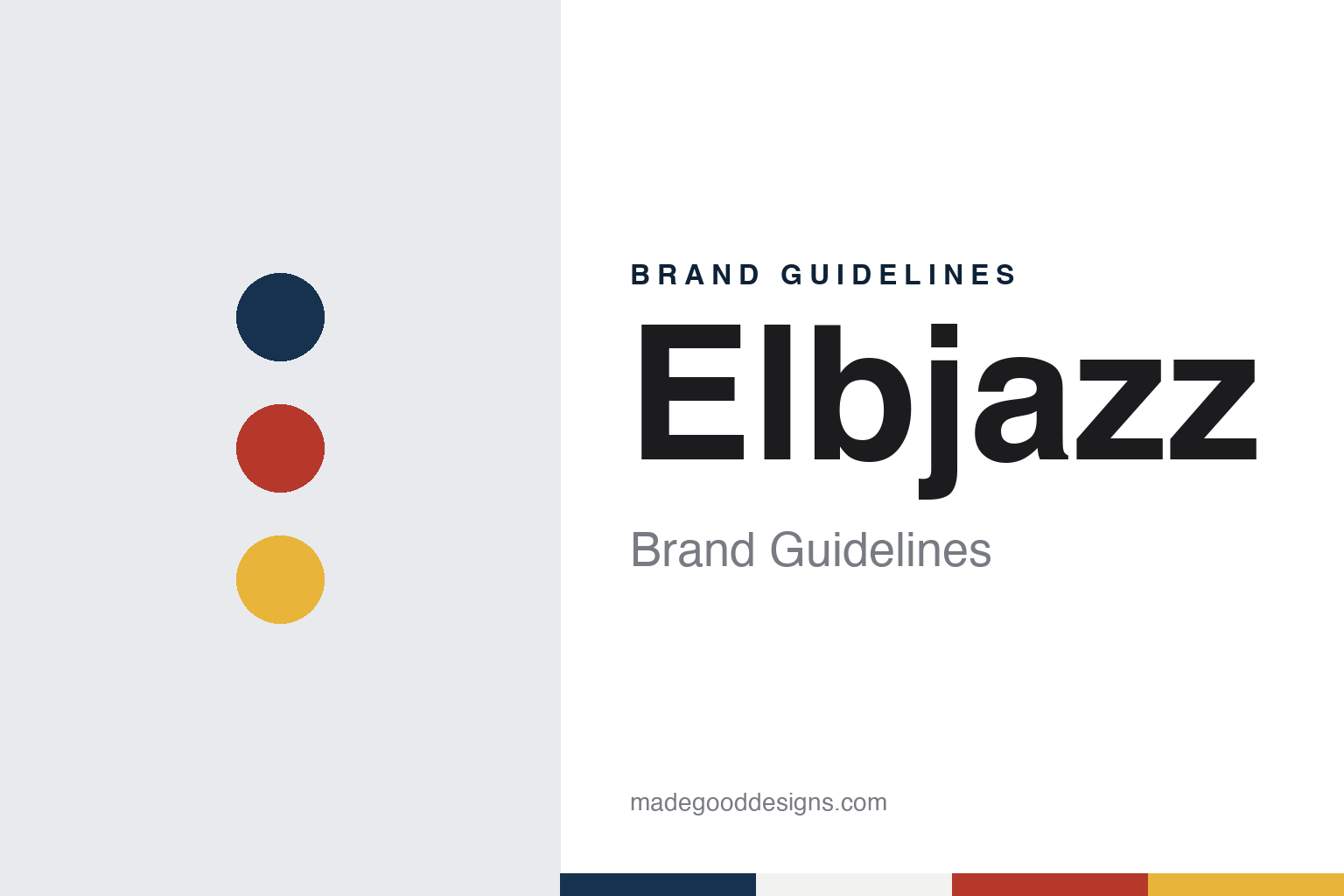
Elbjazz Brand Guidelines
Hamburg’s harbour jazz festival among shipyard cranes since 2010.
Aa
Two constants: an Elbjazz harbour navy, container red and crane yellow palette and a Harbour condensed sans register. Abstract homage — not an Elbjazz poster or mark; no artwork, logo or photograph is reproduced.
A festival in the port
Two founders and a harbour.
Elbjazz is a two-day music festival in the port of Hamburg. German Wikipedia says it was founded in 2010 by Tina Heine and Nina Sauer, who staged its opening edition that year, and that it has been held since then in the harbour and in the HafenCity, the district on the north bank of the Elbe. The festival writes its name in capitals, as ELBJAZZ, throughout its website; in running text this guide uses Elbjazz.
For most of its history the festival fell on the Pentecost weekend, German Wikipedia says, which placed it in late May or early June. That changed in 2026: the festival’s website gives the dates of the 2026 edition as 10 and 11 July, and its “About” page now describes two summer days in July in the harbour.
The audience grew quickly. German Wikipedia reports nearly 10,000 visitors at the 2010 premiere and 15,000 in 2011; the 2010 programme included the trumpeter Till Brönner. In 2011 the NDR Bigband, the big band of the public broadcaster NDR, gave the premiere of a multimedia Hafensinfonie — a harbour symphony — built from historic films, photographs and sounds from the port of Hamburg, the same article says. Previewing the third edition, held on 25 and 26 May 2012, the Berlin daily taz described more than 60 concerts on ten stages at unusual venues between the Blohm+Voss shipyard and the HafenCity, linked by harbour launches.
The festival’s organisation has changed several times, and the record can be stated plainly. The festival was not held in 2016. From 2017, German Wikipedia says, it was run under a new director together with the remaining shareholders: Karsten Jahnke, the promoter FKP Scorpio and Nina Sauer. German Wikipedia reports nearly 29,000 visitors in 2017. In 2020 and 2021 there were no on-site editions; in their place the festival offered a curated online concert programme, free to watch, with Arte and NDR Kultur. The 2025 edition was not held. In a members’ news item dated December 2025 on the Europe Jazz Network website, the festival announced its return for 2026 with Karsten Jahnke as its new main shareholder, describing itself as now in the hands of a family-owned company with roots in jazz.
Colour
Two centres, one river.
Elbjazz’s identity is its setting. German Wikipedia divides its stages between two centres: the area around the Elbphilharmonie concert hall in the HafenCity, and the shipyard grounds of Blohm+Voss across the river. Over the years, the article says, its venues have also included the Hauptkirche St. Katharinen, one of the city’s principal churches, the Hafenmuseum, ships moored in the harbour such as the MS Stubnitz and the MS Bleichen, the Louisiana Star, the Fischauktionshalle — the old fish-auction hall — and the Mojo Club. In 2017, in cooperation with the Theater der Welt festival, concerts were held in the Thalia tent at Baakenhöft.
Moving between those centres is part of the event. German Wikipedia describes visitors crossing between stages by harbour launches, known in Hamburg as Barkassen, by the lift of the Elbe tunnel and by shuttle buses, and says the waiting and the crossing become part of the experience, as visitors meet one another on the way. The festival’s own description sets its main stage among shipping containers and cranes, with gulls overhead and the harbour lights coming on during the summer evening. The City of Hamburg’s events page describes the main stage on the Blohm+Voss shipyard grounds, surrounded by containers, a second open-air stage called “Am Helgen” — “at the slipway” — and the Schiffbauhalle, a shipbuilding hall, as the indoor venue.
The festival has also given a stage to students. German Wikipedia describes a stage called HfMT Young Talents on the Platz der Deutschen Einheit, where students, graduates and teachers from the departments of the Hochschule für Musik und Theater Hamburg traditionally perform.
Concerts inside the Elbphilharmonie have formed a separate strand. The festival’s FAQ calls them “Elbphilharmonie Specials”: concerts curated by Elbjazz that in earlier years ran at the same time as the programme on the festival site, and that now take place as satellite events during the year. Under the label “ELBJAZZ presents,” the festival team also books artists from the festival’s history into Hamburg venues, from small rooms to the Elbphilharmonie, outside the festival weekend.
Typography
Setting and calendar.
A jazz festival is often remembered first by where it happens and when. Some take over a city park in high summer, with stages set between lawns and old trees; others fill the courtyard of a former abbey, the seats of a concert hall, an island in a river or the streets of a small town that changes character for a week. The same name can stay attached to a place for decades, and when a festival does move, the old site often survives in its title.
The calendar works in the same way. A fixed weekend, a fortnight in July or a run of autumn evenings becomes part of the identity, as recognisable to regular visitors as any logo. Many festivals also carry a series of annual posters, and in some cases the designers and illustrators behind them become part of the festival’s own story, with each year’s image added to a visible archive.
Behind the name there is usually an organisation that keeps it going: a non-profit association, a public broadcaster, a municipal body, a foundation or a concert promoter. Names, owners and organisers can change over the years, and a festival title may be held by one body while another runs the days. Following those changes through dated sources is often the clearest way to understand how a festival has lasted.
Then there is the practical layer that audiences handle: programme booklets, day schedules, wristbands and payment cards, maps, stage signage and the names given to the stages themselves. These pieces are rarely documented as design, yet they are where a festival’s identity meets its visitors most directly. The guides in this collection describe them plainly, as their sources do.
Aa
A harbour condensed sans — ELBJAZZ in capitals. (Specimen set in Barlow Condensed, a sans STAND-IN; NOT the Elbjazz logo.)
Elbjazz
ELBJAZZ in capitals.
The practical layer is set out on the festival’s FAQ page. Elbjazz sells festival tickets for the whole site rather than tickets for single concerts; companions admitted free under its access rules receive a festival wristband at the ticket desk; and since 2026 there has been a limited number of grandstand seats at the main stage. The festival’s website menu lists a festival app and a playlist alongside the line-up, the tickets and the FAQ.
Attendance figures vary by source and by year. German Wikipedia gives 22,500 visitors for 2024, and the City of Hamburg’s events page says that nearly 20,000 people saw more than 30 acts at the most recent edition. The festival’s December 2025 announcement described the 2026 edition as about 30 acts on three stages in the Blohm+Voss docks, plus two shows at the Elbphilharmonie, with the NDR Bigband among the performers on the shipyard site.
For a design guide, Elbjazz shows how a festival can take its whole visual vocabulary — containers, cranes, launches on the water and a concert hall on the quay — from the port it plays in, and how a name written in capitals can sit as plainly as a stencil on that backdrop. Compare Elbphilharmonie, the concert hall at the centre of the festival’s HafenCity strand, and JazzFest Berlin, the Berliner Festspiele’s autumn jazz festival. For this guide we use a harbour navy, a container red and a crane yellow with a condensed sans, an unofficial interpretation; no product or logo is reproduced.
Explore & save
Keep Elbjazz’s identity on hand — save it to a board in the Made Good inspiration library.
Elbjazz identity set
Pin the Elbjazz harbour navy, container red and crane yellow palette and the Harbour condensed sans register to your own board.
Source & notes
Frequently Asked Questions
What font can I use to match the Elbjazz look?
This guide describes Elbjazz’s type as “A harbour condensed sans — ELBJAZZ in capitals”. Its type specimen is set in Barlow Condensed from Google Fonts as a stand-in; Barlow Condensed is not Elbjazz’s own lettering.
What colours are in the Elbjazz palette?
This guide’s Elbjazz palette is Harbour navy #16324F, Deep water #0E2236, Container red #B5382B, Crane yellow #E8B53A and Fog white #F2F3F1. The tones are the guide’s own unofficial interpretation, not official Elbjazz hex codes.
When was Elbjazz founded?
Elbjazz was founded in 2010, in Hamburg, Germany.
Who founded Elbjazz?
Elbjazz was founded by Tina Heine and Nina Sauer in 2010.


